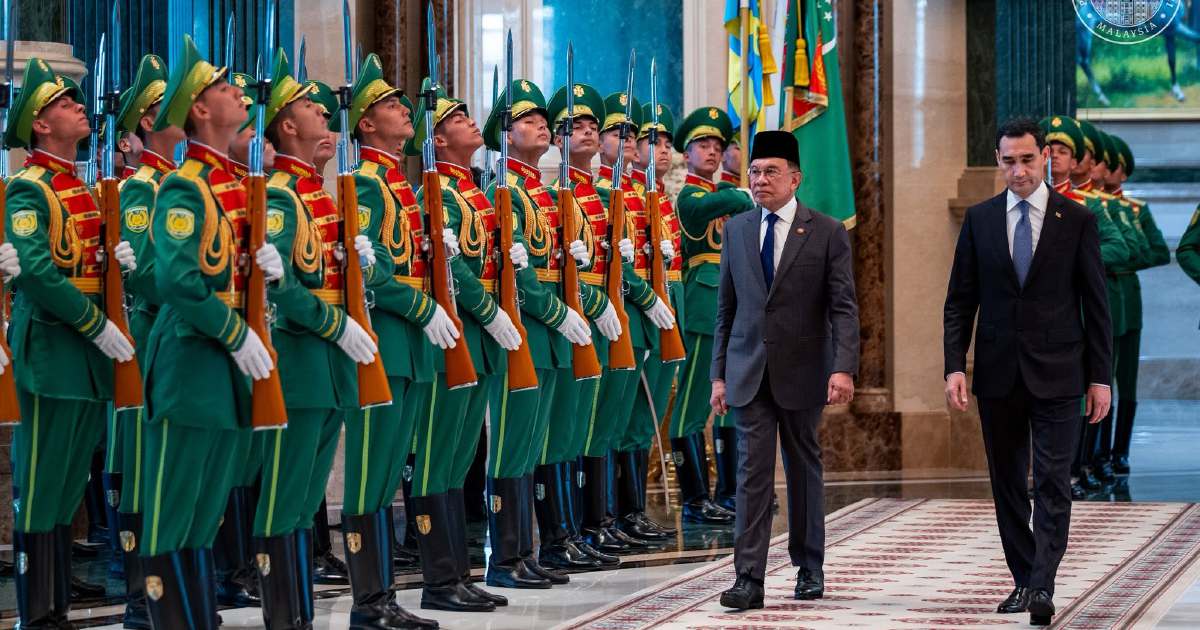
Prime Minister Datuk Seri Anwar Ibrahim arrived in Ashgabat to receive an official welcome ceremony at the Presidential Palace, representing a significant diplomatic milestone for Malaysia's relationship with Turkmenistan and reflecting the federal government's expanded foreign policy priorities under his leadership.
The formal reception underscores Malaysia's broader strategic pivot toward Central Asia, a region that has traditionally occupied a peripheral position in Kuala Lumpur's diplomatic architecture. The ceremonial nature of the welcome—typically reserved for heads of state and prime ministers engaged in substantive bilateral partnerships—indicates Turkmenistan's recognition of Malaysia's economic and political significance in the Islamic world and the broader Southeast Asian sphere. This first official visit since Anwar assumed the premiership signals mutual interest in exploring deeper ties between the two nations across multiple sectors including trade, energy, and cultural exchange.
Turkmenistan, positioned at the crossroads of Central Asia and the Caspian region, commands considerable geopolitical importance as a repository of vast natural gas reserves and a crucial node in transcontinental transportation corridors. The country's strategic location has attracted investment and diplomatic engagement from major powers seeking to diversify energy sources and influence within the region. Malaysia's outreach to Ashgabat reflects both Kuala Lumpur's desire to expand its diplomatic footprint beyond traditional Southeast Asian and Middle Eastern markets, and recognition of the commercial opportunities that Central Asian markets present to Malaysian businesses operating in infrastructure, finance, and manufacturing sectors.
The presidential reception carries symbolic weight within Malaysian domestic politics as well. Anwar's tenure has been characterized by efforts to rehabilitate Malaysia's international standing following the tumultuous preceding administrations, and diplomatic visits to lesser-known regions allow the premier to demonstrate a comprehensive approach to foreign relations that transcends the established Western-centric or Arab-centric frameworks that previously dominated Malaysian diplomacy. The Central Asian visit demonstrates that Anwar's government is willing to invest diplomatic capital in relationships that may yield long-term strategic dividends rather than focusing exclusively on immediate, high-profile partnerships.
From Turkmenistan's perspective, the engagement with Malaysia reflects its own diversification strategy in pursuing international partnerships beyond traditional relationships with Russia, China, and Iran. The country has sought to strengthen ties with Islamic-majority nations and regional powers, viewing such relationships as both economically beneficial and politically stabilizing. Malaysia's Muslim-majority population and influence within ASEAN and the Organisation of Islamic Cooperation provide Turkmenistan with a gateway to broader diplomatic and commercial networks in Southeast Asia and the Muslim world.
Bilateral trade between Malaysia and Turkmenistan has historically remained modest, constrained by geographical distance and limited commercial complementarities. However, the political engagement at the highest level typically precedes expansion of economic ties. Malaysian investors might explore opportunities in Turkmenistan's energy sector, transportation infrastructure, and emerging consumer markets, while Turkmenistan could potentially access Malaysian expertise in Islamic finance, palm oil production, and manufacturing. The formal reception may catalyze the negotiation of framework agreements and institutional mechanisms designed to facilitate bilateral commerce and investment flows.
The visit also situates Malaysia within broader patterns of renewed interest in Central Asia among Asian and Muslim-majority nations. Countries including Pakistan, Indonesia, and Turkey have similarly elevated their engagement with Central Asian republics, recognizing the region's importance in energy security, counterterrorism cooperation, and the emerging geopolitical competition between China, Russia, and Western powers. Malaysia's entry into this competitive space requires diplomatic sophistication and clear articulation of shared interests that transcend the zero-sum calculations that characterize great power rivalry in the region.
For Anwar specifically, the visit represents an opportunity to project an image of Malaysia as a consequential player in international affairs with strategic reach extending far beyond Southeast Asia. This perception proves valuable domestically, where Anwar's political legitimacy partly derives from demonstrating effective governance and successful representation of national interests on the global stage. The ceremonial warmth of the presidential welcome provides visual documentation of international respect for Malaysian leadership that can resonate with domestic audiences seeking reassurance about their nation's standing in regional and global hierarchies.
Looking forward, this inaugural official visit may serve as foundation for expanded cooperation frameworks. Officials from both nations are likely to discuss potential collaboration in areas ranging from trade and investment to cultural and educational exchanges. The establishment of business councils, visa facilitation agreements, and enhanced diplomatic representation could gradually transform bilateral relations from ceremonial recognition into substantive partnership that generates tangible benefits for citizens and businesses in both countries.
The visit ultimately reflects a maturing Malaysian foreign policy that embraces geographic diversity and recognizes opportunity in unexpected quarters. Rather than confining diplomatic efforts to conventional partnerships, Anwar's government appears willing to invest in relationships that promise long-term strategic advantages and commercial potential, even when immediate returns remain uncertain. This approach, if sustained and complemented by institutional development and consistent engagement, could position Malaysia as a bridge-building nation capable of facilitating dialogue and cooperation among diverse regional actors.