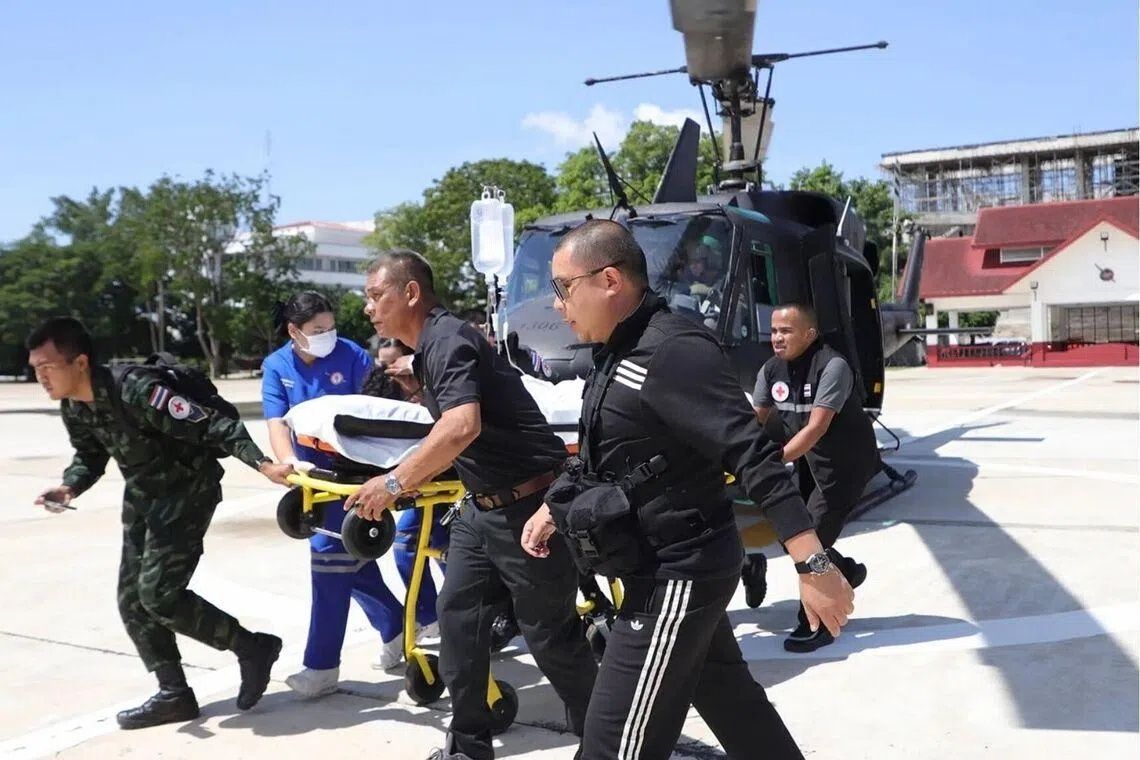
Thailand's violence-plagued southern border provinces endured two separate bomb attacks within hours on Friday, leaving a dozen police officers injured and renewing concerns about militant activity in the region. The first explosion struck at 8.10am in Yala's Thanto district, targeting a patrol unit responsible for protecting teachers, while a second blast hit Pattani's Mayo district three hours later. Both incidents occurred during routine police operations and resulted in multiple casualties requiring hospitalization and urgent medical intervention.
The initial attack took place on the Ban Pulo Saniyae–Ban Sakai road in Ban Rae sub-district, Thanto district, Yala province, where a group of assailants detonated an explosive device targeting a border patrol police team from the teacher protection unit. The blast injured six officers, though the full extent of the damage extended beyond immediate physical harm. Two personnel suffered severe injuries that demanded specialized medical care beyond local hospital capacity: Corporal Kittisak Saksang sustained facial injuries from shrapnel fragments, while Corporal Poraphat Wongruaydee experienced chest trauma, experiencing tightness and partial immobility despite retaining consciousness at the scene.
The gravity of Wongruaydee's condition became apparent after initial stabilization at Thanto Hospital prompted an urgent helicopter evacuation to Yala Hospital for advanced treatment. Medical assessment revealed dangerous fluid accumulation in his pleural cavity—the space surrounding the lungs—necessitating emergency surgical intervention to drain blood and repair lung tissue. The hospital subsequently issued an urgent appeal for blood donations of all types to support his recovery and manage potential complications from the severe trauma. The incident underscores how such attacks can overwhelm local medical facilities and demand rapid coordinated response across provincial healthcare systems.
The second bombing occurred at 11.30am the same day in Pattani's Mayo district, targeting officers from the Special Operations unit as they concluded setting up a security checkpoint in Ban Khuan Yi, Pado sub-district. Five sergeants—Anuchit, Bunyawat, Wisitphon, Aphisit and Sumit—sustained injuries consistent with the blast pattern, experiencing chest tightness and internal trauma similar to those affected in the Yala incident. All five were transported to Mayo Hospital, suggesting the two attacks may have employed similar explosive devices and tactics, though authorities have not publicly confirmed any connection between the incidents.
The timing and targeting of both operations indicate concerning coordination within militant networks operating in Thailand's southernmost provinces. Teacher protection units and police checkpoints represent core elements of the government's counterinsurgency strategy in a region experiencing decades-long conflict between Thai security forces and armed separatist groups. By striking both types of operations within the same morning, perpetrators demonstrated knowledge of police deployment patterns and an ability to execute complex operations across multiple provinces, raising questions about intelligence gathering capabilities among militant factions.
Thailand's deep south—comprising Yala, Pattani, and Narathiwat provinces—has experienced persistent violence rooted in historical grievances, religious tensions, and territorial disputes dating back to the 1960s. The region's predominantly Muslim population has long harbored resentment toward Bangkok-centralized governance, providing recruitment grounds for separatist organizations. While major insurgent groups periodically announce ceasefires or engage in peace talks, splinter factions and autonomous cells continue conducting bombing campaigns and ambushes targeting both security personnel and civilian infrastructure.
For Malaysian readers, these incidents carry direct relevance to cross-border security dynamics. Yala and Pattani provinces lie just north of Malaysia's Kelantan and Terengganu states, with porous borders facilitating weapons smuggling, militant movement, and refugee flows between nations. Extremist networks operating in Thailand's south have historically maintained connections with Malaysian jihadist groups, and heightened violence in Yala and Pattani can trigger spillover effects including increased refugee arrivals and potential recruitment activity within Malaysian border communities. Regional security agencies maintain close coordination to monitor such trends.
Authorities responded to both Friday incidents by implementing standard counterinsurgency protocols, with explosive ordnance disposal teams and forensic specialists conducting detailed site investigations at both locations. Security forces cordoned off affected areas to preserve evidence and collect materials potentially identifying bomb-makers and suppliers. These investigative efforts form part of broader efforts to map militant networks, though the insurgency's decentralized structure and use of lone-wolf attackers complicate attribution and prevention.
The attacks highlight persistent challenges facing Thai security forces despite years of counterinsurgency operations and substantial military investment in the southern provinces. While major terrorist incidents have declined from peaks in the mid-2000s, localized bombing campaigns continue regularly, demonstrating militants' continued capacity to inflict casualties among security personnel. Police and military units in the region operate under constant threat, requiring extensive protective measures that strain resources and complicate normal administrative functions such as checkpoint operations and community patrols.
Thailand's security establishment faces difficult strategic choices regarding southern pacification. Kinetic counterterrorism operations, while occasionally successful in eliminating militant leaders, have not resolved underlying political and communal grievances fueling recruitment. Simultaneously, political dialogue between Bangkok and separatist groups has repeatedly faltered over fundamental disagreements regarding autonomy arrangements and constitutional frameworks. The result remains a protracted stalemate wherein security forces absorb periodic attacks while permanent resolution remains elusive.
Longer-term stability in Thailand's south will likely depend on progress toward negotiated settlements addressing historical injustices and establishing governance arrangements acknowledging regional distinctiveness. In the interim, attacks like Friday's bombings will continue testing the resilience of security personnel operating in one of Southeast Asia's most volatile regions. For neighboring Malaysia, sustained vigilance regarding cross-border militant activity remains essential to prevent destabilization of Kelantan and Terengganu, where extremist recruitment networks have occasionally emerged despite security force monitoring efforts.