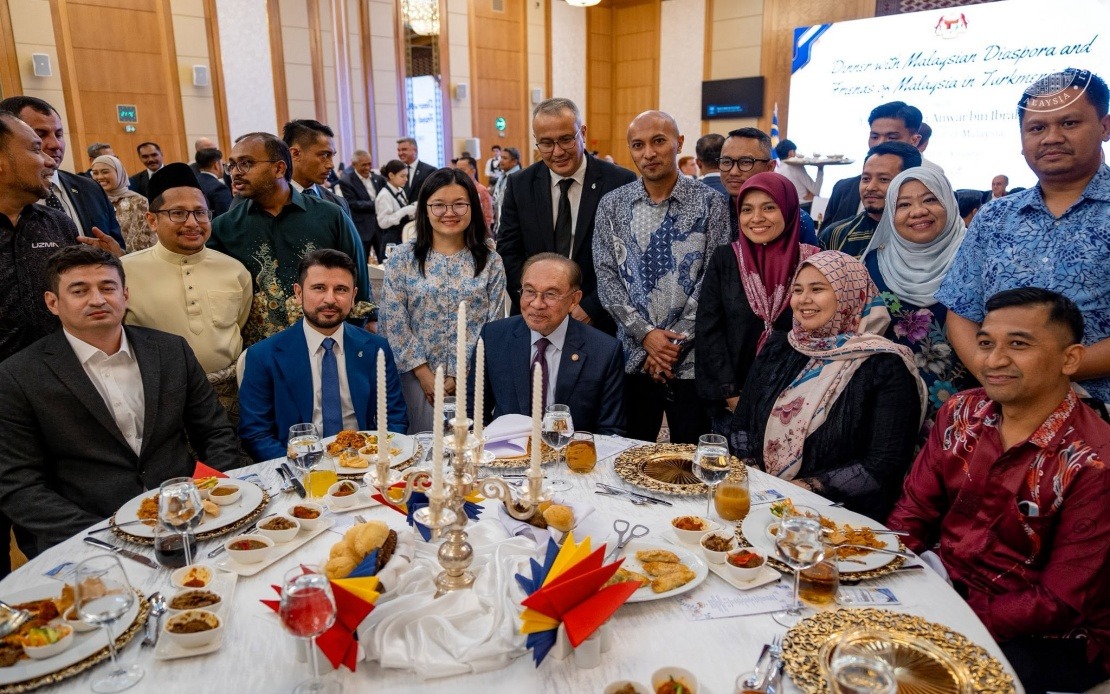
Prime Minister Datuk Seri Anwar Ibrahim seized the opportunity during his official visit to Turkmenistan to engage directly with the Malaysian community residing in Ashgabat, underscoring the MADANI Government's commitment to maintaining robust ties with citizens living abroad. The interaction, facilitated as part of his two-day inaugural official visit to the Central Asian nation, reflects a deliberate diplomatic strategy that extends beyond conventional state-to-state interactions to encompass the vital human dimension of international relations.
During the engagement, Anwar conveyed a message of encouragement to Malaysian expatriates, exhorting them to preserve their connection with their country of origin and to maintain awareness of the nation's evolving trajectory. His remarks highlighted the government's recognition that diaspora communities serve as critical bridges between Malaysia and their host nations, wielding considerable influence over how the country is perceived globally. By addressing this constituency directly, the Prime Minister acknowledged that Malaysia's soft power extends beyond government institutions to encompass the millions of citizens scattered across the world, each contributing to the nation's international standing through their professional endeavours and personal conduct.
In his Facebook statement, Anwar articulated a candid assessment of the diaspora's role in advancing Malaysia's interests overseas. He characterized these Malaysians abroad as "unofficial ambassadors" who actively enhance the country's reputation and image through their daily interactions, professional networks, and community engagement. This framing elevates the diaspora beyond their individual capacities as workers or entrepreneurs, positioning them instead as strategic assets in Malaysia's broader diplomatic architecture. Such recognition carries particular significance for a trading nation like Malaysia, where sustained economic growth and geopolitical influence increasingly depend on the quality of international relationships and the trust extended to Malaysian institutions and individuals.
The visit itself was reciprocal in nature, building on earlier diplomatic momentum generated by Turkmenistan President Serdar Berdimuhamedov's official visit to Malaysia in December 2024. This sequential engagement demonstrates the MADANI Government's commitment to deepening ties with Central Asian nations, a region that has traditionally occupied a secondary position in Malaysia's foreign policy calculations despite its substantial economic and strategic potential. Turkmenistan, as an energy-rich nation with significant reserves of natural gas and oil, represents opportunities for Malaysian businesses seeking diversification and new markets, particularly as regional economic architectures continue to shift.
Anwar articulated that the diplomatic mission encompassed considerably broader objectives than the conventional pillars of trade, investment, and economic cooperation. Instead, the Prime Minister framed the engagement as an endeavour to expand bilateral friendship, deepen mutual understanding, and unlock innovative domains of collaboration beneficial to both nations. This holistic approach to diplomacy reflects a maturation in Malaysian foreign policy thinking, acknowledging that sustainable international relationships rest on foundations that extend beyond transactional economic exchanges. Cultural exchange, educational partnerships, and people-to-people contact increasingly feature in contemporary bilateral frameworks, particularly as countries recognize that shared understanding and goodwill provide the bedrock for long-term cooperation.
For the Malaysian diaspora in Ashgabat and across Central Asia more broadly, such high-level attention from the Prime Minister carries symbolic significance. It signals that the government values their contributions and views them not as citizens who have abandoned the homeland but rather as extended representatives of national interests. This messaging is particularly important given that expatriate communities occasionally experience a degree of disconnection or ambiguity regarding their relationship with their country of origin. Regular governmental engagement, coupled with tangible support for diaspora initiatives and networks, reinforces a sense of belonging and demonstrates that distance from home need not diminish one's stake in national affairs.
The timing of Anwar's visit assumes added importance within the context of regional developments. Southeast Asia and Central Asia have increasingly sought to forge stronger linkages through various multilateral forums and bilateral initiatives. Malaysia's active engagement with Central Asian states positions the nation as a bridge between its immediate regional neighbourhood and the broader Asian continent, enhancing its diplomatic relevance. Furthermore, as global geopolitical alignments continue to evolve, nations that maintain diversified partnerships across multiple regions gain considerable strategic flexibility and resilience.
Anwar's emphasis on ensuring diaspora communities remain informed about national developments also speaks to a broader recognition of information asymmetries that characterize modern expatriate life. Despite technological advances that ostensibly enable seamless global connectivity, many Malaysians abroad struggle to access comprehensive, reliable information about their homeland's progress and policy developments. Government initiatives that proactively disseminate information about Malaysia's achievements and future direction help counter misinformation and maintain emotional bonds between diaspora and homeland.
The MADANI framework itself represents a governance vision emphasizing prosperity, sustainability, unity, and institutional integrity. By communicating these priorities directly to diaspora communities, the government reinforces its commitment to comprehensive national transformation and invites Malaysians abroad to participate in this journey through their own professional and civic endeavours. When diaspora members see alignment between their country's stated values and its actions, they become more effective promoters of Malaysia's interests within their host communities.
Looking ahead, the momentum generated from this engagement could yield tangible benefits if the government sustains active dialogue with diaspora networks. Formalized channels for diaspora input on foreign policy matters, investment opportunities, and cultural promotion could leverage their unique positions as bicultural actors capable of advancing Malaysian interests while building bridges of understanding. The Prime Minister's presence in Ashgabat and his deliberate outreach to the local Malaysian community suggest that such engagement forms part of a wider strategic commitment to harness the full potential of Malaysia's global human capital.