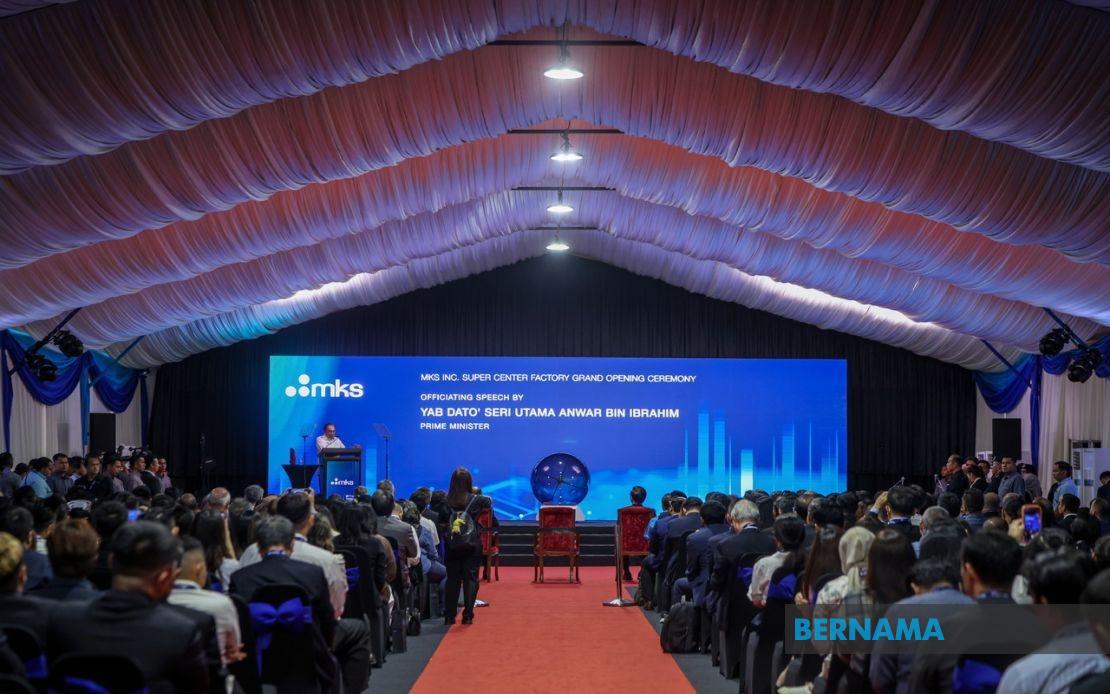
Prime Minister Datuk Seri Anwar Ibrahim has articulated a compelling case for Malaysia's independent and neutral diplomatic posture, arguing that maintaining equidistance from major global powers serves both the nation's sovereignty and its economic interests. Speaking at the MKS Super Centre factory opening in Bandar Cassia Technology Park in Batu Kawan on June 20, Anwar framed Malaysia's refusal to align exclusively with any single geopolitical bloc as a strategic asset that distinguishes the country in an increasingly fractured international landscape. This positioning, he contended, generates measurable advantages in attracting investment and securing commercial agreements that might otherwise elude nations perceived as firmly locked within rival spheres of influence.
The Prime Minister's remarks underscore a deliberate diplomatic strategy that has matured over Malaysia's post-independence history, yet appears to have found renewed relevance amid contemporary great-power tensions. Rather than viewing neutrality as passive disengagement, Anwar presented it as an active and assertive approach involving strategic outreach to nations across ideological and economic divides. His enumeration of recent high-level visits and diplomatic engagements—spanning interactions with United States President Donald Trump, alongside concurrent strengthening of ties with China, India, and Russia—illustrated how Malaysia has cultivated simultaneous relationships that many nations find difficult to balance without arousing suspicion or triggering geopolitical blowback.
The invocation of Petronas's latest agreement in Turkmenistan exemplifies how this diplomatic flexibility translates into concrete commercial wins. Malaysia's state-owned oil and gas giant has historically leveraged the nation's reputation as a reliable, non-ideological partner to secure energy deals in regions where Western companies face restrictions or political complications. The Turkmenistan project, situated in a country of strategic importance to Russia and Central Asian security architecture, exemplifies how Malaysia's capacity to engage without triggering Cold War-style anxieties enables its enterprises to access opportunities that might be foreclosed to nations seen as aligned with rival blocs.
The timing of Anwar's pronouncements carries particular weight given the accelerating structural realignment of global power. As the United States and China compete for technological and economic dominance, and as regional powers like India assert growing ambitions, smaller and mid-sized nations face mounting pressure to choose sides. Malaysia's refusal to do so—or at minimum, its ability to maintain the appearance of not doing so—provides breathing room for policymakers to pursue national interests defined primarily through economic rather than ideological parameters. This approach has enabled Malaysia to participate in diverse frameworks: engagement with the American-led Indo-Pacific initiative, deepening economic ties with China, and pragmatic cooperation with Russia and Central Asian partners, all simultaneously.
From a Southeast Asian perspective, Malaysia's strategy also carries wider implications. As a founding member of ASEAN, Malaysia's demonstrated capacity to maintain strategic autonomy while remaining engaged across geopolitical lines reinforces the association's core principle of non-alignment. Other regional states seeking to navigate between major powers without surrendering sovereignty can point to Malaysia's example as a viable alternative to forced choice scenarios. This model becomes increasingly valuable as tensions rise in critical zones such as the Taiwan Strait and the South China Sea, where many ASEAN members have direct interests but lack the economic heft to withstand coercive pressure from any single power.
Anwar's emphasis on Malaysia's centrality in global affairs reflects an understanding that geopolitical positioning translates into economic leverage. Countries perceived as indispensable bridges between rival powers attract investment, secure favorable trade terms, and command diplomatic respect disproportionate to their size or military capacity. Malaysia, with its location astride critical sea lanes, its role as a regional financial and technological hub, and its moderate Islamic profile that appeals across civilizational lines, possesses genuine structural advantages that non-alignment allows it to monetise more effectively than would alignment with any single bloc.
The factory opening event itself, featuring attendance by Penang Chief Minister Chow Kon Yeow and Deputy Minister of Investment, Trade and Industry Sim Tze Tzin, highlighted how investment attraction remains central to Malaysia's economic strategy. The presence of MKS president and chief executive officer John T.C. Lee underscored the private-sector dimension of this approach; companies like MKS, operating in the technology and manufacturing sectors, benefit from Malaysia's open posture towards global partnership. When Malaysia can credibly claim access to American technology partnerships, Chinese supply chains, Indian service expertise, and Russian resource partnerships, it becomes a more attractive destination for multinational corporations seeking diversified, de-risked global operations.
However, maintaining this balancing act requires continuous diplomatic skill and occasional restraint. Anwar acknowledged that Malaysia does express positions on contentious international issues, suggesting that non-alignment does not mean moral silence or complete amorality in foreign policy. Rather, it appears to involve selective and calibrated statements that avoid irrevocable commitments on issues where Malaysia's material interests do not directly mandate unambiguous stances. This nuanced approach—appearing principled without sacrificing pragmatism—demands sophisticated foreign ministry capacity and consistent messaging across multiple government agencies.
The economic implications warrant closer examination for Malaysian stakeholders. A non-aligned strategy potentially maximises access to diverse sources of foreign direct investment, technology transfer, and market opportunities. However, it also creates vulnerabilities if Malaysia's reputation for neutrality becomes questioned or if major powers perceive hedging as disloyalty. The challenge for policymakers lies in sustaining credibility with all partners while advancing distinct Malaysian interests, a task that requires clarity about red lines and genuine limits to flexibility.
Looking forward, Malaysia's non-aligned positioning appears durable provided the government maintains disciplined execution. The nation's economic model—export-driven, technology-oriented, and increasingly oriented towards services—thrives when barriers to diverse partnerships remain minimal. As geopolitical competition intensifies, Malaysia's refusal to definitively align with any single bloc positions it advantageously relative to nations that have already committed to particular alignments and therefore face restricted access to alternative partnerships. For foreign investors and Malaysian enterprises, this positioning offers genuine strategic value that warrants recognition as a core element of national competitive advantage.