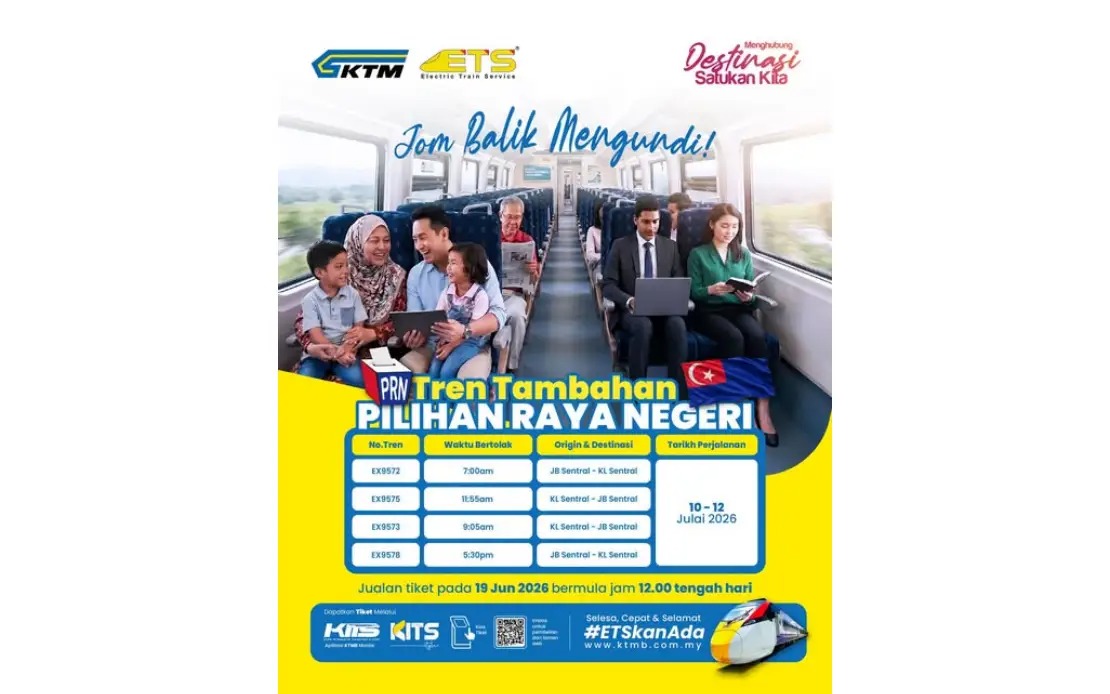
Keretapi Tanah Melayu Berhad (KTMB) is deploying additional Electric Train Service (ETS) capacity to southern Johor ahead of the state election scheduled for July 11, seeking to ease the movement of voters returning to their constituencies for polling day. The national rail operator's decision to augment train services reflects expectations of significant passenger traffic as eligible electors travel back to cast their votes, with the transportation infrastructure strain potentially substantial given that Johor represents Malaysia's second-largest state by population and area.
Ticket sales commenced at noon on the announcement date, with KTMB offering multiple purchasing channels to maximise accessibility for travellers. The KTMB Mobile app and KITS Style app provide mobile-first booking options for smartphone users, while the official website at online.ktmb.com.my caters to those preferring browser-based transactions. Physical ticket kiosks maintained by KTMB across major stations remain available for customers who favour face-to-face transactions, ensuring no demographic segment faces barriers to accessing the additional services.
The expanded rail service window spans July 10 through July 12, strategically framing polling day with one day of advance travel capacity and one day of return journey flexibility. This three-day operational window acknowledges that voters may require time both to reach their home constituencies from employment or study centres and to depart after fulfilling their electoral obligations. The timing proves particularly relevant for Johor's significant migrant worker population, including those commuting to Kuala Lumpur and the Klang Valley for employment, who would otherwise face transport constraints when attempting to return home simultaneously with other displaced voters.
The Johor state election was triggered by the State Legislative Assembly's dissolution on June 1, with the Election Commission subsequently announcing July 11 as polling day. This election represents a significant electoral exercise in Malaysia's peninsula, determining the composition of the 56-seat state assembly and consequently the state government's political direction. As one of Malaysia's economically important states, Johor's political outcome carries implications extending beyond its borders, influencing federal parliamentary mathematics and setting precedent for governance in the broader southern region.
KTMB's proactive capacity expansion demonstrates institutional recognition that election day travel creates predictable but concentrated demand surges on transport networks. Rather than operating at standard capacity and risking passenger overflow or service disruptions, the rail operator's supplementary services approach minimises inconvenience to voters whilst protecting overall system reliability. This operational philosophy contrasts with reactive management and reflects mature infrastructure planning aligned with Malaysia's democratic calendar.
The announcement's emphasis on the phrase "Let's head home to vote" carries implicit acknowledgement that electoral participation requires physical presence in designated constituencies. For Malaysia's geographically dispersed population, particularly workers in peninsular economic hubs or education centres distant from home states, transport accessibility directly correlates with turnout rates. KTMB's initiative thus addresses practical barriers to franchise exercise, acknowledging that robust democratic participation depends partly on removing logistical obstacles to ballot access.
Digital ticketing infrastructure development represents another significant dimension of KTMB's service enhancement. The availability of mobile app-based booking reflects broader digitalisation trends within Malaysian public services and demonstrates how rail operators integrate contemporary technology into voter convenience initiatives. This multi-platform approach reduces queue times at physical ticketing locations whilst accommodating varying technological proficiency levels across the voting-age population.
For Johor residents working or studying in other states, the announcement provides essential planning information for leave applications or schedule adjustments. Many employers recognise voting as a civic responsibility meriting work schedule accommodation, yet transport availability uncertainty can complicate decision-making. KTMB's advance notice of expanded services enables more confident arrangements, particularly important for those dependent on public transport rather than private vehicles.
The southern rail corridor's capacity augmentation also carries implications for regional transport planning beyond this specific election. Data generated during the July 10-12 period regarding passenger volumes, demand patterns, and service performance provides valuable intelligence for KTMB's longer-term capacity planning. Understanding how spikes in demand manifest during election periods informs infrastructure investment decisions and operational scheduling for future electoral cycles.
Businesses and commerce along the ETS corridor may also experience secondary effects from enhanced passenger services. Increased train traffic generates ancillary spending at stations and supporting retail establishments, whilst returning travellers may undertake pre-election shopping or services. The election-driven transport surge thus generates modest economic activity spillovers within communities served by enhanced rail services.
The coordination between electoral administration and public transport providers demonstrates institutional preparedness for managing elections' logistical dimensions. Rather than treating voting as purely an administrative exercise, integrated approaches incorporating transport, accommodation, and infrastructure considerations reflect recognition that elections function within broader practical and physical environments. KTMB's initiatives contribute to ensuring that July 11's Johor polling proceeds smoothly across all logistical dimensions.