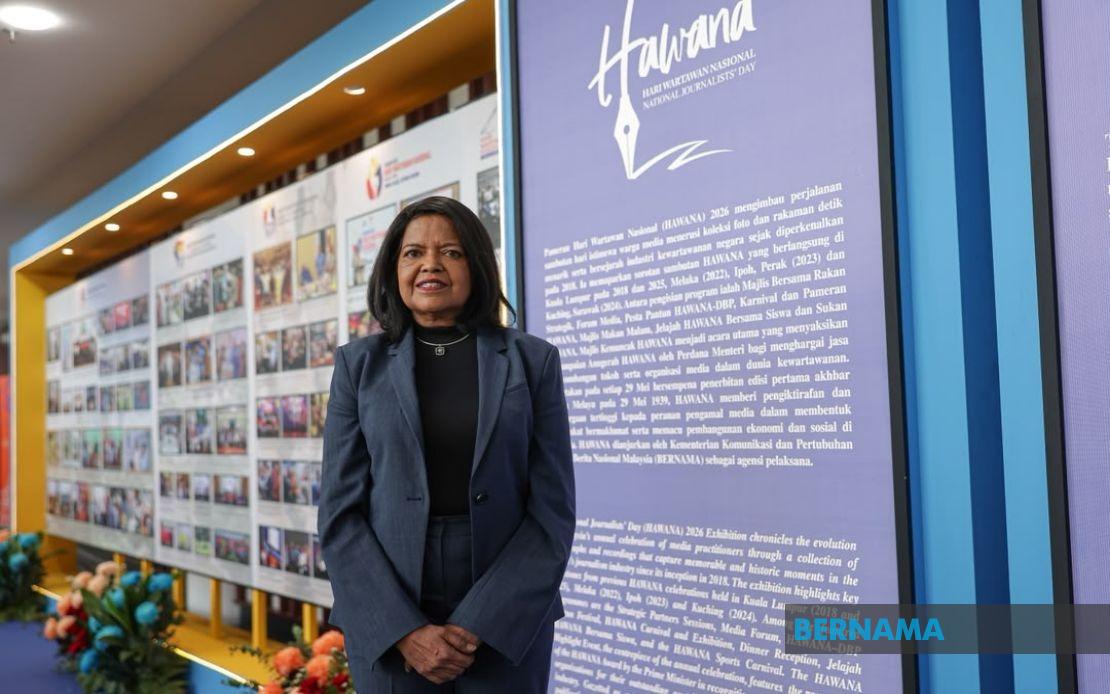
Tan Sri Nallini Pathmanathan, the newly appointed chairman of the Malaysian Media Council, has moved to address concerns about her judicial background by asserting that her experience on the Bench provides the ideal foundation for leading a self-regulatory media body. Speaking at a media dialogue session in Butterworth alongside Communications Minister Datuk Fahmi Fadzil, Nallini articulated a vision of MMC leadership grounded in impartiality rather than journalistic expertise, positioning the council's credibility as dependent on its ability to exercise fairness above all else.
The appointment of a former Federal Court judge to helm Malaysia's media regulator has invited scrutiny, prompting Nallini to articulate plainly what she brings to the role and what she does not. She candidly acknowledged that she has never worked as a journalist, managed a newsroom, or grappled with the pressures of deadline-driven reporting. Yet rather than framing this absence as a liability, Nallini recast it as an advantage, suggesting that the council's effectiveness hinges not on sectoral knowledge but on its reputation for even-handed decision-making and procedural integrity.
According to Nallini, the core competencies developed during her judicial career translate directly to the MMC's mandate. The skill of adjudicating disputes impartially, of weighing evidence without factional allegiance, and of issuing decisions backed by transparent reasoning represents the cornerstone of what the council must demonstrate to the public and to media stakeholders. This framing proves significant for Malaysian readers, as it positions media regulation as an exercise in judicial restraint rather than editorial judgment—a distinction that carries weight in a regional context where media regulation and press freedom remain contentious.
The Malaysian Media Council Act itself stipulates that the chairperson must maintain independence from political, civil service, and legislative influence, a structural requirement that Nallini argued vindicated the selection of a neutral figure. This statutory framework reflects a broader acknowledgment that media self-regulation cannot function credibly if its leadership remains tethered to partisan interests or state machinery. By invoking the Act's own language, Nallini positioned her appointment not as an anomaly but as an alignment with the council's foundational design—a subtle reframing of the narrative around her candidacy.
Looking beyond her personal credentials, Nallini articulated a two-part conception of the council's role that separates editorial judgment from standards enforcement. While acknowledging that journalists and editors possess unquestionable expertise in newsgathering and newsroom operations, she posited that the MMC's responsibility lies in strengthening the broader media ecosystem through credible codes of conduct, accessible complaints mechanisms, and fair dispute resolution processes. This demarcation allows her to occupy the chairmanship without claiming editorial authority, a distinction crucial for the council's perceived legitimacy.
Nallini identified the foundational phase of her tenure as the institution-building phase, during which the council must establish processes rooted in natural justice, proportionality, and transparent reasoning. The metaphor of constitution-writing proved instructive—it signals that these early months will determine the council's trajectory and standing. By framing process design as her immediate preoccupation, Nallini emphasized that the council's credibility depends more on how it reaches decisions than on who makes them, a philosophical stance that aligns with principles of procedural fairness long established in judicial contexts.
Central to Nallini's vision is a framework that reconciles press freedom with media responsibility. She articulated that these principles operate not as counterforces but as complementary halves of democratic trust—a free media must exercise responsibility, and responsible journalism requires protection from manipulation and misuse. This formulation carries particular resonance for Malaysian contexts, where debates over media freedom often pit libertarian and communitarian values against each other. Nallini's framing suggests that responsible regulation need not undermine journalistic independence if its processes are fair and its logic transparent.
The council has identified three immediate priorities: establishing a functioning complaints and adjudication framework, broadening membership across the media industry, and addressing emerging challenges posed by fabricated content and artificial intelligence misuse. These initiatives reflect recognition that media regulation must evolve alongside technological change and shifts in information ecology. For Malaysian stakeholders, the explicit attention to AI and synthetic content proves timely, as Southeast Asian markets grapple with increasing instances of deepfakes and algorithmically amplified misinformation.
A critical dimension of Nallini's remarks concerned the distinction between upholding media standards and suppressing journalistic inquiry. She explicitly cautioned against allowing the council's complaints mechanism to become a vehicle for silencing challenging reporting, emphasizing that robust journalism—particularly reporting that scrutinizes power holders and poses uncomfortable questions—remains essential to democratic functioning. This distinction addresses a substantive concern in regional media contexts, where regulatory bodies have occasionally been instrumentalized to constrain critical coverage.
Nallini invoked the concept of earned independence, arguing that impartiality is not proclaimed in rhetoric but demonstrated through concrete decisions and willingness to disagree with various stakeholders. This formulation proves instructive for media regulation in Malaysia and the broader region, where institutional credibility often depends more on demonstrated behavior than on statutory designation. By suggesting that the council will be judged by whom it proves willing to hold accountable, Nallini signaled an expectation of robust independence that goes beyond formal autonomy.
The dialogue session, held in conjunction with National Journalists' Day 2026 celebrations, brought together Communications Ministry officials, senior figures from the Malaysian National News Agency Bernama, and representatives from local media organizations. This gathering underscored the significance attributed to Nallini's remarks and the council's emerging priorities within government and industry circles. The participation of multiple institutional stakeholders suggests broad recognition of the MMC's importance to Malaysia's media ecosystem.
Looking forward, the substance of Nallini's vision will be tested as the council moves from institutional design to operational adjudication. Her emphasis on procedural fairness, transparent reasoning, and demonstrated independence provides a measurable framework against which the council's performance can be evaluated. For Malaysian readers and media professionals, her appointment and articulated approach signal a potential recalibration of media regulation toward procedural legitimacy rather than editorial authority—a shift that could influence how self-regulation functions across Southeast Asia's media landscape.