George Town's appeal lies not in following a single rigid itinerary but in understanding the city through its interconnected arteries—thoroughfares that weave together commerce, culture, and culinary tradition. Among these, Jalan Burma stands out as a particularly rewarding route for visitors seeking to experience Penang authentically, where heritage architecture sits comfortably alongside street-level gastronomic excellence that has earned international recognition.
The designated heritage zone, anchored by the George Town UNESCO Historic Site, naturally draws the bulk of tourist traffic. Visitors traverse familiar territory along Beach Street, Armenian Street, Lebuh Carnavon, Lebuh Chulia and Pengkalan Weld, where restoration efforts have transformed centuries-old structures into functioning spaces—shops peddling vintage goods, art suppliers, and curio dealers thrive within these storefronts. Yet the city rewards those willing to venture beyond these well-trodden paths. Understanding George Town demands flexibility in approach: some visitors navigate by cuisine type—halal establishments, pork-free options, street food concentrations, or the omnipresent nasi kandar restaurants that define Penang's identity—while others follow Michelin guides or social media recommendations. This multiplicity of entry points explains why the city accommodates diverse visitor preferences without becoming fragmented.
Penang's Michelin presence, while modest in absolute terms compared to major gastronomic capitals, punches above its weight in terms of accessibility. The 74 recognized eateries—comprising two one-star establishments, 33 Bib Gourmand listings, and 39 Michelin Selected venues—predominantly cluster in George Town itself, making serious food tourism feasible within a compact geography. What distinguishes Penang's recognition is that many awarded venues operate in unpretentious settings: food courts and independent coffeeshops rather than fine-dining establishments. This democratization of quality makes Michelin-tracking an unusually organic experience, one that doesn't require reservations months in advance or formal attire.
Jalan Burma itself, stretching nearly 5 kilometres from the heritage zone's eastern edge through to the residential enclave of Pulau Tikus, exemplifies this accessibility. A midday visit to Duck Blood Curry Mee, tucked into an unassuming shopfront, provides entry into Penang's food discourse—a simple bowl of white curry noodles that costs a fraction of restaurant meals elsewhere yet represents decades of accumulated technique. Proximity matters here; situated mere doors from the newly restored heritage property, food stalls and hotels coexist in natural symbiosis, allowing visitors to alternate between gastronomic exploration and comfortable accommodation without elaborate planning.
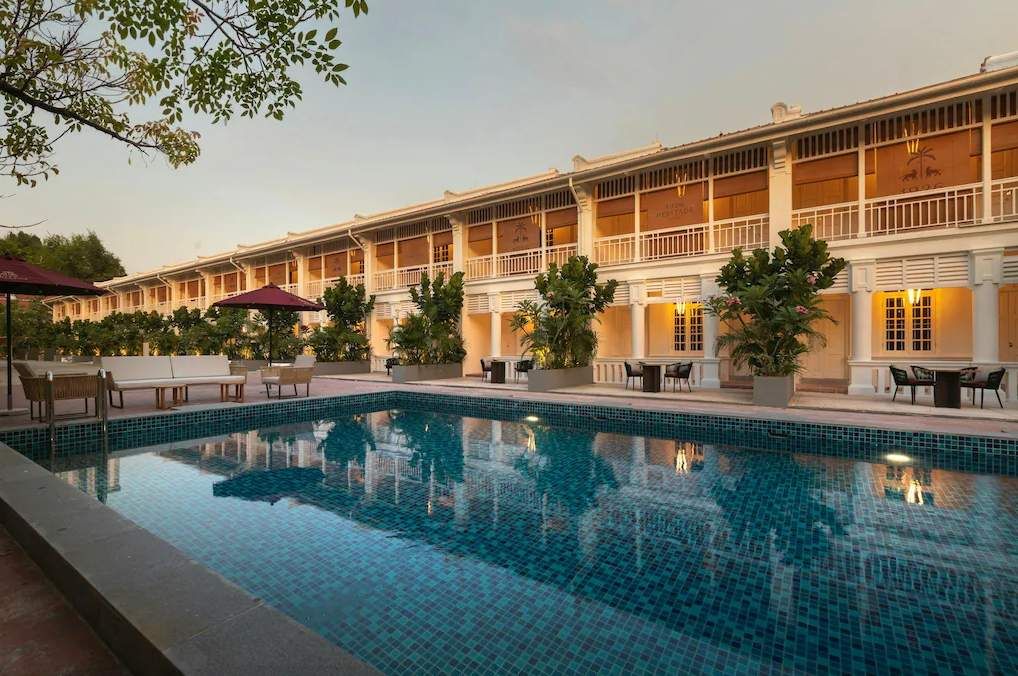
The heritage hotel itself merits attention as an architectural document. Built in 1926, now celebrating its centennial year, the property originally served as residential quarters for British and local government officials—a physical embodiment of colonial-era Penang through its Anglo-Malay design vocabulary. When the Penang Development Corporation repurposed the original 24 interconnected link houses into hotel use in 1999, the conversion preserved rather than erased this history. The current configuration—78 rooms across six categories, including Heritage Rooms designed for solo travellers and the expansive Straits Suite—maintains the low-rise character of the original structures while meeting modern hospitality expectations. This commitment to adaptive reuse, increasingly common in George Town, transforms heritage preservation from static museum practice into living, revenue-generating urban revitalization.
Immediately adjacent to the hotel complex sits Restoran Old Green House, home of the Bib Gourmand-listed Green House Prawn Mee & Loh Mee. This clustering illustrates an important dynamic in George Town's food geography: reputation and tradition supersede novelty. While a secondary Green House location operates further along Jalan Burma toward Jalan Penang, locals consistently direct visitors to the original stall, acknowledging a hierarchy of authenticity that transcends menu similarity. This preference for established venues over newer branches reflects how Penang's food culture operates as genealogy—tracking lineages of recipe transmission, owner succession, and neighborhood association matters more than franchise consistency or marketing reach.
Jalan Burma's historical nomenclature reveals layers of settler communities and cultural influence that shaped modern Penang. Originally called Burmah Road, the thoroughfare carried multiple simultaneous names in Malay, Hokkien, and Cantonese, each translatable to English variants—Jalan Tarek Ayer (Water Cart Road), Gui Chia Chui (Water On Bullock Carts)—reflecting its primary function in transporting water via bullock-drawn carts during the 19th century. The subsequent establishment of a Burmese settlement in Pulau Tikus prompted the official renaming that persists today. This nomenclatural archaeology matters because it demonstrates how George Town's street names encode economic history, labor practices, and immigration patterns that remain physically visible to contemporary walkers. Rangoon Road, Mandalay Road, and Moulmein Close—satellite thoroughfares intersecting Jalan Burma—perpetuate this Burmese influence, while the Dhammikarama Burmese Temple, established two centuries ago, anchors the community's spiritual continuity in the landscape.
Traversing Jalan Burma on foot—approximately 4 kilometres round-trip from the hotel to the heritage zone shopping district along Lebuh Campbell, Lebuh Kimberley, and Beach Street—constitutes a manageable urban walk despite Penang's subtropical heat. The route generally accommodates pedestrians, though occasional sections lack dedicated pathways. This walkability matters for visitors attempting to structure days around sequential experiences: a morning curry noodle breakfast, midday exploration of the heritage hotel's preserved colonial architecture, afternoon shopping in the tourist-oriented heritage precinct, and evening dining at the hotel's modern Chinese restaurant. The physical exertion of walking, the sensory immersion in street-level commerce and food preparation, and the social encounters with other pedestrians collectively create an experiential density that automobile-dependent itineraries inevitably flatten.
The Hin Bus Depot, a weekend-activated marketplace housed within a restored bus terminus, exemplifies how George Town continuously discovers new uses for historical infrastructure. Local vendors selling handmade clothing, artworks, curios, and services like caricature drawing transform the space into a living craft commons. The addition of homemade food stalls and live music performances suggests that heritage preservation in contemporary George Town extends beyond architecture into the cultivation of social spaces where informal economies—artisan production, street food, spontaneous performance—can flourish. This model contrasts sharply with heritage zones in other Southeast Asian cities that calcify into commercialized nostalgia, where tourist trinkets and sanitized dining experiences displace the generative messiness that originally created neighborhood character.
For visitors attempting to penetrate George Town's seemingly labyrinthine geography, organizing exploration around anchor points rather than prescribed zones yields richer discoveries. Beginning at Jalan Burma—where colonial-era accommodation meets Michelin-recognized street food, where Burmese settlement history manifests in temple architecture and road nomenclature—provides conceptual coherence without imposing artificial boundaries. The avenue functions as a kind of biographical timeline of Penang itself: 19th-century water transport systems, turn-of-the-century colonial administration, late-20th-century adaptive reuse, and 21st-century culinary renaissance all remain legible within a single walk. This layering, this palimpsest quality where different historical periods occupy the same space without complete supersession, distinguishes George Town from cities where modernization demands wholesale replacement of the past. Jalan Burma embodies this principle in compressed form—making it an essential rather than optional component of understanding contemporary Penang.