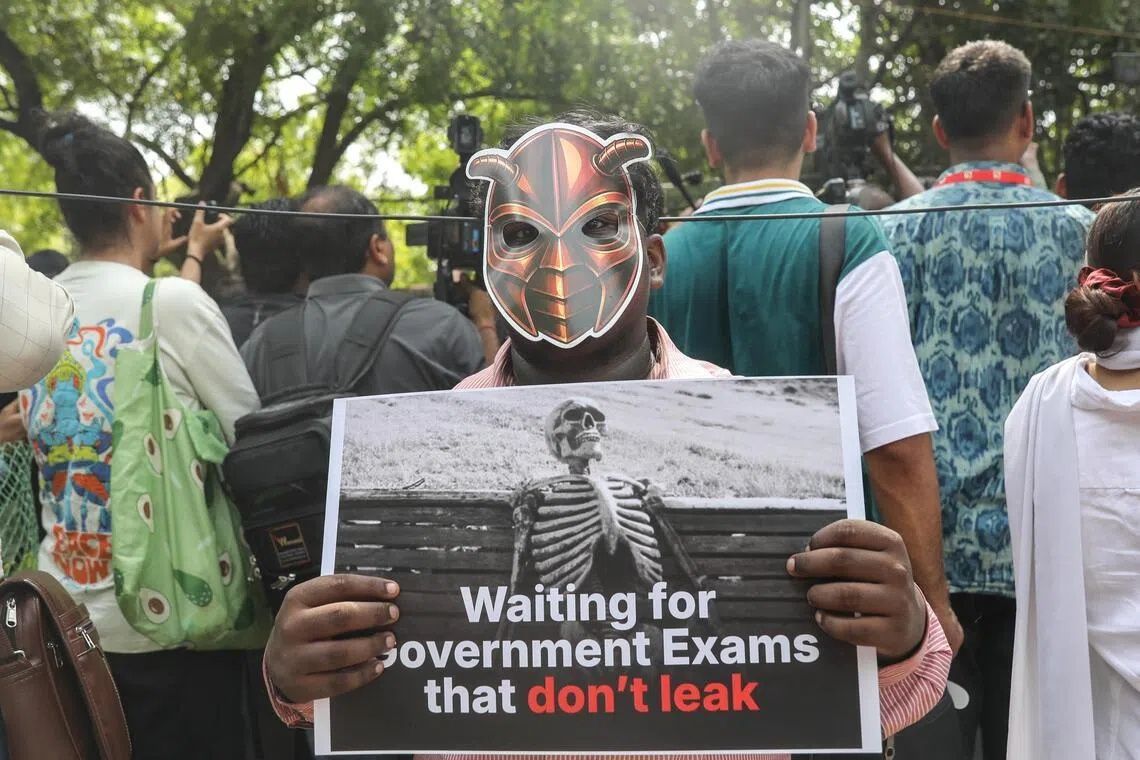
India's education system faces one of its most serious integrity crises in recent memory as 2.2 million aspiring medical students prepare to sit a re-examination on Sunday, June 21, following a catastrophic security breach that invalidated the original test. The cancellation of the National Eligibility cum Entrance Test, the primary gateway through which candidates compete for approximately 100,000 undergraduate medical seats across the country, has exposed vulnerabilities in the examination infrastructure and deepened public distrust in institutions responsible for overseeing the nation's educational standards.
The original examination was scrapped after question papers were leaked into the public domain, triggering an unprecedented wave of anger among students, parents, and civil society. The incident quickly escalated beyond a typical examination irregularity when reports emerged of suicides among teenagers linked to the scandal, amplifying the emotional toll of the breach and galvanising public demand for systemic accountability. This convergence of examination fraud and human tragedy transformed what might have otherwise been a technical issue into a broader social and political flashpoint.
The crisis has compounded existing frustrations with the education ministry's management of examinations. Running parallel to the medical test controversy, a separate marking fiasco affected nearly two million high school students, with numerous complaints of incorrect grades and results being assigned to the wrong candidates. These concurrent failures have created a perception that the machinery responsible for evaluating India's youth lacks adequate quality control and oversight mechanisms, amplifying calls for institutional reform across multiple levels of the examination system.
Thousands of students and parents have taken to the streets demanding the resignation of Education Minister Dharmendra Pradhan, whose tenure has become synonymous with examination management failures. The intensity of this backlash is evident in the emergence of satirical political movements such as the "Cockroach People's Party," which launched in May and has accumulated millions of followers by channeling widespread frustration with government educational policies. This phenomenon reflects how deeply the examination scandals have resonated with young voters and their families.
The National Testing Agency has responded by implementing what it describes as a "multi-layered security framework" designed to prevent repetition of the earlier breach. The deployment of more than 200,000 officials, including extensive police presence at examination centres across the country, represents a massive logistical mobilisation aimed at creating a fortress-like examination environment. Complementing this physical security apparatus, authorities have introduced technological safeguards including biometric authentication systems to verify candidate identity and prevent impersonation.
Artificial intelligence-enabled camera surveillance within examination halls represents an attempt to create comprehensive visual monitoring that can detect suspicious activity and deviation from standard test procedures. Simultaneously, authorities have implemented GPS tracking systems for question papers themselves, creating a digital trail that can document the movement of examination materials from their point of printing through distribution to individual test centres. These technological interventions aim to make any future leak detectable and traceable to specific individuals within the supply chain.
The messaging application Telegram has faced a week-long ban in India, reflecting official assessment that digital communication platforms have become primary tools for examination fraud networks. The National Testing Agency acknowledged that cheating rackets had deliberately exploited messaging apps to distribute leaked questions to candidates willing to pay substantial bribes. However, Telegram chief Pavel Durov has publicly challenged the efficacy of such bans, arguing that restricting specific platforms merely redirects illegal activity toward alternative communication channels rather than addressing root causes.
Durov's observation points toward a deeper structural problem within India's examination ecosystem. The intelligence agencies identified a chemistry lecturer as the alleged kingpin orchestrating the leak, highlighting how insider participation has become integral to sophisticated examination fraud operations. The existence of highly organised criminal networks that profit from paper leaks suggests that the problem transcends technological vulnerabilities and reflects systemic corruption that has become embedded within educational institutions themselves.
The intensity of competition for limited medical college places has inadvertently nourished this ecosystem of fraud. With roughly 2.2 million candidates pursuing just over 100,000 seats, the acceptance rate remains below five percent, creating conditions where desperate students and their families are willing to invest enormous sums to secure even marginal advantages. This desperation has sustained a thriving coaching industry and created lucrative opportunities for criminals specialising in examination manipulation.
For Malaysia and other Southeast Asian nations observing India's experience, the implications are sobering. Examination systems across the region rely on similar technological and administrative frameworks, and the revelation that organised networks can penetrate even high-stakes national examinations suggests that security vulnerabilities may be widespread. The Indian government's decision to deploy extraordinary security measures underscores the difficulty of maintaining examination integrity when sophisticated criminal organisations view such systems as profit opportunities.
The broader significance of this crisis extends beyond questions of security protocols or technology implementation. It reflects declining public confidence in state institutions' capacity to deliver fair and equitable systems, with particular resonance among young populations who view education as their pathway to social mobility. The emergence of satirical protest movements and widespread student mobilisation indicates that the examination scandal has become a proxy for deeper anxieties about government competence and institutional accountability.
As India implements its new examination on Sunday with an unprecedented security apparatus in place, policymakers across the region will be watching closely to determine whether technological interventions and massively scaled physical presence can reliably prevent examination fraud. The test results will provide insights not merely about individual student performance, but about whether existing institutional frameworks can be sufficiently fortified to restore public confidence in educational systems that millions of families depend upon for their children's futures.