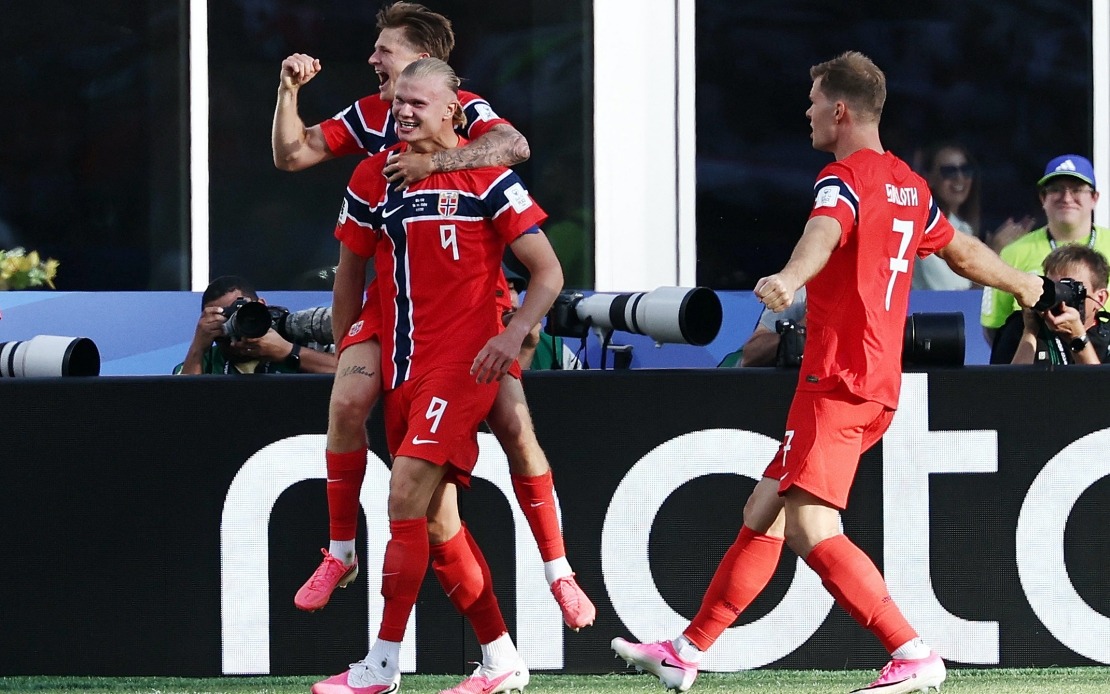
Three Norwegian footballers entering the World Cup carry an inheritance that extends far beyond typical family expectations. Erling Haaland, Alexander Sørloth and Kristian Thorstvedt all have fathers who represented Norway at the 1994 World Cup held in the United States, where the national team was eliminated during the group stage. Now, the sons are determined to accomplish what the previous generation could not—advancing beyond the initial rounds and etching their own legacy in international football's most prestigious tournament.
The generational narrative gained immediate momentum when Norway opened their campaign with a commanding 4-1 victory over Iraq, setting an encouraging tone for the subsequent matches ahead. This performance provided vindication for a squad seeking to establish themselves on the global stage while simultaneously achieving something their fathers' teammates never managed. The emotional weight of this parallel is not lost on the players, who have spoken openly about the significance of surpassing their fathers' accomplishments in a tournament that represents the pinnacle of international sporting achievement.
Erling Haaland, widely regarded as Norway's most marketable and talented player, carries perhaps the most prominent name into the tournament. The Manchester City forward has achieved far greater individual success than his father, Alf-Inge "Alfie" Haaland, whose career nonetheless established a foundation in Norwegian football. When shown photographs of his father from 1994, Haaland expressed amusement at the striking physical differences across the decades. "He looks so young. I have never seen him with such long hair," Haaland remarked, highlighting the personal connection between generations while acknowledging the passage of time and changing football culture.
The connection between father and son extends beyond mere sentiment for these players. Haaland has literally followed his father's path, eventually joining Manchester City just as his father did years earlier. This professional trajectory reinforces the family bond forged through football and suggests a mentorship relationship that transcends typical parent-child dynamics. The fact that Haaland has surpassed his father's achievements both domestically and internationally speaks to evolving standards in modern football, where physical conditioning, tactical sophistication and global opportunity have transformed the sport significantly since 1994.
Alexander Sørloth, performing for Atletico Madrid, represents another fascinating case of paternal influence on the pitch. The midfielder recently expressed his perspective on emulating his father's World Cup experience, describing the opportunity as "simply great." Sørloth has credited his father Gøran extensively with foundational football knowledge, stating that "he has taught me everything I know about football." This testament to parental guidance demonstrates that the relationship between these fathers and sons transcends typical competition dynamics—the younger generation views their fathers as instructors and role models rather than benchmarks to surpass purely for competitive ego.
Sørloth's first vivid memory of the World Cup emerged not from the 1994 tournament itself, but rather from 2002 in Japan and South Korea. During a family holiday in Denmark, he watched those matches with his father, recalling the excitement and wonder of experiencing international football at such a formative age. This memory encapsulates how paternal influence shapes a child's trajectory toward professional sport—the casual viewing of a World Cup with a parent becomes a foundational moment that eventually propels the child toward the same stage years later.
Kristian Thorstvedt, like his teammates, exists in the shadow of his father Erik Thorstvedt's 1994 experience. Though less prominently discussed in broader international football circles compared to Haaland, Thorstvedt nonetheless carries the same motivation and historical awareness as his peers. The three players represent a cohort united not merely by their ages or national team membership, but by a shared understanding that they are writing a response to their fathers' unfulfilled ambitions in this tournament.
Norway's next challenge against Senegal on Monday will provide the first meaningful test of their credentials beyond Iraq. A victory could secure qualification to the knockout rounds, substantially exceeding what their fathers' generation accomplished three decades earlier. The match takes on additional significance given the royal patronage expected to attend. Princess Ingrid Alexandra and Prince Sverre Magnus, children of Crown Prince Haakon and Crown Princess Mette-Marit, are anticipated to be present in New Jersey, underscoring the national importance placed on this squad's performance.
The broader Norwegian society has demonstrated unprecedented enthusiasm for this World Cup campaign. The "rowing routine" of supporters, rooted in Viking cultural heritage, has transcended stadium boundaries and even penetrated Norway's parliament, where members from all political parties participated in organized displays of support. This nationwide mobilization reflects not merely enthusiasm for football but a collective sense that this generation of players represents something significant—a chance to rewrite history and establish a new narrative for Norwegian football on the global stage.
The final group match against France will complete Norway's preliminary journey, though the squad's aspirations extend far beyond merely finishing the group stage. If the sons of Haaland, Sørloth and Thorstvedt manage to navigate the group stage successfully, they will have immediately achieved more than their fathers' generation. Yet the unspoken ambition clearly extends deeper—these players are not simply seeking to escape group-stage elimination but to advance meaningfully through the tournament, establishing themselves as genuine contenders rather than participants with historical footnotes.
This World Cup represents a unique convergence of sporting talent, family legacy, national expectation and historical opportunity. For Haaland, Sørloth and Thorstvedt, every match carries layers of significance beyond typical international competition. Their performances will be measured not simply against their opponents but against the standard set by their fathers three decades prior, creating a powerful psychological dynamic that runs through the Norwegian squad. Whether they ultimately succeed or fall short will determine whether this narrative of generational ambition becomes one of triumph or unfulfilled expectation.

