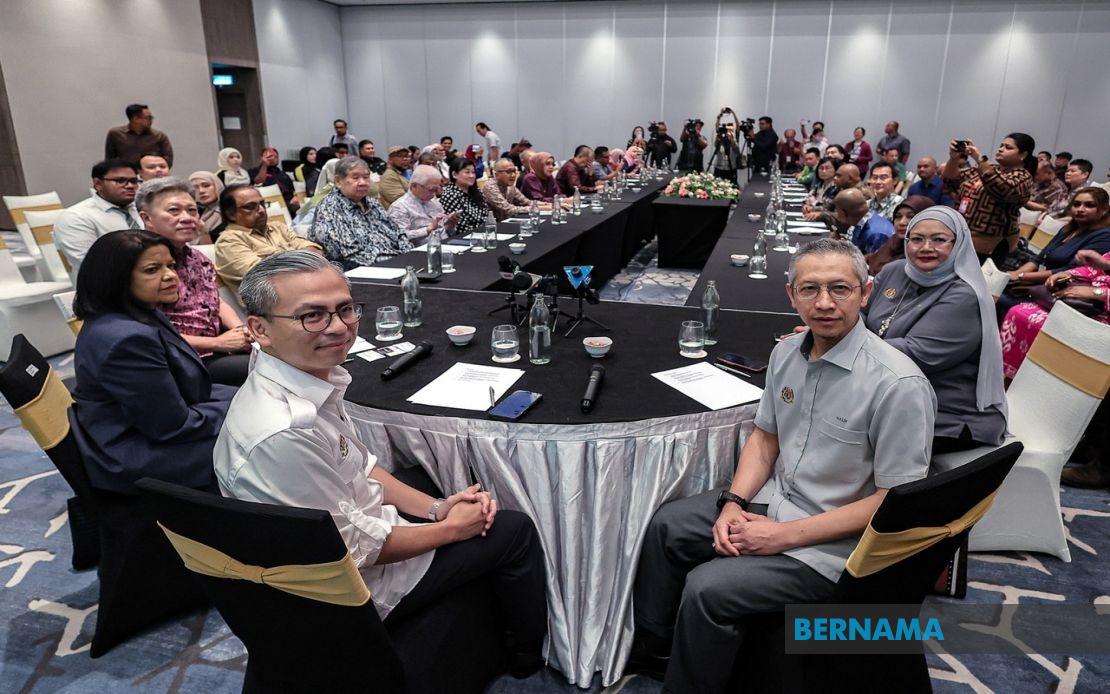
Communications Minister Datuk Fahmi Fadzil has introduced an initiative to institutionalise structured dialogue between government and the media industry by proposing that retreat sessions be incorporated into every future National Journalists' Day (HAWANA) celebration. The proposal emerged following a nearly two-hour engagement session held in Butterworth during HAWANA 2026, where Fahmi outlined his vision for sustained communication between the government and media practitioners on matters of mutual concern.
The proposed retreat framework would operate under a collaborative arrangement whereby the Communications Ministry requests the Malaysian Media Council to assume responsibility for coordination and logistical implementation. This structural approach distributes the organisational burden while ensuring that the sessions maintain consistency and credibility within the industry. By delegating management responsibilities to the MMC, the government signals confidence in the council's ability to serve as an impartial intermediary between public sector interests and media concerns.
Fahmi emphasised that these retreat sessions would function as dedicated forums for gathering substantive feedback, insights, and concrete policy proposals from industry stakeholders. The sessions are intended to be vehicles for media organisations to communicate their priorities and concerns directly to government decision-makers, with particular emphasis on structural issues affecting the sector. This two-way engagement mechanism represents a shift toward more systematic solicitation of industry perspectives in the policymaking process.
The scope of issues to be addressed through these sessions extends to legislative and regulatory domains. Fahmi indicated that feedback could encompass policy-level matters, proposed amendments to existing legislation, and regulatory frameworks governing media operations. By explicitly inviting proposals regarding amendments to acts and laws, the government appears to acknowledge that existing legal structures may require periodic review and refinement to remain responsive to evolving industry realities and technological change.
A central concern motivating the initiative is the financial sustainability crisis confronting mainstream media outlets. Fahmi identified a critical economic challenge whereby traditional media organisations produce substantial content that circulates across social media platforms without generating corresponding revenue. This content asymmetry—where platforms benefit from media-generated content while media companies absorb production costs—has become a structural impediment to industry viability. The issue reflects a broader Southeast Asian challenge affecting both established and emerging media markets.
In addressing this economic dimension, Fahmi committed to government facilitation of negotiations between Malaysian media organisations and social media platforms. Rather than imposing unilateral regulatory solutions, the government has positioned itself as an intermediary willing to support industry-led discussions with technology companies. This approach acknowledges the transnational nature of digital platforms while respecting the commercial relationships between local media and global technology firms.
The dialogue session featured extensive participation from both government and media sector representatives, underscoring the event's significance as a forum for high-level engagement. Attendees included Communications Ministry secretary-general Datuk Abdul Halim Hamzah, deputy secretary-general Datuk Bahria Mohd Tamil, Malaysian National News Agency chairman Datuk Seri Wong Chun Wai, Bernama chief executive Datin Paduka Nur-ul Afida Kamaludin, MMC chairman Tan Sri Nallini Pathmanathan, and senior management representatives from major local media organisations. The breadth of participation reflects the gravity with which both sectors view the sustainability question.
The timing of this initiative proves particularly significant given the broader regional context. Southeast Asian media industries face mounting pressures from digital disruption, advertiser migration to digital platforms, and structural challenges to traditional business models. Malaysia's experience parallels developments across the region, where established media outlets struggle to maintain financial viability while competing for audience attention and advertising resources with technology companies that function as distribution platforms.
Fahmi's proposal also signals government awareness of the media industry's importance to public discourse and democratic functioning. By institutionalising regular dialogue and explicitly inviting policy recommendations, the administration demonstrates recognition that media health constitutes a public interest consideration extending beyond purely commercial concerns. This framing positions media sustainability as linked to broader governance objectives rather than treating it solely as a private sector commercial matter.
The proposed retreat mechanism could establish important precedent for sector-specific government engagement beyond media. If successfully implemented, the model might inform similar periodic dialogue initiatives with other critical industries facing sustainability challenges or requiring legislative updates. The emphasis on formalised feedback channels and structured policy input from affected stakeholders reflects evolving best practices in consultative governance.
For Malaysian media organisations, the proposed arrangement offers both opportunities and considerations. While regular government engagement creates channels for advocating industry-specific policy needs, it simultaneously requires clarity regarding government expectations and the extent to which policy modifications align with genuine industry priorities versus government preferences. The success of these retreats will depend on whether participants perceive them as genuine consultation forums or primarily as platforms for government to communicate predetermined positions.
The proposal also reflects implicit recognition that media regulation in Malaysia requires modernisation to address digital-age challenges that existing frameworks may not adequately address. Questions regarding content liability, platform responsibilities, data protection, and revenue-sharing mechanisms between content creators and distributors increasingly require legislative or regulatory attention. By inviting comprehensive policy proposals, the government appears to acknowledge that traditional regulatory approaches may require substantial revision.
Looking forward, the effectiveness of these retreat sessions will likely determine whether they become genuinely influential in shaping media policy or remain primarily ceremonial. Industry stakeholders will closely observe whether government subsequently acts upon substantive proposals emerging from these forums, particularly regarding the contentious issue of fair revenue arrangements with social media platforms. The establishment of this mechanism represents a beginning point for more structured sector dialogue, but its long-term impact depends on demonstrable government responsiveness to industry input and tangible policy outcomes.