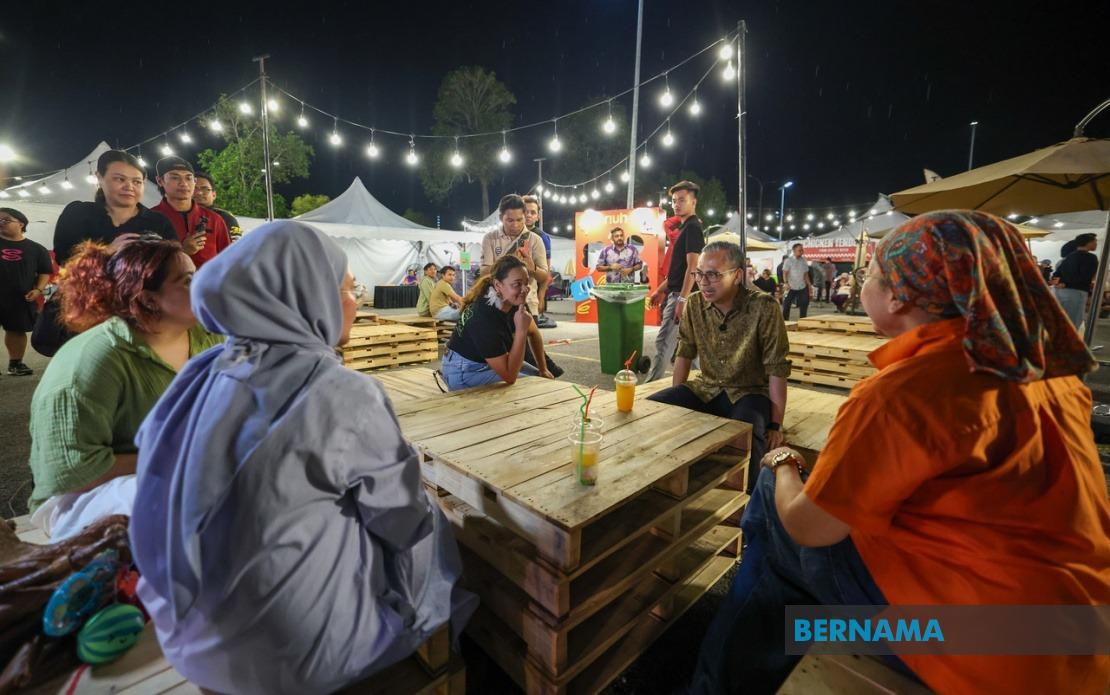
Communications Minister Datuk Fahmi Fadzil has expressed strong satisfaction with the public reception of the RIUH Pi HAWANA carnival, highlighting its role as a vital platform for amplifying Malaysia's creative community and grassroots entrepreneurship. Speaking during a visit to the event held at the PICCA Convention Centre @ Butterworth Arena in Penang, Fahmi commended organisers for orchestrating a programme that seamlessly blended entertainment, commerce, and cultural celebration in conjunction with National Journalists' Day (HAWANA) 2026.
The carnival has struck an effective balance between honouring journalism's importance and providing emerging creative professionals with meaningful exposure to audiences across generations. Fahmi's remarks underscore the Communications Ministry's broader commitment to nurturing Malaysia's creative economy, a sector increasingly recognised as integral to the nation's economic diversification beyond traditional industries. His emphasis on the event's ability to bridge veteran performers with younger talents reflects growing policy attention to mentorship and intergenerational knowledge transfer within Malaysia's cultural industries.
The programming strategy has proven particularly successful in drawing crowds to Butterworth, a location strategically positioned to capture visitors from Penang's growing urban centres. The carnival features eighteen live performances spanning established acts including Exists and Bunkface alongside emerging artists such as Sakura Band, Fugo, Budak Nakal Hujung Simpang, and Chelsia Ng. This curated mix demonstrates conscious programming designed to appeal to diverse demographic groups, from nostalgic attendees seeking familiar performers to younger visitors discovering fresh creative voices.
Beyond the performance component, the carnival's commercial dimension speaks to the event's comprehensive approach to supporting Malaysia's creator economy. The gathering brings together more than twenty-four locally-based creative brands alongside twenty food and beverage vendors, transforming the carnival into a marketplace where entrepreneurs can directly engage consumers and build brand loyalty. For many small and medium-sized creative enterprises in Malaysia, such high-traffic events remain among the most cost-effective channels for expanding customer bases and securing immediate revenue.
The interactive workshop element distinguishes RIUH Pi HAWANA from conventional festivals, actively inviting visitors to participate in creative activities rather than passively consuming performances and shopping. These hands-on sessions lower barriers to creative participation, particularly for individuals who might otherwise perceive artistic pursuits as inaccessible or requiring specialised skills. For Malaysia's creative sector, such democratisation initiatives matter considerably as the nation seeks to broaden participation in cultural production beyond established professional networks.
Fahmi's explicit call for increased public attendance, particularly from Penang residents, carries implicit messaging about government support for creative industries during an economic period when such sectors require sustained promotion. His suggestion that RIUH Pi HAWANA become a recurring fixture alongside future HAWANA celebrations indicates potential institutional support and resource commitment. Should this materialise, the recurring nature of such platforms could significantly enhance predictability for creative professionals and entrepreneurs seeking to plan annual promotional calendars.
The history of HAWANA itself—established in 2018 and coordinated by the Communications Ministry with Bernama as implementing agency—illustrates how government infrastructure can amplify professional celebrations into community-facing cultural events. The evolution from journalists' day commemoration to a multidimensional creative carnival demonstrates adaptive event management and an expanding conceptualisation of how government ministries engage public constituencies.
From a Southeast Asian perspective, Malaysia's approach to elevating creative entrepreneurship through government-backed events reflects regional trends toward elevating soft power through cultural channels. Countries across the region increasingly recognise that creative economies generate employment, enhance international cultural influence, and provide alternative development pathways for communities seeking alternatives to manufacturing or service sector employment. Malaysia's positioning of creative brands and performers at governmental events signals that such activities carry national importance rather than existing as peripheral cultural pursuits.
The carnival's Penang location further reflects considered geographic distribution of cultural opportunities beyond Kuala Lumpur's dominant position in Malaysia's entertainment ecosystem. Butterworth-based programming potentially energises communities in northern Malaysian states while demonstrating that creative industries development need not remain centralised. This geographic dispersal strategy holds implications for talent retention, as aspiring performers and entrepreneurs in peripheral regions gain evidence that viable professional pathways exist locally rather than requiring migration to the capital.
For visitors and participating vendors alike, the carnival represents convergence of leisure, commercial opportunity, and cultural participation. The event's span through Sunday provides extended opportunity windows for working professionals and families balancing entertainment attendance with other weekend commitments. Such extended durations, common in contemporary festival design, reflect understanding of modern consumption patterns where single-day visits may not accommodate all interested participants.
Looking forward, ministerial endorsements such as Fahmi's carry weight in determining whether RIUH Pi HAWANA achieves sustainability as an institutional event or remains a one-off celebration. Government blessing translates into potential budget allocations, promotional support through official channels, and institutional coordination that proves difficult for purely private or non-governmental event organisers to replicate. For MyCreative Ventures, the organising entity, such high-level validation provides foundation upon which to build arguments for expanded editions in subsequent years.
The carnival ultimately exemplifies how governments can facilitate rather than direct creative development, creating infrastructure and platforms while allowing organic creative expression to flourish. This approach—distinct from state-mandated cultural production or heavily curated artistic programming—appears increasingly attractive to Malaysian policymakers recognising that grassroots creativity often generates more authentic resonance with diverse audiences than centrally-planned cultural initiatives. Fahmi's satisfaction with the carnival's early performance may consequently influence how future HAWANA events incorporate and expand creative industry components.