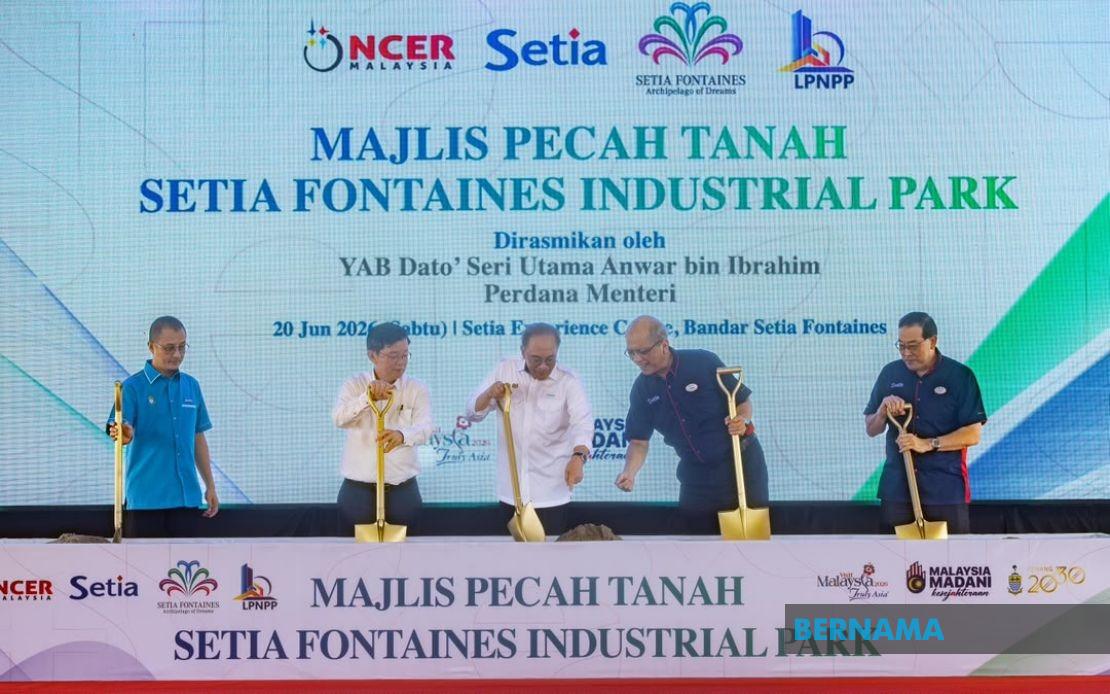
Prime Minister Datuk Seri Anwar Ibrahim has called for a fundamental shift in how Malaysia approaches development, insisting that rapid economic growth must translate into tangible opportunities for those earning middle and lower incomes. Speaking at the groundbreaking ceremony for the Setia Fontaines Industrial Park in Bandar Setia Fontaines on June 20, Anwar warned that without deliberate inclusion strategies, investment-driven expansion would exacerbate inequality and leave millions further behind.
The Prime Minister's remarks reflect mounting pressure within government circles to demonstrate that Malaysia's development agenda serves the broader population rather than concentrating wealth among specific groups. Anwar specifically named major institutional investors—Khazanah Nasional Berhad, Permodalan Nasional Berhad, and the Employees Provident Fund—alongside private companies, signalling that expectations for inclusive growth apply equally to state-owned enterprises and commercial entities. This framing suggests the government intends to use its policy levers and ownership stakes to enforce compliance with equity principles across the investment landscape.
Anwar's emphasis on distributional outcomes rather than headline growth figures represents a recalibration of how economic success is measured in Malaysia. He explicitly rejected the notion that strong investment inflows and favourable macroeconomic indicators constitute sufficient achievement if those gains bypass ordinary workers and small entrepreneurs. This perspective acknowledges a persistent frustration among Malaysians that GDP growth, foreign direct investment, and corporate earnings have not consistently translated into improved living standards or expanded pathways to prosperity for the majority. By framing development approval as conditional on demonstrating inclusive benefits, Anwar signalled the government's intent to embed equity considerations into project vetting processes.
The Setia Fontaines Industrial Park exemplifies the type of initiative Anwar wishes to position as a model for inclusive growth. Located in Seberang Perai, the project addresses a long-standing regional imbalance whereby development has concentrated on Penang Island and the southern districts while mainland Seberang Perai has lagged comparatively. By anchoring industrial capacity and employment opportunities on the mainland, the government aims to distribute economic dynamism more evenly across Penang state, reducing migratory pressures and strengthening communities that have experienced slower advancement.
Crucially, Anwar tied the park's potential to Malaysia's broader industrial transformation. As the nation attempts to transition from low-value assembly and back-end manufacturing toward higher-technology production, the quality and availability of skilled labour will determine competitiveness. Anwar stressed that opportunities must extend beyond semi-skilled factory roles to encompass professional and technical positions, underscoring that inclusive growth requires upgrading human capital systematically. This framing positions workforce development not as a marginal concern but as central to Malaysia's economic future and the equitable distribution of prosperity.
The Prime Minister highlighted a critical mismatch between job creation and worker readiness. Malaysia can generate employment openings in emerging sectors, but these positions remain inaccessible to those lacking requisite qualifications and technical competencies. Anwar identified accelerating technological change as a complicating factor—industry standards and skill requirements evolve within months or years, rendering static educational curricula obsolete. This observation underscores why collaboration between industrial employers, technical and vocational education institutions, and universities including Universiti Sains Malaysia must deepen and operate in real time, ensuring training programmes anticipate rather than lag industry demand.
The government's emphasis on vocational and technical training reflects both pragmatism and an implicit acknowledgment that Malaysia cannot rely solely on conventional university education to equip workers for modern employment. Vocational pathways offer speedier transitions to the workforce and can be calibrated closely to employer requirements. By elevating technical education's status and integrating it with industrial planning, Malaysia hopes to create talent pipelines matching the economy's transformation, thereby broadening opportunities for middle and lower-income individuals to access better-paying, more stable employment.
Anwar's insistence on equitable development also resonates with emerging demographic and political dynamics. As regional inequality and perceptions of unfair distribution fuel social discontent, political leaders recognise that legitimacy increasingly depends on demonstrating tangible improvements in ordinary citizens' circumstances. The Prime Minister's repeated messaging that every approved project must benefit broader society serves partly as reassurance to working Malaysians that their interests remain central to policymaking, even as billion-ringgit megaprojects dominate headlines.
The challenge facing Malaysia, however, is translating Anwar's aspirations into consistent implementation across hundreds of development and investment decisions annually. Government-linked companies and private firms often prioritise shareholder returns and operational efficiency over distributional equity, creating structural tensions with inclusivity mandates. Without robust monitoring, enforcement mechanisms, and incentive alignment, declarations of commitment to equitable growth risk remaining rhetorical. The government's task involves constructing institutional frameworks that make inclusive outcomes financially rational for project developers rather than merely morally preferable.
Moreover, Anwar's framework assumes that development projects can be designed to simultaneously maximise returns and distribute benefits widely—a proposition not universally guaranteed. Trade-offs between profitability and inclusion inevitably arise, forcing choices about which constituencies receive priority. The extent to which government-linked entities will subordinate financial performance to social objectives, and whether private companies will absorb higher costs voluntarily or only under regulatory pressure, remains uncertain. These tensions will likely shape Malaysia's progress toward the more equitable development model Anwar has articulated.