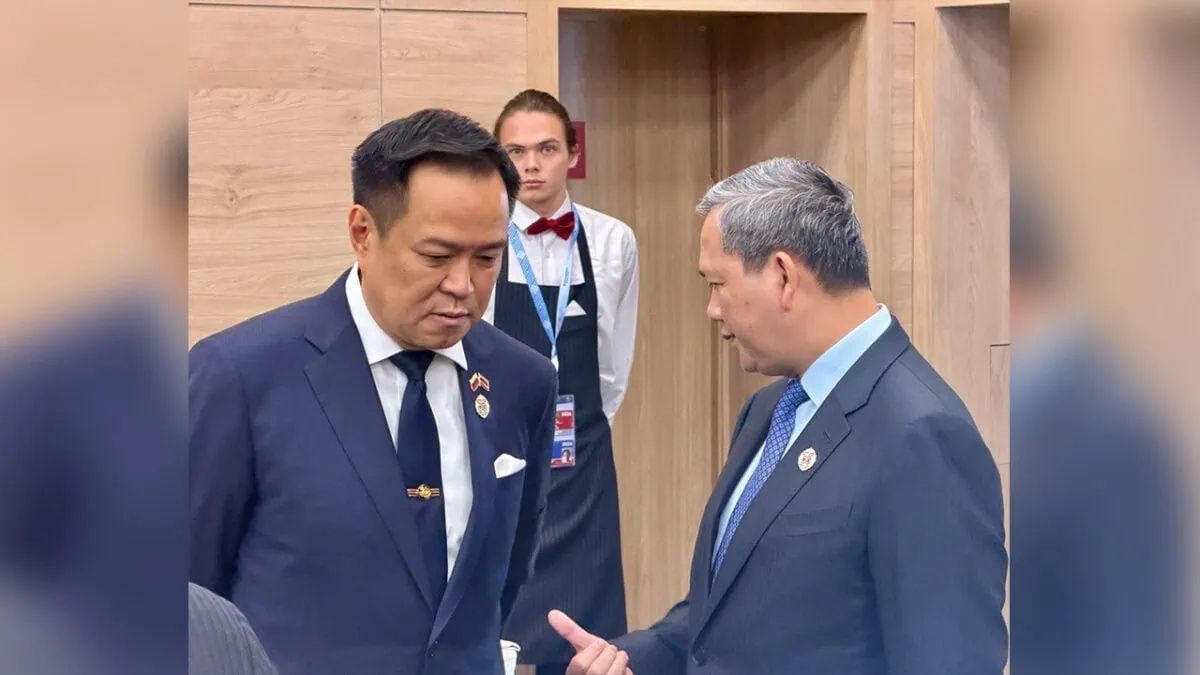
Cambodian Prime Minister Hun Manet has pressed Thailand to move forward with appointing leadership for the Joint Boundary Commission and launching overdue border demarcation activities, while reiterating his country's dedication to resolving territorial disagreements through lawful diplomatic processes. The two Southeast Asian leaders discussed the matter during an informal meeting at the sidelines of an Asean-Russia summit held in Kazan, Russia, a setting that provided space for candid bilateral exchange on this sensitive matter affecting both nations.
The conversation between Manet and Thai Prime Minister Anutin Charnvirakul, which took place on the margins of the Kazan gathering, highlighted a carefully calibrated diplomatic position from Phnom Penh. In remarks posted on social media following the Friday encounter, Manet articulated Cambodia's continued preference for bilateral engagement through established institutional frameworks rather than through escalatory measures. He specifically referenced Point Three of a joint statement signed on December 27, 2025, which appears to establish concrete commitments regarding the timing and methodology for conducting boundary surveys and demarcation exercises.
Cambodia's strategy reflects a two-pronged approach to managing its territorial disputes with Bangkok. For maritime boundary disagreements, Phnom Penh is pursuing compulsory conciliation proceedings under the UN Convention on the Law of the Sea, a mechanism both nations have already activated. This formal international legal track operates in parallel with more traditional bilateral negotiations, providing Cambodia with leverage and an alternative pathway should direct discussions stall. However, for terrestrial border matters, Manet has consistently championed the Joint Boundary Commission as the appropriate venue for resolution, indicating Cambodia's preference for keeping land disputes within bilateral channels rather than internationalizing them through multilateral forums.
The Cambodian leader's public statement emphasised that discussions concerning the reopening of land border checkpoints remain premature at this stage, a position that underscores the technical nature of current negotiations. Such clarification likely aims to manage expectations within Cambodia and forestall speculation that substantive resolution of territorial claims may be imminent. The emphasis on procedural advancement rather than immediate political settlement reflects pragmatic recognition that boundary demarcation is inherently lengthy and complex work requiring meticulous survey work and mutual agreement on contested areas.
Thailand's account of the Kazan exchange largely aligned with Cambodia's public narrative, though Bangkok's perspective carried subtly different emphases. Prime Minister Anutin characterised the encounter as a brief, informal exchange necessitated by limited time availability at the multilateral conference. His colourful description of the interaction as merely "pulling each other aside by the elbow" conveyed the informal, impromptu nature of the discussion, distinguishing it from scheduled high-level bilateral meetings that might generate more formal outcomes. Anutin's lighthearted description underscores how border diplomacy between these two neighbouring nations must be carefully balanced against domestic political sensitivities in both countries.
Anutin's response to questions about border checkpoint reopening proved particularly revealing of domestic political constraints in Thailand. When queried whether the topic had surfaced during his discussion with Hun Manet, the Thai Prime Minister reportedly declined to engage seriously with the question, remarking that raising such matters would provoke significant public disapproval within Thailand. This candid acknowledgement of domestic political limits illustrates how border management in Southeast Asia operates within distinct national contexts where public opinion, historical memory, and competing constituencies all shape diplomatic manoeuvre room.
Despite differing rhetorical emphases, both leaders aligned in affirming commitment to international and bilateral legal frameworks governing boundary disputes. Thailand reiterated its adherence to UNCLOS, the JBC, and the General Border Committee, demonstrating comprehensive engagement across multiple institutional mechanisms designed to manage territorial disagreements. The parallelism of both nations invoking these same structures suggests genuine convergence around the principle that disputes should be resolved through established channels rather than unilateral action or confrontation. Neither leader's statements contained inflammatory language or ultimatums, instead reinforcing messages about mutual desire to avoid conflict.
The Cambodia-Thailand border has long represented one of Southeast Asia's more complex territorial issues, with overlapping claims in both maritime and terrestrial zones reflecting historical ambiguities in colonial-era delimitation agreements and subsequent interpretation disputes. The region's significance extends beyond bilateral concerns, as stability along this frontier affects broader regional security architecture and the credibility of Asean's commitment to peaceful dispute resolution. For Malaysian readers and others across Southeast Asia, how Phnom Penh and Bangkok manage their boundary disagreements carries implications for confidence in regional conflict management mechanisms and demonstrates whether established diplomatic frameworks can effectively resolve disputes between neighbouring nations.
Cambodia's emphasis on acceleration of JBC work appears driven by recognition that prolonged demarcation delays perpetuate ambiguity and create opportunities for bilateral tensions to escalate. By publicly pressing Thailand to complete its institutional obligations—particularly the appointment of a JBC chief—Hun Manet establishes a clear record of Cambodia's commitment to progress while creating diplomatic pressure for reciprocal Thai action. This approach allows Cambodia to demonstrate proactivity without abandoning its preference for bilateral mechanisms, a delicate balance essential for maintaining domestic political support while advancing substantive boundary resolution.
The December 2025 joint statement referenced by Manet appears to represent a significant diplomatic agreement establishing concrete timelines and procedures for boundary work, though the original source material provides limited detail regarding its full contents or implementation schedule. The fact that both leaders are publicly referencing specific commitments from this agreement suggests it carries genuine binding force within their respective governments, though ensuring its implementation amid competing domestic priorities and periodic diplomatic tensions remains an ongoing challenge. Cambodia's public reminder of these commitments serves partly as diplomatic accountability mechanism, creating external pressure for compliance.
Looking forward, the success of Cambodia-Thailand border diplomacy will depend on whether both nations can maintain momentum on technical demarcation work despite periodic political tensions or shifts in domestic leadership priorities. The JBC mechanism, while useful, requires consistent high-level political support and adequate resource allocation to advance surveys in challenging terrain. Regional observers will watch whether Thailand's appointment of a JBC chief materialises in coming months, as this administrative action represents the most concrete deliverable from the Kazan discussion and will signal both nations' genuine commitment to advancing boundary resolution. The willingness of both Phnom Penh and Bangkok to maintain dialogue through multilateral settings like the Asean-Russia summit demonstrates awareness that border stability serves broader regional interests beyond immediate bilateral concerns.