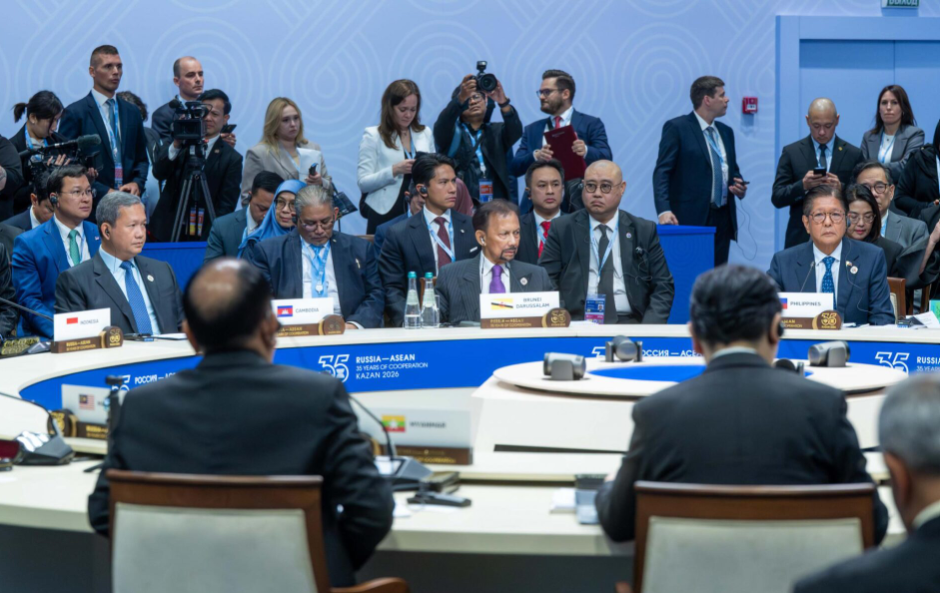
Sultan Hassanal Bolkiah represented Brunei at the Asean-Russia Commemorative Summit held in Kazan, Russia on Thursday, June 18, where he delivered remarks underscoring the enduring significance of the partnership between the ten-member regional bloc and Moscow. The event, hosted at the Kazan Expo International Exhibition Centre, brought together Southeast Asian leaders and Russian officials to mark 35 years of formal dialogue relations. Accompanying the Brunei monarch was Minister of Foreign Affairs Prince 'Abdul Mateen, reflecting the high-level commitment both Brunei and the broader Asean community place on this engagement.
In his address, the Sultan expressed gratitude to Russian President Vladimir Putin for the cordial reception extended to the Asean delegation, whilst also acknowledging the hospitality of the Republic of Tatarstan government and the people of Kazan. The visit provided an opportunity for regional leaders to reaffirm their commitment to strengthening ties with Russia at a time when geopolitical realignments are reshaping international relations. The Sultan further conveyed the Asean leaders' sympathies regarding the death of Thailand's Princess Bajrakitiyabha, offering condolences to Thai Prime Minister Anutin Charnvirakul.
Central to the Sultan's remarks was a reflection on the trajectory of Asean-Russia relations over the past three and a half decades. He characterised the partnership as having demonstrated considerable resilience whilst growing in importance despite sweeping transformations in the global order. The dialogue partnership, initially established to facilitate communication between two distinct geopolitical spheres, has evolved into a multifaceted engagement spanning economic, security and cultural domains. According to the Sultan, collaborative efforts have produced measurable returns for both sides, particularly through the expansion of cooperation across all three pillars of the Asean Community framework—the political-security, economic, and socio-cultural dimensions.
The Sultan stressed that deepening Asean-Russia cooperation carries particular relevance as Southeast Asia charts its course through an increasingly complex international landscape. Asean's Vision 2045 agenda, which outlines the bloc's aspirations for greater regional integration and centrality in global affairs, hinges substantially on partnerships with major powers including Russia. The Sultan identified several pressing challenges requiring collaborative solutions, notably escalating political tensions between major powers, fragmentation of economic systems, the accelerating impact of climate change, and the disruptive potential of rapid technological advancement. These multifaceted pressures necessitate a coordinated response drawing on the diplomatic experience and resources of diverse partners.
Energy security emerged as a particularly salient concern in the Sultan's framing of Asean-Russia cooperation. For Southeast Asia, energy supply reliability constitutes a fundamental pillar of economic stability and development, given the region's dependence on global energy markets. Russia's significant oil and gas reserves and its established role as a major energy exporter position it as a natural partner for Asean nations seeking to diversify energy sources and secure long-term supply arrangements. Complementing energy cooperation, food security represents another domain where Asean-Russia collaboration offers mutual benefit, particularly as climate disruptions increasingly threaten agricultural productivity across both regions.
The Sultan further emphasised the role of Asean-Russia cooperation in addressing non-traditional security challenges that transcend conventional state boundaries. Disaster management capacity-building, climate action initiatives, and responses to transnational threats have become central preoccupations for Southeast Asian policymakers. Russia's experience managing large territories and diverse populations, combined with its technological capabilities in areas such as early warning systems and resource management, complements Asean's own initiatives in building regional resilience. The Sultan portrayed such collaboration not as charity or strategic manoeuvre, but as pragmatic cooperation serving mutual interests in an interdependent world.
Recognising that sustained partnership depends ultimately on generations of leaders and professionals with shared understanding and commitment, the Sultan highlighted the importance of human capital development through education, academic exchanges and training programmes. These initiatives, he argued, equip future policymakers, business leaders and technical professionals with the knowledge networks and cross-cultural competencies essential for navigating future challenges collaboratively. By investing in people-to-people connections, Asean and Russia build social foundations that transcend the vagaries of diplomatic cycles, creating constituencies in both regions with vested interests in deepening ties.
The commemorative summit produced four substantive outcome documents reflecting the breadth of Asean-Russia engagement. The Kazan Declaration 2026 served as the summit's principal political statement, articulating the theme of unity amid diversity and anchoring the relationship in three and a half decades of accumulated trust. More operationally focused was the Comprehensive Plan of Action to Implement the Asean-Russian Federation Strategic Partnership covering 2026 to 2030, providing a roadmap for concrete cooperation in the medium term. Separate joint statements on energy cooperation and cultural cooperation respectively addressed two domains of particular strategic significance, reflecting recognition that enduring partnerships require engagement across multiple sectors rather than reliance on security dimensions alone.
The summit's second plenary session, convened as a working lunch and themed around "Integration Processes in Eurasia," broadened the discussion beyond bilateral Asean-Russia relations to situate this partnership within wider regional architecture. Remarks from the Asean Secretary-General alongside officials from the Shanghai Cooperation Organisation and the Eurasian Economic Commission highlighted the interconnectedness of regional integration projects across Eurasia. For Southeast Asian leaders, participation in such discussions positions Asean as an integral actor in transcontinental patterns rather than a peripheral observer. The Sultan and his counterparts also received updates on the outcomes of the Asean-Russia Business Forum, held on June 17 as an adjacent event, indicating the summit's success in mobilising both governmental and commercial constituencies behind deepened engagement.
For Malaysia and other Southeast Asian nations, the Kazan summit signals renewed institutional commitment to cultivating the Asean-Russia relationship at a time when regional states navigate tensions between major power competition and the imperative of maintaining autonomous strategic space. Brunei's active participation and the Sultan's substantive contributions reflect how smaller Asean members utilise bloc mechanisms to engage major powers. The outcomes achieved—particularly the strategic partnership framework extending to 2030—establish scaffolding for sustained cooperation across energy, climate, security and people-to-people domains that hold direct relevance for Malaysian interests and Southeast Asian development trajectories. As geopolitical fragmentation accelerates globally, Asean's cultivation of partnerships spanning divergent power centres remains central to its strategy of defending regional autonomy and prosperity.