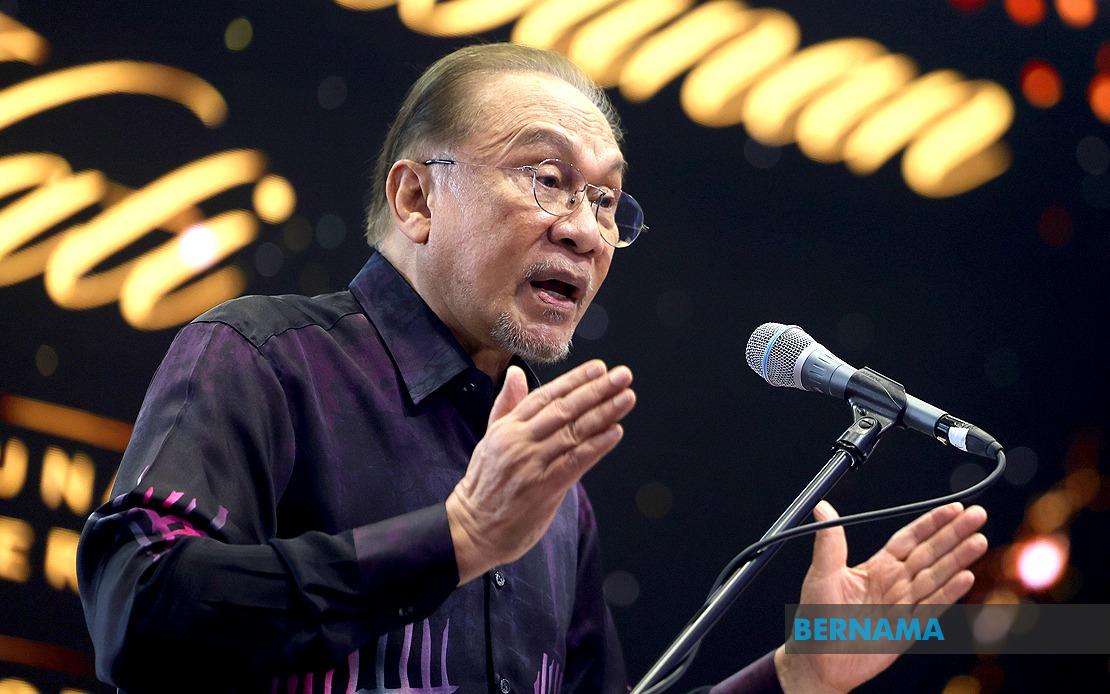
Prime Minister Datuk Seri Anwar Ibrahim delivered an impassioned appeal at a gathering in Seremban on June 20, urging citizens across all ethnic backgrounds to defend the nation's foundational commitment to unity while rejecting attempts by political figures to sow discord along communal lines. Speaking before more than 1,000 members of Pertubuhan Lima Generasi (PLG) Malaysia at a dinner event, Anwar identified the deliberate cultivation of ethnic resentment as a threat that transcends individual grievances and strikes at the heart of Malaysia's national cohesion.
The prime minister's remarks come at a time when Malaysia continues to grapple with periodic flare-ups of communal tension and polarizing rhetoric from various quarters. Anwar framed the challenge not as an inevitable consequence of diversity but as the result of calculated political strategy by specific leaders seeking to exploit existing sensitivities for narrow advantage. By naming the tactic explicitly—pitting Malays against Chinese, Chinese against Indians, and Indians against Malays—Anwar sought to expose the manipulative nature of such campaigns and appeal to citizens' higher instincts.
Central to Anwar's message was the assertion that Malaysia's ethnic composition, far from being a liability, constitutes one of the nation's most valuable assets. This framing represents a conscious choice to emphasize the positive-sum nature of multiethnic coexistence rather than treating diversity as inherently fraught or requiring constant management. Anwar argued that this potential could only be realised through deliberate cultivation of mutual understanding and genuine cooperation between communities, suggesting that unity requires active engagement rather than passive acceptance.
The invocation of multiple ethnic groups—Malays, Chinese, Indians, Kadazans, and others—served to reinforce the breadth of Malaysia's demographic tapestry and to counteract the reductive binary framings that divisive politicians often employ. By explicitly naming indigenous communities alongside other groups, Anwar also acknowledged the complexity of Malaysia's ethnic landscape beyond the Malay-Chinese-Indian triad that dominates public discourse. This inclusive enumeration carries particular resonance in Peninsular Malaysia and Sabah-Sarawak relations, where East Malaysian communities have occasionally felt sidelined in national conversations.
The timing and venue of the address warrant consideration. Seremban, located in Negeri Sembilan, is a state where multiethnic cooperation has historically been central to political stability. The presence of Negeri Sembilan Menteri Besar Datuk Seri Aminuddin Harun alongside the prime minister underscored government alignment on this message at both federal and state levels. The gathering of over 1,000 PLG members, presumably representing a cross-section of Malaysian society motivated by shared values, provided a receptive audience for appeals to unity and national interest.
For Malaysian policymakers and civil society observers, Anwar's intervention signals continued concern about the durability of social cohesion. The repeated warnings against racial sentiment suggest that such rhetoric remains sufficiently prevalent and influential to warrant direct prime ministerial attention. In the regional context, Malaysia's ability to maintain ethnic peace while managing political competition offers a model that neighbouring countries with their own diversity challenges observe closely. Any significant deterioration in Malaysian communal relations could have reverberations across Southeast Asia.
The challenge facing the government lies not merely in rhetorical opposition to divisive tactics but in addressing the underlying grievances and anxieties that make such rhetoric appealing in the first place. Citizens who feel economically marginalised or culturally threatened become more susceptible to leaders promising to defend their group's interests. Anwar's call for unity thus implicitly acknowledges that sustained social peace requires attention to economic opportunity, equitable development, and genuine inclusion across ethnic lines—not merely exhortations to get along.
The framing of certain leaders as deliberately stoking division also raises questions about accountability and consequences. While Anwar clearly identified the behaviour as reprehensible, he did not specify mechanisms for addressing such rhetoric or whether government institutions would take action against those engaged in divisive campaigns. This gap between moral clarity and concrete response remains a persistent tension in Malaysian politics, where freedom of expression protections and political sensitivities often constrain enforcement.
For Southeast Asian observers, Anwar's emphasis on transcending ethnic boundaries while maintaining cultural identity reflects broader regional debates about the relationship between nationalism and pluralism. Malaysia's model—predicated on explicit constitutional recognition of ethnic communities' rights and interests—differs from approaches emphasizing civic nationalism or cultural assimilation. Yet Anwar's message suggests that even within a framework acknowledging group identities, political actors have choices about whether to emphasise commonalities or amplify differences.
The reception of such appeals among the Malaysian public will likely vary substantially along lines of political affiliation, economic circumstance, and personal experience with intercommunal relations. Those already committed to multiethnic cooperation will find validation in the prime minister's words, while those sceptical of government narratives or nursing deeper grievances may view the address as politically motivated or insufficient. Meaningful progress on unity thus depends less on occasional high-profile statements and more on sustained institutional and political commitment to inclusive policies and fair representation.
Moving forward, the efficacy of Anwar's call will be measured not by applause at Seremban but by concrete government policies addressing inequality, representation in public institutions, and protection against hate speech and discrimination. As Malaysia navigates post-pandemic economic recovery, rising cost of living pressures, and generational political change, maintaining the consensus around ethnic and religious diversity will require both principled leadership and practical commitment to shared prosperity.