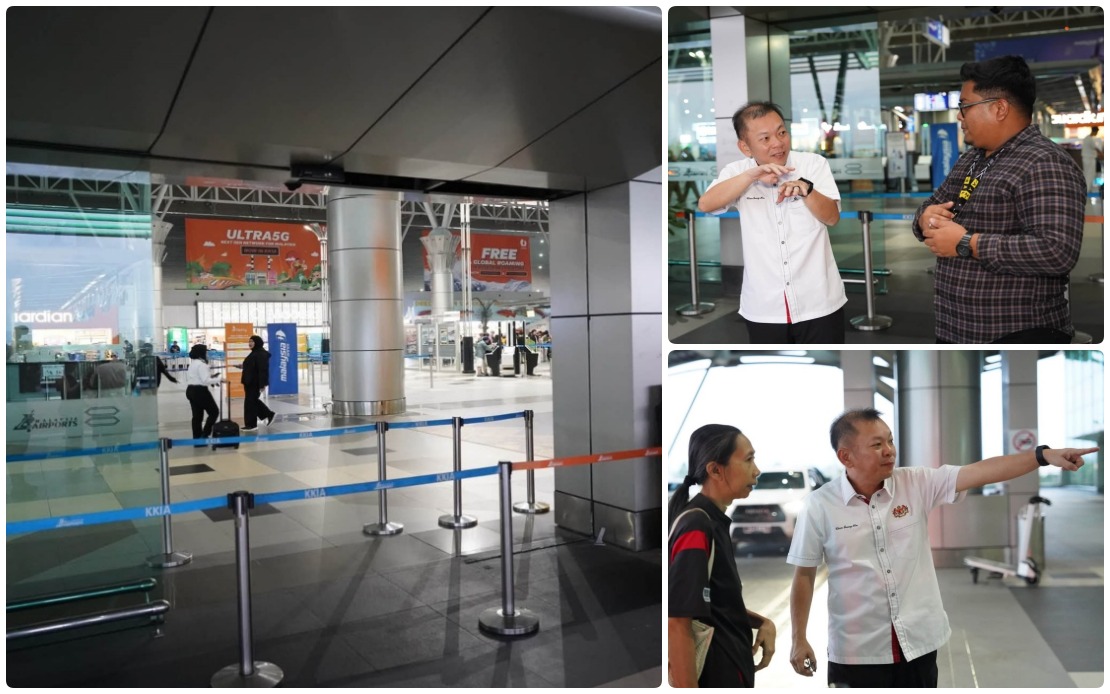
A female driver sustained minor injuries on Wednesday afternoon when the sport utility vehicle she was operating veered out of control and collided with the glass entrance structure serving the departure hall at Kota Kinabalu International Airport. The accident occurred at approximately 4:20 pm on Level 3 of Terminal 1, causing extensive damage to the entrance doors while leaving bystanders and airport personnel unharmed.
The impact shattered the glass door assembly at the terminal's kerbside entrance, with the vehicle's front end sustaining severe structural damage from the collision. Responders from Aviation Security and Customer Service were deployed to the scene within minutes of the incident, immediately providing assistance to the injured driver. She was transported to a nearby medical facility via ambulance for treatment of her injuries, which were assessed as minor by emergency personnel.
Kota Kinabalu District Police Chief ACP Shahrudin Mat Husain confirmed receipt of the report and disclosed that investigators are actively pursuing multiple lines of inquiry to establish the precise circumstances that led to the loss of vehicular control. The police statement did not indicate any preliminary findings regarding mechanical failure, driver error, or other contributing factors, emphasising that the investigation remains ongoing. Such incidents at major transport hubs typically prompt thorough examination of both vehicle condition and operator factors.
Malaysia Airports, the entity responsible for terminal operations, moved swiftly to mitigate disruption to passenger services. The operator's statement confirmed that all operational functions at KKIA continued without interruption, with alternative entrance access remaining available through fully functional automatic doors. The affected area was declared clear by 6:00 pm, with the damaged vehicle and associated debris removed from the departure level. Restoration work on the compromised glass door installation commenced immediately and remains underway.
Deputy Minister of Agriculture and Food Security Datuk Chan Foong Hin, who fortuitously was arriving at the airport during the incident, publicly commended the responsiveness of KKIA management and personnel. In remarks shared via social media, he highlighted the efficiency demonstrated by all parties involved in responding to the emergency and restoring normal passenger flow. His observation underscores the importance of rapid coordination between security personnel, customer service staff, and medical responders in managing airport incidents.
The swift restoration of operations reflects operational resilience at Malaysia's secondary international gateways. KKIA handles substantial passenger volumes serving Sabah's tourism and business sectors, making continuity of service critical during peak travel periods. The availability of redundant entry points and the prioritised clearance of the incident scene both demonstrated preparedness for managing such disruptions without cascading delays.
From a broader perspective, vehicular incidents at airport terminals remain rare but noteworthy occurrences across the Asia-Pacific region. Enhanced safety protocols at departure kerbs typically include barrier systems and traffic management measures designed to prevent uncontrolled vehicle intrusion into passenger processing areas. The Kota Kinabalu incident will likely prompt review of existing safeguards and may inform recommendations for additional protective infrastructure.
The referral of the matter to the Royal Malaysia Police for formal investigation aligns with standard procedures governing accidents at major facilities. The police examination will determine whether factors such as mechanical defect, medical episode affecting the driver, or environmental conditions contributed to the loss of control. Such findings often inform regulatory guidance for vehicle operators and terminal safety planners.
Malaysia Airports' commitment to extending full cooperation to investigating authorities reflects the cooperation expected between private operators and law enforcement in incidents affecting public spaces. The investigation will document the sequence of events and generate findings that feed into industry-wide safety discussions and potential policy refinements. Stakeholders monitoring airport safety standards will assess whether the incident reveals systemic issues or represents an isolated occurrence.
For Malaysian air travellers and the aviation sector, the incident serves as a reminder of the multifaceted safety challenges confronting airport operators beyond conventional aviation concerns. While aircraft operations receive intense regulatory scrutiny, ground-level security and prevention of vehicular mishaps at terminal facilities represent equally important dimensions of passenger and staff protection. The rapid response capability demonstrated at KKIA illustrates how preparedness translates into minimal impact on user experience.

