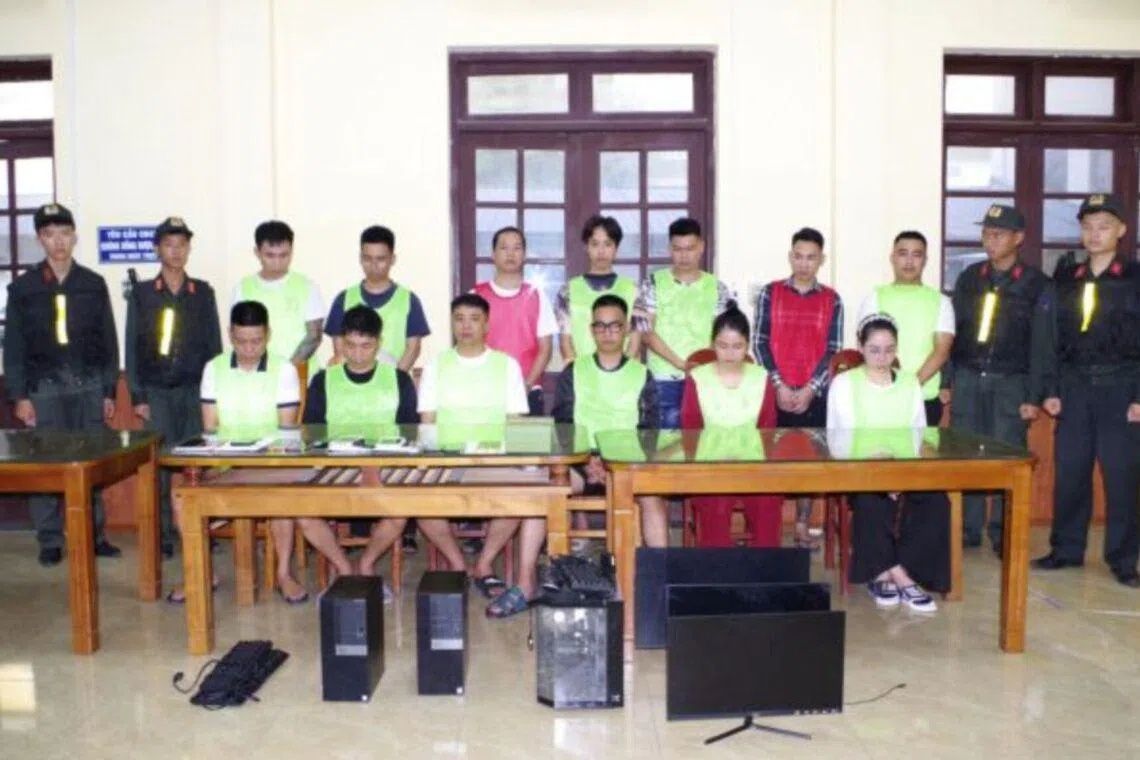
Authorities in Vietnam's northern Ninh Binh province have successfully dismantled a sophisticated transnational cybercrime operation that has caused financial losses surpassing 250 billion dong, equivalent to RM39.2 million. The operation resulted in the arrest of 12 suspects, with investigations into the network ongoing as police work to identify additional members and recover misappropriated funds.
The organised fraud scheme operated across multiple countries, with Vietnamese nationals recruited and transported to Cambodia to execute the scams from foreign territory. This cross-border operational model reflects a troubling trend among Southeast Asian cybercriminals who establish command centres outside their home countries to evade local law enforcement and complicate investigative efforts. The arrangement enabled the group to maintain operational distance while coordinating attacks against victims within Vietnam, a tactic increasingly observed in regional criminal networks targeting financial fraud.
Investigations identified Nguyen Van Cuong, aged 28, and Nguyen Van Phuong, aged 34, as the primary architects and leaders of the criminal enterprise. Their roles suggest a hierarchical structure with clear command authority, indicating sophisticated management of what amounted to a sizable workforce distributed across multiple locations. The network maintained distinct operational divisions, with different members assigned specific functions ranging from victim identification and initial contact to money laundering and account management.
The fraud syndicate employed an arsenal of deceptive techniques designed to exploit psychological vulnerabilities and institutional trust. Members impersonated high-ranking government officials, including police officers, prosecutors, judges, and tax authorities, lending credibility to their fraudulent schemes. The psychological advantage gained through official impersonation cannot be understated—victims naturally comply more readily when believing they are interacting with legitimate state institutions, creating an effective exploitation vector that proved highly successful.
Technological sophistication distinguished this operation from simpler fraud attempts. The group developed counterfeit websites and mobile applications engineered to replicate the digital interfaces of legitimate government agencies and established commercial enterprises. These fake platforms closely mimicked authentic user experiences, making detection difficult for average users unfamiliar with subtle design variations. By combining official impersonation with convincing technological infrastructure, the network significantly increased conversion rates among targeted victims.
The fraud schemes encompassed multiple methodologies, reflecting a diversified portfolio approach to criminal revenue generation. Romance scam components targeted emotionally vulnerable individuals through fabricated relationships, while investment fraud schemes lured victims with promised returns in finance, securities, and cryptocurrency markets. Fake employment recruitment scams offered seemingly legitimate part-time opportunities requiring initial deposits or equipment purchases. Additionally, the network compromised social media accounts to leverage victims' existing social networks, requesting funds from their contacts under false pretences.
One particularly complex fraud variation involved fraudsters posing as military personnel contacting commercial establishments with requests for substantial orders. The perpetrators then manipulated shop owners and business operators into purchasing additional merchandise supposedly on their behalf, requesting advance payments and deposits to be transferred to controlled bank accounts. This variant demonstrates sophisticated social engineering, exploiting commercial trust relationships and the normal business practice of advance payments to facilitate theft.
The investigation revealed that since October 2024, the network had successfully defrauded approximately 500 victims throughout Vietnam, accumulating losses totalling more than 250 billion dong. This victim count and financial scale underscore the operation's significant reach and effectiveness, suggesting that many additional unreported victims may exist who either successfully recovered funds, avoided recognising themselves as victims, or remained unaware of the fraud. The timeline also indicates the network's relatively recent establishment, yet its rapid accumulation of victims points to highly effective targeting and conversion mechanisms.
Law enforcement response has involved charging six of the arrested suspects with fraudulent appropriation of property, with these individuals placed in temporary detention pending trial proceedings. The remaining six suspects face procedural measures as investigations continue to establish their specific roles and culpability within the hierarchical structure. This differentiated charging strategy suggests investigators have identified varying degrees of participation and responsibility among network members, likely reserving more serious charges for those with direct involvement in fraud execution versus those in supporting roles.
Police authorities are actively pursuing expansion of the investigation to locate additional network members who remain at large. Given the transnational nature of the operation and the involvement of Cambodia as a base of operations, coordination with Cambodian authorities will likely prove essential for apprehending suspects who have remained in that country. Such international cooperation represents a critical evolution in Southeast Asian law enforcement responses to organised cybercrime, recognising that regional stability and security depend on coordinated cross-border action.
Asset seizure and account freezing operations form a parallel track to criminal prosecution, with authorities moving to recover stolen funds and prevent further dissipation of criminal proceeds. This financial remediation approach directly benefits affected victims and removes financial incentives for ongoing criminal operation. The recovery effort's success depends on identifying all accounts and holdings under the suspects' control, including potentially concealed assets held through intermediaries or converted into cryptocurrency or physical valuables such as jewellery and vehicles.
The case underscores persistent vulnerabilities in cybersecurity practices among Southeast Asian populations and the increasingly sophisticated tactics deployed by transnational criminal networks. Malaysian readers should recognise that similar fraud operations targeting Malaysian citizens may operate from neighbouring countries using comparable methodologies. Heightened consumer awareness regarding official impersonation, technological sophistication in fake platforms, and the fundamental principle that legitimate government agencies never request bank transfers through unofficial channels remain essential protective measures.

