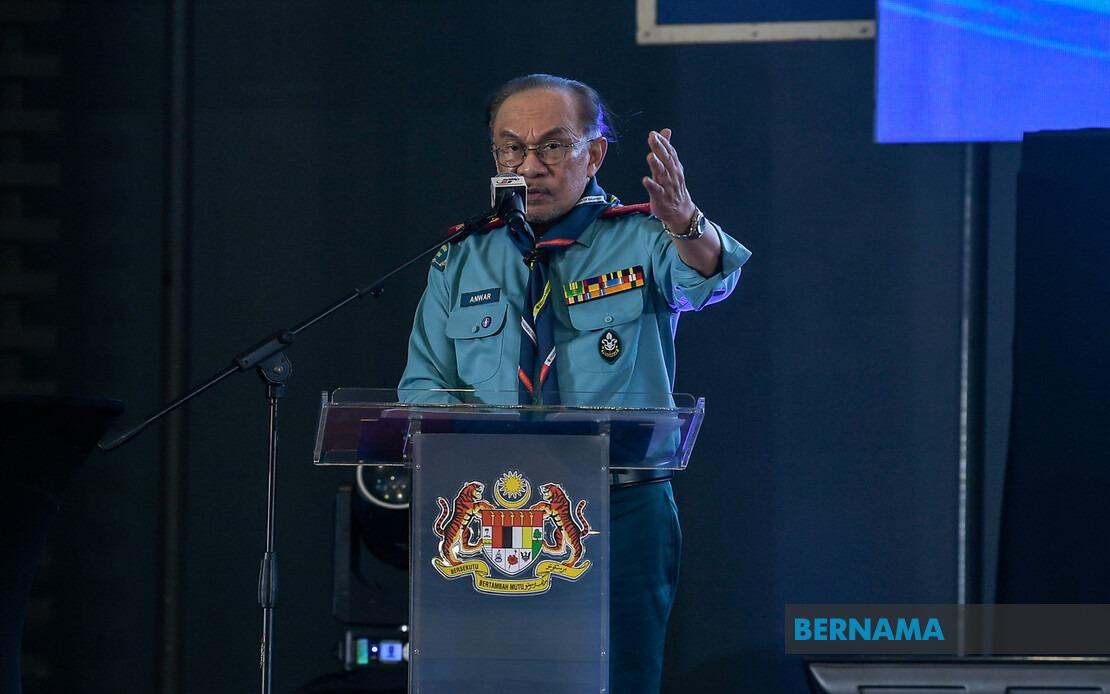
Prime Minister Datuk Seri Anwar Ibrahim has clarified that Malaysia's commitment to reinforcing Malay as the national language represents a complementary rather than competitive approach to linguistic development. Addressing an audience at Universiti Teknologi MARA (UiTM) Permatang Pauh during the Ambang Merdeka Sahabat MADANI 2026 programme, Anwar rejected the notion that elevating Malay proficiency necessarily undermines competency in other languages, a distinction that carries particular resonance in Malaysia's multicultural context where language policy frequently intersects with national identity discourse.
The Prime Minister articulated a vision of inclusive linguistic capability, proposing that all Malaysian citizens, irrespective of ethnic origin, should achieve strong command of the national language whilst simultaneously cultivating expertise in additional tongues. This approach reflects an evolving understanding within government circles that mastery of multiple languages serves as an economic accelerant rather than a distraction from national language development. By framing multilingualism as mutually reinforcing rather than mutually exclusive, Anwar addressed long-standing concerns within non-Malay communities that emphasising Malay standards might marginalise other linguistic traditions.
English occupies a particular place in this multilingual ecosystem, having evolved into the de facto international language for commerce, technology and diplomacy. Anwar acknowledged this reality without treating it as a threat to Malay's constitutional status, instead positioning English as a complementary tool that extends opportunities beyond national borders. His assertion that Malaysia's education and economic systems should embrace rather than resist English proficiency signals a pragmatic recalibration of how authorities approach language planning in an interconnected global economy. This stance contrasts with earlier periods when English expansion was occasionally portrayed as culturally corrosive.
Mandarin Chinese represents an increasingly critical component of regional economic literacy, reflecting China's dominant role across Southeast Asian trade networks, investment flows and technological innovation. Anwar specifically highlighted Mandarin's rising importance as a regional commercial language, effectively acknowledging that contemporary economic prosperity requires facility beyond traditional Western languages. For Malaysian businesses seeking to deepen integration with supply chains and markets throughout Greater China, Mandarin fluency has become an asset analogous to English proficiency a generation ago. The Prime Minister's validation of this linguistic imperative provides government-level endorsement for families and educational institutions prioritising Mandarin instruction.
Tamil language development featured in Anwar's remarks as well, reflecting Malaysia's significant Tamil-speaking population and the cultural continuity that proficiency in this tongue represents. By grouping Tamil alongside Mandarin and English as languages deserving systematic cultivation, the Prime Minister signalled that linguistic pluralism encompasses not merely globally dominant languages but also heritage languages rooted in Malaysia's historical communities. This inclusive framing addresses concerns that globalisation-driven language policy might inadvertently erode minority linguistic traditions, an anxiety particularly acute within Indian-Malaysian communities.
Crucially, Anwar rejected what he termed a "zero-sum game" mentality regarding language competency, articulating instead a conception of linguistic development as cumulative rather than competitive. His encouragement that children master Mandarin whilst maintaining solid Malay proficiency exemplifies this integrative approach, suggesting that regional linguistic capability need not compromise national language standards. This formulation carries implications extending beyond education into professional development, migration patterns and transnational family communication across Southeast Asian networks where many Malaysians maintain economic and kinship ties.
The economic dimension underpinning this linguistic philosophy deserves particular attention for Malaysian policymakers and workforce participants. Anwar framed multilingual competency explicitly as an economic imperative, positioning language development as instrumental to securing individual futures and competitive advantages within regional labour markets. This economically-grounded justification circumvents some cultural-nationalist objections to promoting non-Malay languages by reframing such promotion as investment in human capital rather than cultural dilution. For Malaysian workers in industries spanning technology, finance, tourism and manufacturing, the ability to operate comfortably across multiple linguistic registers has become a tangible professional asset.
The Prime Minister's emphasis on avoiding racial hostility and maintaining national harmony alongside these linguistic considerations reveals awareness that language policy remains intertwined with communal sensitivities in Malaysian politics. By explicitly cautioning against sowing seeds of division while simultaneously promoting multilingualism, Anwar attempted to anchor language development within a broader national cohesion agenda. This framing acknowledges that language education systems, curriculum choices and resource allocation carry symbolic weight extending far beyond mere communication mechanics, touching on questions of cultural respect and collective belonging that remain politically sensitive across Malaysia's ethnic landscape.
Anwar's articulation of a "spirit of sharing, caring and helping one another" as prerequisite for inclusive development suggests that successful multilingual policy requires foundations in intercommunal trust and equitable distribution of development benefits. This holistic approach recognises that language planning divorced from broader commitments to fairness and representation risks reproducing or exacerbating existing inequalities. For Malaysia specifically, where linguistic identity remains entangled with constitutional arrangements, educational access and economic opportunity structures, Anwar's insistence on linking language questions to inclusivity principles addresses legitimate concerns that any shift in language policy might advantage particular communities whilst disadvantaging others.
The timing and venue of these remarks merit consideration within Malaysia's political calendar and institutional landscape. Delivering this message at UiTM, an institution whose founding charter emphasises Malay language and culture, underscores that even institutions historically associated with Malay-centric policy can embrace broader multilingual frameworks. This symbolism carries weight for audiences interpreting government linguistic positions, suggesting evolution rather than reversal of established principles. For educational administrators and policymakers throughout Malaysia, Anwar's positioning provides political cover for implementing genuinely multilingual curricula without accusations of abandoning national language commitments.
Looking forward, Anwar's framework faces implementation challenges across Malaysia's diverse educational contexts, from vernacular schools serving primarily single-language communities to private institutions offering international curricula. Translating his vision of harmonised multilingualism into consistent pedagogical practice requires sustained investment, teacher training, curriculum development and institutional coordination across federal and state education authorities. Moreover, ensuring that multilingual capability becomes genuinely accessible across socioeconomic strata rather than remaining concentrated among affluent communities capable of affording private language instruction remains a critical equity consideration implicit in his development-focused framing.

