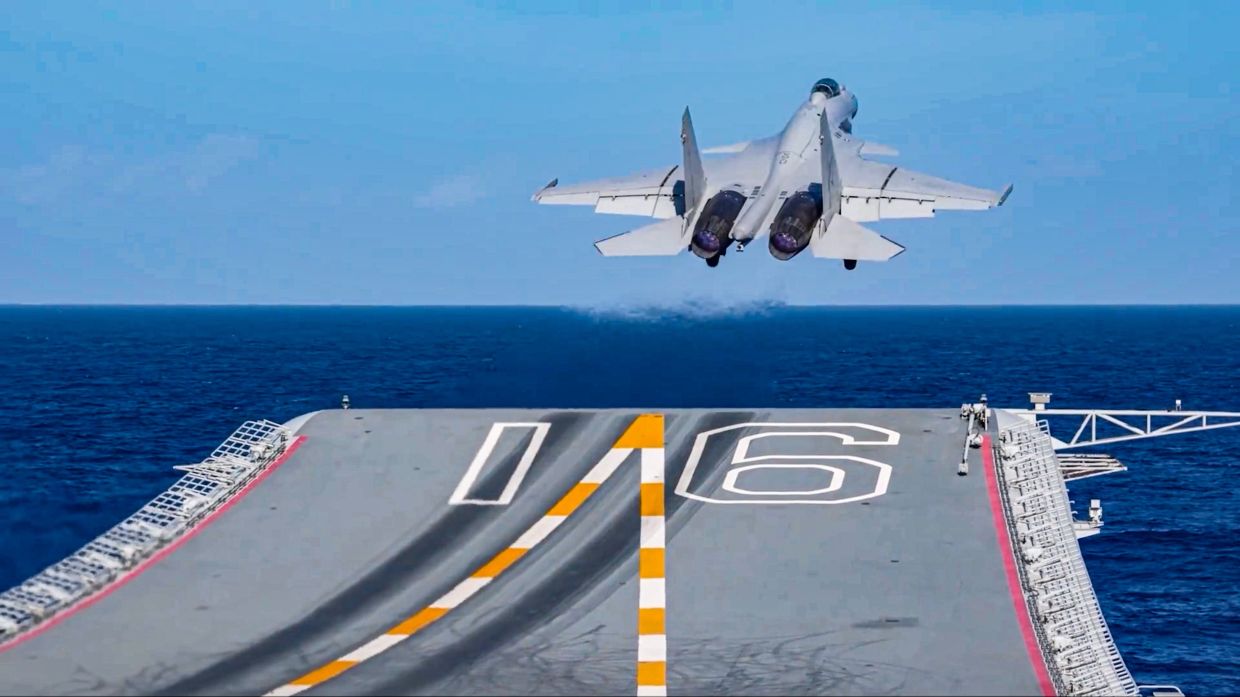
China's rapidly modernising aircraft carrier fleet, central to Beijing's vision of naval power projection across the Indo-Pacific, harbours a critical weakness that military strategists increasingly view as difficult to overcome: vulnerability to submarine attack. While the People's Liberation Army Navy invests heavily in building a carrier-centric force, analysts argue that deficiencies in undersea warfare capabilities could leave these expensive vessels exposed to determined adversaries, fundamentally undermining their strategic utility and the billions invested in their construction.
The Washington-based Centre for Strategic and International Studies recently outlined a comprehensive "cost-imposition" strategy designed to counter China's advancing carrier capabilities. The approach encompasses multiple dimensions: land-based offensive networks, extended-range aerial strikes enhanced by satellite reconnaissance, cyber and electromagnetic warfare, and coordinated drone deployments. Yet among these varied approaches, submarine operations emerge as the element where China faces its most acute disadvantage. American attack submarines operating throughout the western Pacific represent perhaps the most formidable threat to Chinese carrier formations, principally because China's navy currently cannot adequately detect, track, or neutralise these vessels as they manoeuvre beneath the surface.
Geography compounds this strategic dilemma. The narrow maritime passages that Chinese carriers must navigate—particularly the crucial chokepoints linking China to the broader Indo-Pacific—create ideal environments for submarine ambushes. Allied forces could position undersea assets in these confined waterways to threaten carrier groups during transit, forcing difficult operational decisions on Chinese commanders. Beyond these constrained zones, long-range carrier-based aircraft, guided by satellite surveillance systems, could launch devastating strikes while cyber warfare could simultaneously blind Chinese sensor networks and communications infrastructure, rendering defensive coordination nearly impossible.
Christopher Sharman, director of the China Maritime Studies Institute at the US Naval War College, acknowledges that China's undersea vulnerability "remains significant today," though he cautions it should not be viewed as permanent or unchanging. Beijing recognises the problem and has embarked on ambitious programmes to narrow the technological and operational gaps that currently disadvantage its submarine force. Yet substantial obstacles persist. Chinese researchers affiliated with the PLA candidly acknowledge that their nation's meteorological and oceanographic intelligence lags considerably behind American capabilities—a disparity that translates directly into operational disadvantages in undersea warfare, especially when operations extend beyond the first island chain into deeper, less-charted waters.
To address these deficiencies, China launched the Transparent Ocean initiative over a decade ago, designed to weave together satellites, research vessels, buoys, autonomous underwater gliders, and seabed sensor networks into a comprehensive system for gathering oceanographic data across strategically vital regions including the western Pacific, South China Sea, and Indian Ocean. The Ocean University of China, which conceived the programme, reports establishing hundreds of deep-sea observation systems and substantially expanding monitoring capabilities from the South China Sea into the Pacific. Beijing has explicitly framed these investments as national security imperatives, signalling recognition that controlling undersea information translates into military advantage.
Simultaneously, China has modernised its anti-submarine capabilities through multiple channels. The maritime studies institute has documented expanding fleets of fixed-wing maritime patrol aircraft and newly commissioned Type 927 ocean-surveillance vessels equipped with towed-array sonar systems capable of detecting submarines at considerable distances. Sensor upgrades on existing maritime helicopters and reconnaissance platforms continue, incrementally improving China's ability to hunt and destroy submarines. Nevertheless, defence analysts maintain that these improvements, while significant, cannot fully compensate for deeper structural disadvantages accumulated over decades of American and allied submarine development.
The strategic significance of submarine warfare extends far beyond protecting China's carriers. Naval strategists emphasise that undersea operations constitute a core pillar of PLA strategy, particularly for achieving sea control within the first island chain during wartime. Beyond that geographical boundary and stretching into the Indian Ocean, Chinese military planners view effective submarine operations as essential counterweights to enduring American naval superiority and as mechanisms for complicating potential third-party intervention in a Taiwan contingency. Beijing regards the island as a breakaway province and has retained the option of military unification, creating persistent tensions with Washington, which maintains security commitments to Taipei despite diplomatic recognition of the People's Republic.
Military-affiliated Chinese authors have sometimes characterised the coastal waters surrounding China as a "wide-open door," frankly acknowledging that inadequate monitoring and control capabilities leave these strategically vital areas vulnerable to penetration by foreign submarines. This candid assessment underscores the anxiety within Chinese strategic circles regarding undersea threats. Timothy Heath, a senior defence analyst, notes that American submarines rank among the world's quietest, providing technological advantages difficult to overcome through sheer investment. He further warns that Japanese involvement in any Taiwan scenario would dramatically elevate the complexity, as Japan possesses sophisticated anti-ship capabilities that could target Chinese naval formations operating within range of Japanese territory.
This operational reality creates a strategic bind for Chinese military planners. While carriers theoretically could provide air cover for naval forces attempting to deter or forestall third-party intervention in a Taiwan conflict, deploying them into zones where American and allied submarines operate densely represents an unacceptable risk to vessels costing billions of dollars and embodying years of technological development. Heath argues that "it would be foolish for China to deploy the carriers that far out," given the multiplicity of threats arrayed against them. China's land-based intermediate-range ballistic missiles provide more cost-effective options for threatening American and allied warships extended throughout the second island chain, without risking precious carrier platforms to submarine ambush.
This strategic constraint shapes broader implications for regional security and force development priorities. The Centre for Strategic and International Studies authors contend that the difficulties China faces in projecting carrier power across contested waters should inform American procurement decisions and investment priorities. They specifically advocate for expanded production of advanced torpedoes, autonomous undersea drones, and missile systems developed cooperatively with allies including Japan and Australia. Such investments would consolidate submarine advantages, making it progressively more difficult and costly for Beijing to extend carrier operations into the Indo-Pacific, thereby reinforcing deterrence against adventurous military action across the Taiwan Strait and preserving the regional balance of power that has underpinned decades of peace and prosperity across Southeast Asia and the broader region.
Ultimately, the submarine threat exposes fundamental constraints on China's carrier ambitions. While Beijing can construct vessels and train personnel, it cannot easily overcome decades of technological separation in undersea warfare capabilities or rapidly accumulate the oceanographic knowledge that transforms submarines from platforms into effective weapons systems. This mismatch between aspirations and capabilities will shape Chinese strategic calculations for years ahead, potentially tilting military planners toward alternative approaches that leverage China's genuine advantages in land-based systems and shorter-range platforms rather than expensive carriers operating at the edge of sustainable risk.

