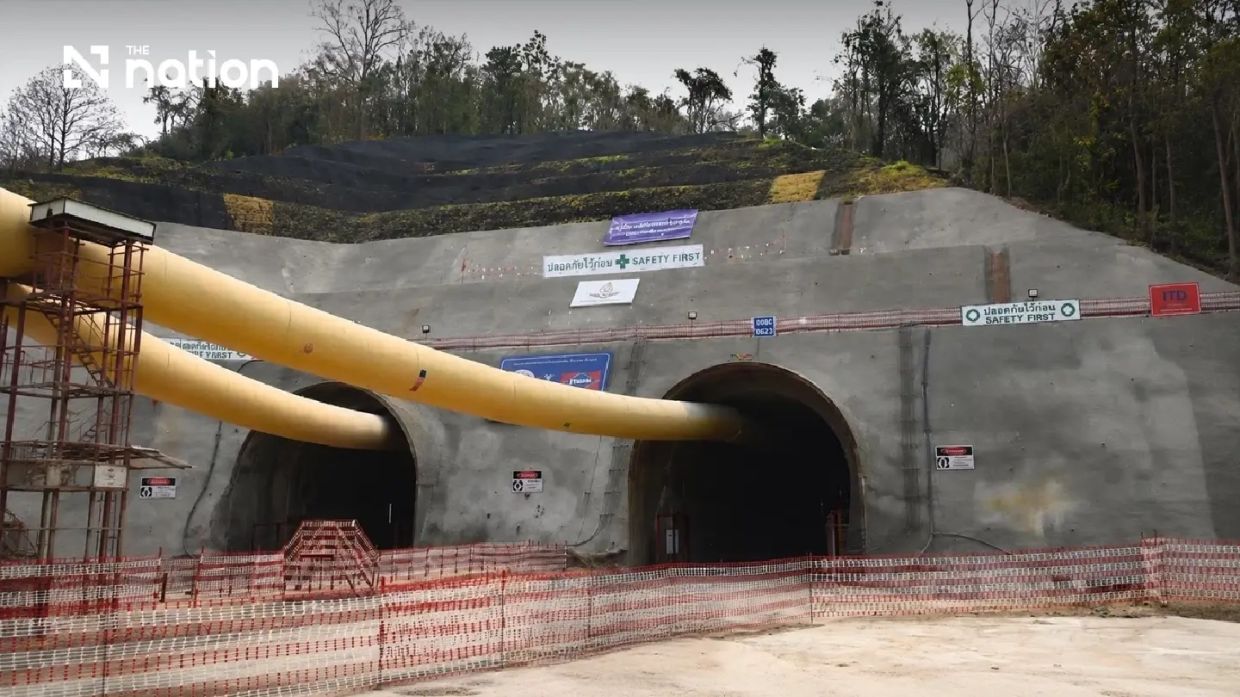
A construction accident at Thailand's Chiang Rai railway project has claimed two lives and left seven workers wounded after scaffolding gave way inside the Doi Luang tunnel on Saturday evening. The incident occurred as workers were conducting waterproofing installation activities at the site, part of the State Railway of Thailand's ambitious Den Chai-Chiang Rai-Chiang Khong railway line under development. Emergency responders confirmed receipt of the initial accident report at 8.35pm, with all affected personnel transported to hospital for treatment.
According to Deputy Transport Minister Siripong Angkasakulkiat, preliminary findings suggest that falling rocks from the tunnel wall contributed to the scaffolding failure. The exact sequence of events that led to the structural collapse is still being verified by investigation teams, though earlier accounts had mentioned complications in the shotcrete work zone. Officials emphasized that establishing the precise cause remains a priority, with multiple agencies coordinating their examination of the accident scene. The injured comprised three workers with serious injuries and four with minor wounds requiring medical attention.
The Doi Luang tunnel, located in Chiang Saen district, represents a critical component of the broader railway expansion initiative. The 3.4-kilometre tunnel has already been bored through, placing workers in the interior finishing phase where waterproofing and safety systems installation typically occurs. This phase of tunnel construction is particularly hazardous, as it requires workers to operate at height using temporary structures to access walls and overhead areas. The presence of loose rock material in freshly bored tunnels adds an additional layer of risk, as geological stability remains unpredictable even after initial excavation completes.
The accident site has been secured and sealed off to prevent further incidents, with the project's dedicated safety unit assuming control of operations. Deputy Minister Siripong confirmed that conditions at the tunnel entrance and surrounding work areas are now stabilized, though full-scale investigation activities continue. The State Railway's Special Projects and Construction Department has mobilized inspection personnel to examine structural integrity, equipment condition, and worker safety protocols currently in place. This comprehensive assessment will inform whether additional precautions are necessary before construction resumes.
The Den Chai-Chiang Rai-Chiang Khong railway represents a substantial regional infrastructure initiative with significant implications for Southeast Asian trade and connectivity. The overall project aims to connect central Thailand's rail network to Chiang Rai and eventually to the Laotian border at Chiang Khong, facilitating freight and passenger movement across a key regional corridor. This particular section generates considerable economic importance for northern Thailand, where rail capacity has traditionally constrained development.
Contract 3, which encompasses the Doi Luang tunnel and surrounding infrastructure, carries a value of THB19.385 billion and includes responsibility for constructing approximately 87 kilometres of track spanning both at-grade and elevated sections. Beyond the tunnel itself, the contract requires completion of three railway stations, three halt points, comprehensive signalling and telecommunications systems, and associated civil works. The CKST-DC3 Joint Venture, a partnership between CH. Karnchang Public Company Limited, Sino-Thai Engineering & Construction Public Company Limited, and Chiangmai Construction Co., Ltd., bears primary responsibility for delivering these works to specification and schedule.
The involvement of multinational and domestic contractors in such projects reflects Thailand's construction industry standards, where complex infrastructure typically requires collaboration between firms with complementary expertise. However, the fatal accident raises questions about safety management coordination among consortium members and compliance with occupational health protocols. Joint venture arrangements, while enabling technical capability and financial capacity, can sometimes create ambiguity in safety responsibility allocation and decision-making during emergency situations.
For Malaysian stakeholders, this incident carries particular relevance given Malaysia's own substantial investment in railway infrastructure and the cross-border nature of regional development corridors. The Den Chai-Chiang Rai-Chiang Khong project shares characteristics with Malaysian initiatives such as the East Coast Rail Link, where large-scale tunnelling and complex geological conditions similarly demand rigorous safety management. The accident demonstrates how even established contractors can face unexpected hazards in tunnel environments, underscoring the importance of continuous safety oversight regardless of project experience or contractor reputation.
The investigation outcomes will likely generate lessons applicable across the region's construction sector. Tunnel work in Southeast Asia frequently encounters comparable geological challenges—unstable rock formations, water seepage, and confined working conditions—that create compounded risk environments. Malaysian project managers and safety officers monitoring this investigation will gain insights into incident causation and prevention measures relevant to local operations. The findings may influence regional industry standards and contractor qualification requirements for underground infrastructure projects.
State authorities have indicated that detailed findings will be released once investigation teams complete their examination. This commitment to transparency addresses both immediate accountability concerns and the broader public interest in understanding how critical infrastructure projects manage worker safety. The incident underscores that project scale and contract value do not automatically guarantee hazard-free execution; rather, systematic safety culture and real-time risk management remain paramount regardless of project prestige or timeline pressures.
The accident's potential impact on project scheduling remains unclear, though investigations typically require temporary work suspensions in affected areas. Whether the delay affects the broader Den Chai-Chiang Rai-Chiang Khong completion timeline will depend on investigation duration and any remedial measures required before resumption. For regional observers tracking Thai infrastructure progress and connectivity improvements, this incident represents both a human tragedy and a reminder of the genuine hazards inherent in delivering complex cross-border transportation infrastructure.
%22%2F%3E%3C%2Fpattern%3E%3C%2Fdefs%3E%3Crect%20width%3D%22100%25%22%20height%3D%22100%25%22%20fill%3D%22url(%23ph2e74ng)%22%2F%3E%3Crect%20width%3D%22100%25%22%20height%3D%22100%25%22%20fill%3D%22url(%23ph2e74np)%22%2F%3E%3Ctext%20x%3D%2250%25%22%20y%3D%2250%25%22%20text-anchor%3D%22middle%22%20dominant-baseline%3D%22central%22%20fill%3D%22rgba(255%2C255%2C255%2C0.95)%22%20font-family%3D%22Georgia%2C%20'Times%20New%20Roman'%2C%20serif%22%20font-weight%3D%22700%22%20font-size%3D%22272%22%20letter-spacing%3D%22-0.02em%22%3ETEKUN%3C%2Ftext%3E%3C%2Fsvg%3E)