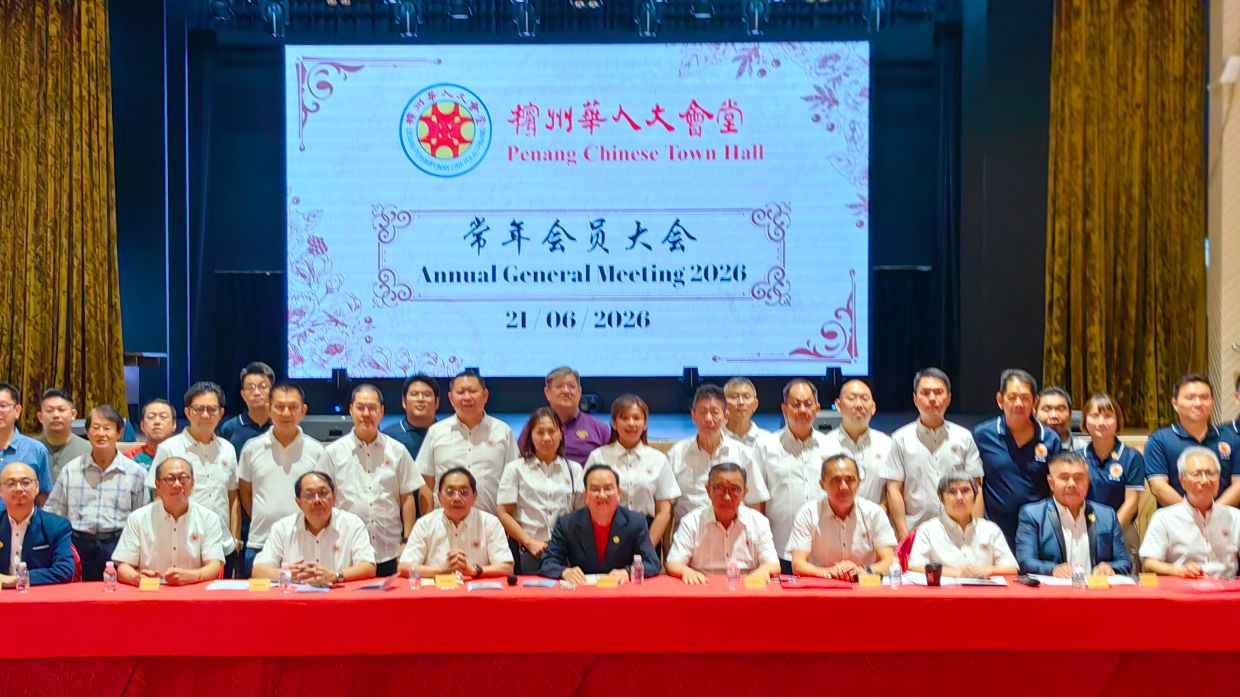
Penang Chinese Town Hall (PCTH) closed its 2025 financial year with RM12.61 million in total income against RM12.55 million in spending, generating a modest surplus of RM59,191. The organization's audited accounts, presented at its annual general meeting on June 21, reflect the financial backbone of one of Penang's most prominent community institutions, demonstrating stable operational capacity even as the region navigates broader economic and political transitions.
Donations formed the overwhelming majority of PCTH's revenue stream, contributing RM11.24 million or approximately 89% of total income. Beyond charitable contributions, the hall supplemented its finances through rental and maintenance fees amounting to RM439,671, auditorium rental income of RM361,245, and anniversary-related receipts totalling RM222,498. This diversified income model underscores the organization's multifaceted role within Penang's civic landscape, functioning simultaneously as a community gathering space, cultural venue, and charitable foundation.
The expenditure profile reveals PCTH's primary mission as a philanthropic institution. Donations disbursed by the organization reached RM11.12 million, consuming 88.6% of total spending during the period. This represents a significant decrease from RM12.35 million distributed in 2024, suggesting either a deliberate recalibration of charitable commitments or reduced donation collection compared to the prior year. Meanwhile, operational costs climbed modestly, with salaries and allowances rising to RM502,625 from RM452,761 in 2024, reflecting inflationary pressures and potential staffing adjustments within the organization.
Chairman Tan Sri Prof Tan Khoon Hai used the gathering of approximately 200 members to pivot toward broader governance questions. With Johor and Negri Sembilan scheduled to conduct state elections during 2025, Tan urged Malaysian voters to exercise their democratic responsibilities with deliberation and care. His intervention into electoral discourse signals how established community organizations are positioning themselves within contemporary political dialogue, transcending purely financial reporting to address civic engagement.
Tan emphasized that electoral choices carry consequences extending far beyond parochial local concerns. Voters, he argued, must evaluate competing parties and their candidates through a rational lens, assessing both past performance records and future policy commitments. The ideal candidate, in his framing, combines capacity for fostering national unity, catalyzing economic expansion, and preserving social cohesion—a notably centrist formulation that reflects the pragmatic values of Malaysia's business and community leadership.
"Elections are not only about local development, but also about shaping our nation's future," Tan declared, articulating a vision wherein electoral exercises constitute moments for collective national direction-setting rather than transactional municipal governance. This rhetorical positioning resonates particularly within Penang's context, where state politics have historically intertwined with broader questions of regional economic trajectory and inter-ethnic relations.
Beyond financial stewardship and civic exhortation, PCTH unveiled a renovated Ping Zhang Hall, signalling the organization's commitment to physical infrastructure modernization. The upgraded venue boasts expanded spatial capacity alongside contemporary sound, lighting, and LED systems, positioning itself as a premium facility for corporate functions, cultural celebrations, charitable galas, and community assemblies. Such capital investment in venue enhancement reflects confidence in sustained demand for gathering spaces and suggests PCTH's strategic interest in diversifying revenue through expanded rental opportunities.
Tan announced an ambitious initiative to co-host the 2026 China-Asean Artificial Intelligence Cooperation Forum in Penang this November in partnership with technology and business organizations from across China and Southeast Asia. This positioning leverages Penang's established industrial heritage and contemporary aspirations within the technology sector. The state, which has marketed itself as the "Silicon Valley of the East," possesses genuine credentials as Malaysia's preeminent hub for electrical and electronics manufacturing, providing tangible foundations for AI ecosystem development.
The proposed forum constitutes more than ceremonial gesturing toward technological modernity. By convening experts, corporate decision-makers, and industry practitioners from across the region, the event promises substantive exploration of emerging AI applications, commercial deployment models, and mechanisms for cross-border industrial cooperation. For Penang specifically, hosting such gatherings reinforces its positioning within regional technology networks and potentially attracts talent and investment capital seeking proximity to AI innovation clusters.
Tan explicitly solicited member participation from those possessing relevant technological expertise, framing individual involvement as contribution to Penang's broader regional role. This approach—enlisting community institution membership as active participants in economic and technological advancement—reflects an understanding of how established organizations can serve as connective tissue between grassroots communities and high-level strategic initiatives. By positioning PCTH as facilitator rather than mere spectator in regional AI cooperation, leadership articulates an expanded institutional purpose encompassing not merely charitable distribution and cultural preservation but active participation in shaping Penang's economic future.
%22%2F%3E%3C%2Fpattern%3E%3C%2Fdefs%3E%3Crect%20width%3D%22100%25%22%20height%3D%22100%25%22%20fill%3D%22url(%23ph6tl9g)%22%2F%3E%3Crect%20width%3D%22100%25%22%20height%3D%22100%25%22%20fill%3D%22url(%23ph6tl9p)%22%2F%3E%3Ctext%20x%3D%2250%25%22%20y%3D%2250%25%22%20text-anchor%3D%22middle%22%20dominant-baseline%3D%22central%22%20fill%3D%22rgba(255%2C255%2C255%2C0.95)%22%20font-family%3D%22Georgia%2C%20'Times%20New%20Roman'%2C%20serif%22%20font-weight%3D%22700%22%20font-size%3D%22320%22%20letter-spacing%3D%22-0.02em%22%3EIAEA%3C%2Ftext%3E%3C%2Fsvg%3E)
%22%2F%3E%3C%2Fpattern%3E%3C%2Fdefs%3E%3Crect%20width%3D%22100%25%22%20height%3D%22100%25%22%20fill%3D%22url(%23ph352i8g)%22%2F%3E%3Crect%20width%3D%22100%25%22%20height%3D%22100%25%22%20fill%3D%22url(%23ph352i8p)%22%2F%3E%3Ctext%20x%3D%2250%25%22%20y%3D%2250%25%22%20text-anchor%3D%22middle%22%20dominant-baseline%3D%22central%22%20fill%3D%22rgba(255%2C255%2C255%2C0.95)%22%20font-family%3D%22Georgia%2C%20'Times%20New%20Roman'%2C%20serif%22%20font-weight%3D%22700%22%20font-size%3D%22320%22%20letter-spacing%3D%22-0.02em%22%3EIran%3C%2Ftext%3E%3C%2Fsvg%3E)
%22%2F%3E%3C%2Fpattern%3E%3C%2Fdefs%3E%3Crect%20width%3D%22100%25%22%20height%3D%22100%25%22%20fill%3D%22url(%23ph3iugkg)%22%2F%3E%3Crect%20width%3D%22100%25%22%20height%3D%22100%25%22%20fill%3D%22url(%23ph3iugkp)%22%2F%3E%3Ctext%20x%3D%2250%25%22%20y%3D%2250%25%22%20text-anchor%3D%22middle%22%20dominant-baseline%3D%22central%22%20fill%3D%22rgba(255%2C255%2C255%2C0.95)%22%20font-family%3D%22Georgia%2C%20'Times%20New%20Roman'%2C%20serif%22%20font-weight%3D%22700%22%20font-size%3D%22151%22%20letter-spacing%3D%22-0.02em%22%3EBezzecchi%3C%2Ftext%3E%3C%2Fsvg%3E)