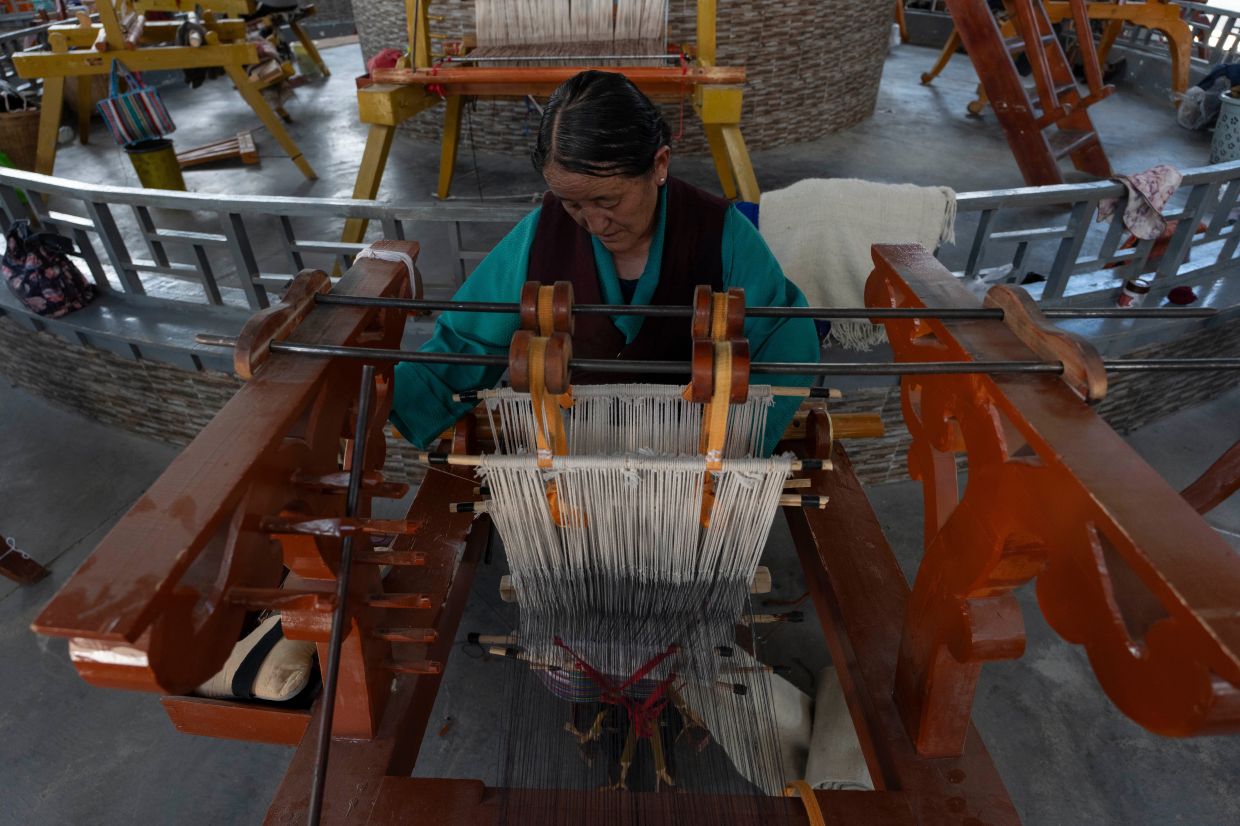
In a workshop nestled high on the Tibetan plateau, more than a dozen artisans work methodically at wooden looms, their hands moving in rhythmic patterns as they weave Pulu, the traditional woolen fabric that has warmed the people of Tibet for over a thousand years. The soft click of shuttles passing through rows of yarn and the steady pull of threads represents far more than simple textile production—it embodies a cultural heritage that nearly vanished within a generation. Today, the Ethnic Huaji Handwoven Cooperative in Shannan stands as a bulwark against that loss, employing more than 100 local residents while keeping alive a craft that once seemed destined for extinction.
Founded in 2008 by Tibetan artisan Pasang, the cooperative emerged from a deeply personal concern: the knowledge of traditional weaving was disappearing as younger generations turned to other pursuits. When Pasang began his mission to preserve the craft, fewer than ten people in the region still possessed the skills necessary to weave Zeter, the finest and most prestigious variety of Pulu. This exceptional fabric is crafted from the softest wool, sourced from the necks and backs of sheep raised in the high-altitude regions around Shannan, which sits approximately 3,700 metres above sea level. The specialized nature of this material makes spinning and weaving considerably more demanding than producing ordinary Pulu, requiring both patience and extensive technical knowledge.
The significance of Zeter extends well beyond its material qualities. Lighter, softer, and more delicate than standard Pulu, this fabric commanded such respect in historical times that it was reserved as a tribute offering from Tibet to Chinese imperial courts during the Ming dynasty. According to local tradition, the weaving techniques themselves arrived in Tibet through Princess Wencheng, a Chinese bride who married the seventh-century Tibetan King Songtsen Gampo. This historical narrative, central to how both Tibetan and Chinese officials understand cultural exchange on the plateau, underscores how the craft has long served as a tangible connection between two civilizations. Statues of both the king and princess stand prominently within the workshop, reminding workers daily of this legendary origin story.
Pasang learned these intricate techniques from his parents during an era when the craft was already in sharp decline, a fact that shaped his determination to reverse its trajectory. His efforts have been formally recognized by Chinese authorities, with Pulu weaving designated as part of China's national intangible cultural heritage. This official acknowledgment has provided both legitimacy and resources to the cooperative's work, though the primary motivation remains deeply rooted in cultural preservation. Through the cooperative's training programmes, numerous younger Tibetans have acquired knowledge that their own parents' generation might have dismissed as economically obsolete, creating a transmission chain that breaks the pattern of generational loss.
The cooperative's employment model reflects a progressive approach to rural development in Tibet. By deliberately hiring individuals with disabilities alongside able-bodied workers, and by drawing employees from surrounding communities, the workshop addresses both cultural preservation and economic vulnerability. Tsering Yangchen, an 80-year-old weaver who joined the cooperative seven years ago after relocating from another county, exemplifies the impact this opportunity has provided. She had struggled to find meaningful employment before the workshop taught her the weaving techniques, allowing her to contribute productively while earning income. For Tsering Yangchen and many like her, Pulu represents not merely a commercial product but a material embodiment of their cultural identity—something they wear themselves, made entirely from pure wool.
The cooperative's product range has expanded considerably since its founding, extending beyond traditional garments to include contemporary items such as scarves, shawls, jackets, and bags. These goods are displayed in a showroom adjacent to the main workshop, where both Tibetan and Chinese customers browse the offerings. While most sales remain concentrated within Tibet itself, the cooperative has gradually built a wider customer base across other regions of China. This diversification strategy helps stabilize income while introducing the fabric to audiences who might otherwise have no connection to Tibetan weaving traditions.
The high-altitude context of Shannan proves integral to the cooperative's continued viability. The sheep that provide the wool are raised on the plateau itself, ensuring both authenticity and a supply chain rooted in the local economy. This geographical advantage transforms the cooperative from merely a heritage project into a sustainable enterprise that benefits pastoralist communities whose livelihoods depend on sheep herding. The symbiotic relationship between weaving and pastoral production creates multiple economic linkages within the region, making cultural preservation inseparable from rural economic development.
For Southeast Asian readers and observers of Asian cultural politics, the Ethnic Huaji Handwoven Cooperative offers a instructive example of how marginalized craft traditions can be revitalized through cooperative organization and government recognition. The model demonstrates that heritage preservation need not be a purely nostalgic exercise; instead, it can generate employment, restore dignity to rural workers, and create pathways for intergenerational knowledge transfer in an era of rapid modernization. The cooperative's success—measured both in employment figures and in the number of younger weavers trained—suggests that structured support for traditional crafts can succeed even in remote, economically challenged regions.
Looking forward, Pasang has emphasized his hope that younger generations will sustain this tradition beyond his lifetime, ensuring that Pulu weaving remains a living practice rather than a museum artefact. The challenge remains formidable: competing with industrial textiles, attracting youth to labour-intensive manual work, and maintaining quality standards while scaling production. Yet the cooperative's track record over more than a decade suggests that when cultural heritage aligns with viable economic opportunity and receives institutional support, communities can resist the pull toward cultural homogenization. For Tibet's weaving traditions, and for countless other endangered crafts across Asia, the Ethnic Huaji Handwoven Cooperative provides evidence that restoration is possible when artisans, communities, and policy-makers commit to a shared vision of cultural continuity.

