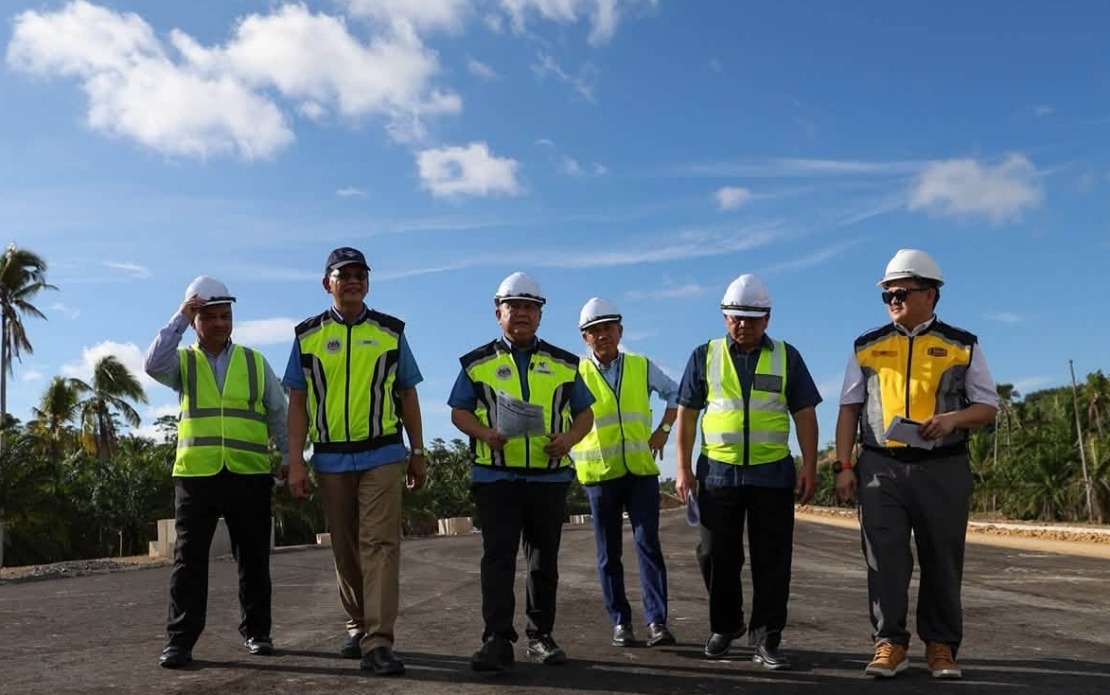
The contractor responsible for constructing Work Package 11 of the Pan Borneo Highway in Sabah has submitted a formal recovery plan to address scheduling pressures that have accumulated since project commencement. Works Minister Datuk Seri Alexander Nanta Linggi confirmed the submission, which seeks to realign implementation timelines and deliver the RM167.48 million Rampayan Laut-Sarang alignment section by its contractual deadline of September 29, 2026. The initiative represents a coordinated effort among multiple government agencies and the private sector to rescue a critical infrastructure initiative that has faced mounting logistical challenges.
As of late June, the 7.3-kilometre section had reached 61.76 per cent completion, yet this progress still lagged the original construction schedule by 4.35 percentage points. The 32-day shortfall in execution timing reflects the accumulation of various on-site obstacles that have hindered progress throughout the first half of 2024. The recovery plan sets an ambitious intermediate milestone, aiming to reduce the backlog to just 14 days by August 2026—essentially recovering 18 days of lost time over the following 14 months before the final completion date arrives.
The primary impediment to timely construction has centred on utility relocation activities that proved far more complicated than initial project assumptions suggested. Coordinating with Sabah Electricity Sdn Bhd to relocate electrical infrastructure, engaging the Sabah State Water Department for water supply line adjustments, and managing Celcom Timur Sabah Sdn Bhd's telecommunications network modifications have collectively consumed considerable time and resources. Beyond utilities, land acquisition procedures have introduced additional complexity, requiring negotiation with private landholders and government entities to secure right-of-way access. These intersecting complications underscore how large-scale infrastructure development in rural areas depends on solving numerous parallel coordination challenges rather than simply mobilising construction equipment and labour.
Nanta emphasised that overcoming these constraints demands genuine partnership among stakeholders rather than each agency working within its narrow mandate. The Works Ministry, Sabah's Public Works Department, the appointed project consultant, and the contractor must function as an integrated team, proactively identifying bottlenecks and resolving them before they compound into longer delays. This requirement for enhanced coordination reflects a broader lesson from Malaysian infrastructure projects: technical competence and adequate funding, while necessary, prove insufficient without sustained institutional collaboration and transparent communication channels that allow problems to surface and be addressed rapidly.
Beyond the administrative hurdles, the project carries substantial strategic significance for Sabah's development trajectory. The completed Rampayan Laut-Sarang alignment will establish a safer, more efficient route that substantially reduces travel distances to Simpang Mengayau and Kudat—gateway towns to Sabah's northeastern region. Journey times between these areas and major settlements will compress by 30 to 60 minutes, creating meaningful quality-of-life improvements for residents and commuters. More significantly, the highway reduces the physical distance to these destinations by up to 30 kilometres, making regular travel more economical and feasible for ordinary citizens.
The economic and tourism implications of this infrastructure upgrade extend across multiple sectors. The improved connectivity directly supports implementation of the Northern Sabah Coastal Tourism Master Plan, which envisions transforming the region into a destination for domestic and international visitors seeking beach experiences, cultural encounters, and natural attractions. Faster, safer access translates into increased visitor flows to tourism establishments, multiplying revenue opportunities for hotels, restaurants, tour operators, and supporting businesses throughout the corridor. Local communities positioned along the route gain improved market access, enabling agricultural and artisanal producers to reach larger customer bases more reliably and cost-effectively.
Employment generation forms another dimension of the project's anticipated benefits. Construction itself employs hundreds of workers directly and thousands indirectly through material supply chains and service provision. Once completed, the highway's improved accessibility creates conditions for investors to establish manufacturing facilities, agricultural processing centres, and commercial enterprises throughout northern Sabah. These employment opportunities span skilled and unskilled positions, offering pathways for economic advancement across social strata. For a region where economic opportunities have historically concentrated in coastal towns and major urban centres, infrastructure-driven connectivity can catalyse more dispersed development patterns.
The Works Ministry's framing emphasises not merely punctual delivery but quality and safety standards that befit public infrastructure serving thousands of daily users. This commitment reflects lessons learned from previous Malaysian highway projects where cost overruns and expedited timelines occasionally resulted in structural deficiencies, maintenance problems, or safety issues that emerged years after opening. Nanta's stated intention to balance schedule recovery with quality preservation suggests ministry awareness that a project completed on time but of inferior standard would ultimately prove counterproductive and expensive.
The recovery plan mechanism itself illustrates evolving Malaysian infrastructure governance practices. Rather than absorbing delays through contract extensions or accepting reduced completion standards, the ministry has mandated the contractor develop and submit a detailed recovery strategy for official review and monitoring. This approach introduces accountability and transparency into the remediation process, allowing independent verification that corrective measures are genuinely progressing rather than merely promised. Regular monitoring touchpoints, including the August 2026 intermediate milestone, create opportunities to adjust strategies if initial recovery measures prove insufficient.
For Malaysia's broader infrastructure ambitions across Peninsular Malaysia and East Malaysia, the Pan Borneo Highway initiative carries symbolic importance. The project demonstrates government commitment to connecting remote and regional areas to national economic networks, reducing geographic disparities in development and opportunity access. Sabah's position as a resource-rich but geographically dispersed state makes transportation infrastructure particularly critical to realising economic potential. The Rampayan Laut-Sarang alignment, despite current delays, remains integral to this vision.
Looking forward, the recovery plan's success will provide valuable experience for other delayed projects within Sabah and elsewhere in Malaysia. The coordination mechanisms established to resolve utility relocation and land acquisition issues can be refined and replicated, building institutional capacity for more efficient infrastructure delivery. If the contractor successfully recovers 18 days of delay while maintaining quality standards, the achievement will demonstrate that determined collaborative problem-solving can overcome seemingly intractable logistical obstacles. Conversely, if recovery efforts prove insufficient and further delays accumulate, the situation will prompt reflection on how future large-scale projects can anticipate and prevent similar coordination challenges from emerging.

