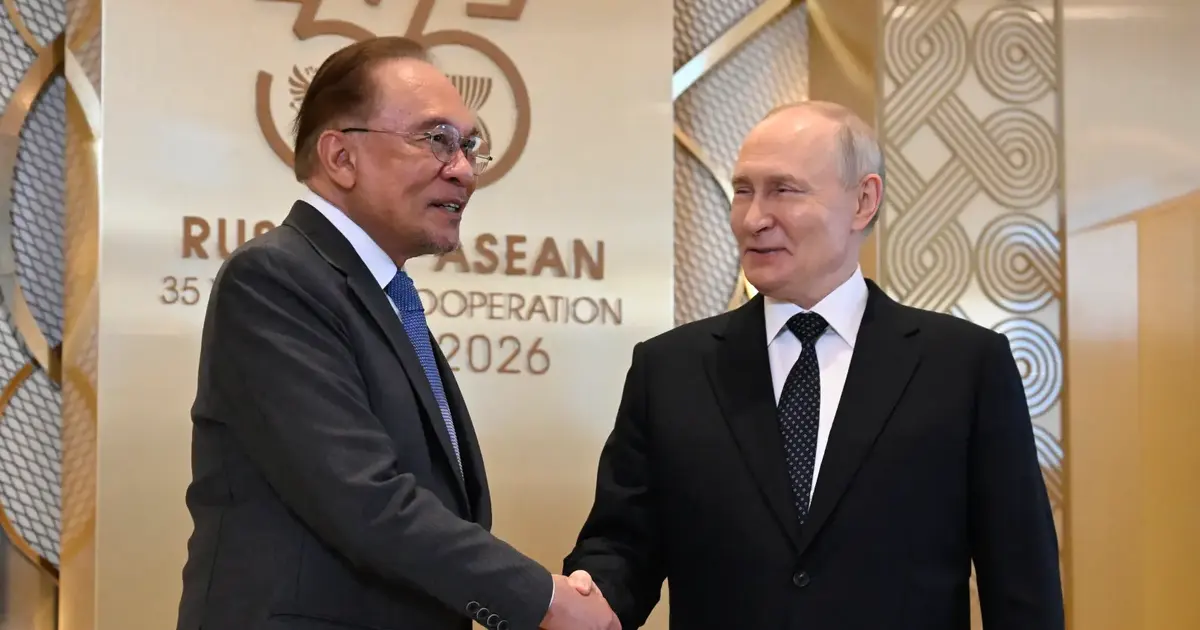
Prime Minister Anwar Ibrahim announced that Russian President Vladimir Putin has committed to supplying Malaysia with crude oil and natural gas for the next two decades, providing a degree of certainty to the country's long-term energy procurement strategy. This assurance comes at a time when Malaysia, like many Asian economies, is navigating complex geopolitical currents and seeking to diversify its energy import sources beyond traditional suppliers.
The pledge represents a significant development in Malaysia-Russia energy relations, offering the country predictable access to hydrocarbons during a period when global energy markets remain volatile and vulnerable to supply shocks. For Malaysian policymakers and industry stakeholders, such a long-term commitment reduces uncertainty around fuel availability and can support more stable planning for refineries, power generation, and petrochemical facilities that depend heavily on imported raw materials.
Energy security has become increasingly critical for Southeast Asia as regional economies rebound and energy demand rises in tandem with manufacturing output and urban development. Malaysia, despite its own hydrocarbon reserves, requires substantial imports to meet domestic and industrial needs. A two-decade agreement with a major global producer like Russia diversifies Malaysia's supplier base and reduces over-reliance on any single source, a principle that has guided energy policy across the region.
Beyond the energy accord, Anwar Ibrahim's engagement in the region signals Malaysia's broader strategic intent to expand economic partnerships with Central Asian markets and leverage those connections to strengthen its position in key Asian export destinations. The Prime Minister outlined plans to capitalise on the visit to Turkmenistan to facilitate increased Malaysian exports to major economic powerhouses including China, Japan, and South Korea—markets that represent over a quarter of global GDP and are critical for Malaysian manufacturing and agricultural exports.
Central Asia, historically positioned at the crossroads of Asian commerce, has become increasingly relevant to Southeast Asian trade strategies as countries seek alternative routes and commercial partnerships. Turkmenistan, as a major hydrocarbon exporter and strategic transit hub, offers Malaysian businesses potential gateways to supply networks serving the broader Eurasian region. The visit signals recognition that prosperity in Southeast Asia is increasingly tied to stability and commercial cooperation across multiple Asian regions.
The timing of these initiatives reflects Malaysia's pragmatic approach to foreign policy and economic engagement. Rather than aligning exclusively with any single power, the country pursues what observers describe as a balanced strategy—maintaining traditional partnerships while simultaneously developing relationships that serve specific economic objectives. Energy security and export market access represent two fundamental pillars of this approach.
For Malaysia's manufacturing sector, expanded access to export markets in China, Japan, and South Korea carries substantial implications. These economies represent both fierce competitors and crucial customers for Malaysian semiconductors, electronics, palm oil products, and petrochemicals. By establishing stronger trade corridors through Central Asian partnerships, Malaysian exporters potentially reduce logistics costs and create additional distribution options for their goods.
The emphasis on a two-decade energy supply arrangement also reflects how Russia continues to adapt its economic strategy following Western sanctions imposed in 2022. Despite geopolitical tensions, Russia remains committed to its traditional energy partnerships in Asia, where demand for oil and gas continues to grow. For Asian importers, this persistence of supply relationships offers advantages, as competition among suppliers tends to improve pricing and contract terms.
Malaysia's diversification efforts extend beyond energy and exports. The country has worked consistently to position itself as a bridge between the Islamic world and Western economies, a neutral venue for regional dialogue, and a centre for Islamic finance. These broader strategic aims complement the practical focus on securing energy supplies and expanding trade—they reflect a comprehensive approach to enhancing Malaysia's role and influence within Asian and global commerce.
The implications for Southeast Asian energy markets are noteworthy as well. Malaysia's success in securing long-term supply commitments may encourage similar negotiations by other regional economies seeking to lock in prices and availability for the medium to long term. This could reshape procurement patterns across Southeast Asia and potentially affect how global energy suppliers approach the region.
Looking forward, the effectiveness of these arrangements will depend on their implementation. Energy contracts must navigate ongoing geopolitical shifts, potential changes in government relationships, and evolving global energy dynamics including the longer-term transition toward renewable sources. Nevertheless, the commitment provides a foundation for stable energy planning and signals to international investors that Malaysia maintains strong relationships with multiple major economies.
For Malaysian businesses and consumers, the practical benefit of such security extends across multiple sectors. Industrial competitiveness depends partly on reliable, affordable energy; stable hydrocarbon supplies help contain inflation in transportation and production costs. The pursuit of expanded export opportunities simultaneously opens new revenue streams and employment, creating a complementary economic effect that benefits the broader population.
%22%2F%3E%3C%2Fpattern%3E%3C%2Fdefs%3E%3Crect%20width%3D%22100%25%22%20height%3D%22100%25%22%20fill%3D%22url(%23phnmk2g)%22%2F%3E%3Crect%20width%3D%22100%25%22%20height%3D%22100%25%22%20fill%3D%22url(%23phnmk2p)%22%2F%3E%3Ctext%20x%3D%2250%25%22%20y%3D%2250%25%22%20text-anchor%3D%22middle%22%20dominant-baseline%3D%22central%22%20fill%3D%22rgba(255%2C255%2C255%2C0.95)%22%20font-family%3D%22Georgia%2C%20'Times%20New%20Roman'%2C%20serif%22%20font-weight%3D%22700%22%20font-size%3D%22272%22%20letter-spacing%3D%22-0.02em%22%3EBukit%3C%2Ftext%3E%3C%2Fsvg%3E)