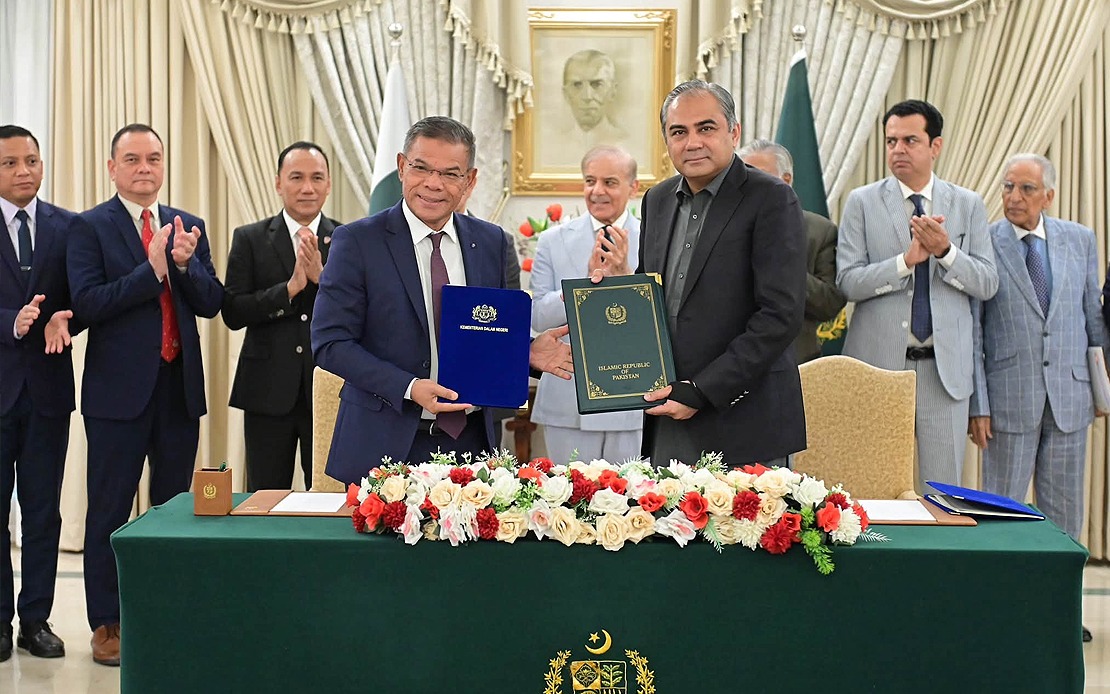
Malaysia and Pakistan have formalised a landmark agreement on prisoner transfers, signing the International Transfer of Prisoners (ITOP) Treaty in a ceremony at Pakistan's Prime Minister's Office in Islamabad. The treaty, witnessed by Pakistani Prime Minister Muhammad Shehbaz Sharif, was inked by Malaysia's Home Minister Datuk Seri Saifuddin Nasution Ismail and Pakistan's Interior and Narcotics Control Minister Syed Mohsin Raza Naqvi, marking a significant advancement in the two nations' longstanding security and legal partnership.
The agreement represents the culmination of five separate rounds of intensive negotiations that commenced in September 2025, involving multiple Malaysian government agencies working in concert. The Home Ministry coordinated efforts with the Foreign Ministry, Attorney General's Chambers, Malaysian Prisons Department, and Royal Malaysia Police to develop a framework that addresses the unique legal and penal systems of both countries. Malaysia's Cabinet formally endorsed the treaty on May 13, clearing the final hurdle before today's formal signing ceremony.
At its core, the ITOP framework addresses a longstanding challenge in bilateral relations: managing citizens detained in each other's jurisdiction. Malaysian nationals currently incarcerated in Pakistani facilities will have the option to be transferred back to Malaysia to serve out their remaining sentences within the domestic penal system. Similarly, Pakistani prisoners held in Malaysian jails may opt for repatriation to complete their sentences in Pakistani institutions. This reciprocal arrangement eliminates the complications arising from language barriers, cultural disconnection, and the practical difficulties foreign inmates face when separated from their home countries.
Beyond the mechanics of prisoner movement, the treaty emphasises rehabilitation as a central objective. By allowing convicts to serve their remaining terms in their native countries, both nations acknowledge that rehabilitation programmes are significantly more effective when tailored to a prisoner's cultural context and social environment. The agreement explicitly enables inmates to participate in rehabilitation initiatives suited to their respective countries' institutional frameworks, increasing the likelihood of successful reintegration into society upon release.
For Malaysia, the treaty carries particular significance given the substantial number of Malaysian citizens held in foreign prisons, including in Pakistan. This agreement provides a legal pathway for their return, easing the burden on families unable to afford regular international visits and reducing the administrative strain on Malaysian diplomatic missions abroad. The Home Ministry's engagement in this process reflects the government's commitment to protecting Malaysian citizens' interests while maintaining constructive international relations.
The bilateral relationship between Malaysia and Pakistan extends far beyond criminal justice cooperation, encompassing trade, defence, and cultural exchanges. By adding the ITOP Treaty to their existing legal instruments, both countries underscore their willingness to deepen institutional ties and establish clearer protocols for managing shared challenges. Saifuddin Nasution's characterisation of the treaty as a milestone reflects how such technical agreements often serve as foundations for broader diplomatic cooperation.
From a regional perspective, this treaty positions Malaysia and Pakistan as thoughtful participants in Southeast Asian and South Asian institutional frameworks. As regional groupings increasingly focus on security cooperation, bilateral agreements like ITOP demonstrate that neighbouring nations—even those separated by thousands of kilometres—can establish pragmatic solutions to cross-border legal issues. The treaty may also serve as a model for similar arrangements with other Commonwealth nations or ASEAN members still developing their own transfer mechanisms.
The emphasis on rehabilitation within one's own cultural context reflects evolving international thinking on criminal justice. Rather than viewing prisoner transfers as merely logistical exercises, modern frameworks increasingly incorporate restorative approaches that consider how cultural familiarity and family proximity improve rehabilitation outcomes. Both Malaysia and Pakistan's acceptance of this philosophy signals alignment with contemporary best practices in penology and criminal justice reform.
Implementation of the ITOP Treaty will require establishing administrative protocols between the Malaysian Prisons Department and its Pakistani counterpart, as well as coordination between foreign ministries to process individual transfer requests. While the treaty provides the overarching legal framework, its success will depend on smooth day-to-day cooperation between bureaucratic agencies in both capitals. Potential challenges may include determining prisoner eligibility, handling security assessments, and managing cases where diplomatic tensions might complicate otherwise routine transfers.
The timing of this agreement, finalised during what appears to be a productive period in Malaysia-Pakistan relations, suggests both governments prioritise practical cooperation despite broader geopolitical complexities. In an era when international agreements increasingly face scrutiny or non-compliance, Malaysia and Pakistan's commitment to formalising prisoner transfer mechanisms demonstrates confidence in institutional frameworks and reciprocal good faith.
For Malaysian communities with ties to Pakistan, and vice versa, the treaty offers concrete reassurance that governments are working to support citizens facing legal troubles abroad. The agreement acknowledges that imprisonment abroad creates hardships not only for detainees but also for their families, many of whom lack resources to maintain contact across international borders. By facilitating transfers, both nations recognise their humanitarian obligations to their diaspora populations.
The ITOP Treaty also reflects practical recognition that managing large foreign prisoner populations imposes administrative and financial costs on host nations. By enabling transfers, both Malaysia and Pakistan can reduce overcrowding in facilities housing foreign inmates and redirect resources toward domestic criminal justice priorities. This efficiency argument, while less emotionally resonant than rehabilitation concerns, likely contributed to both governments' willingness to invest diplomatic effort in the agreement's development and finalisation.

