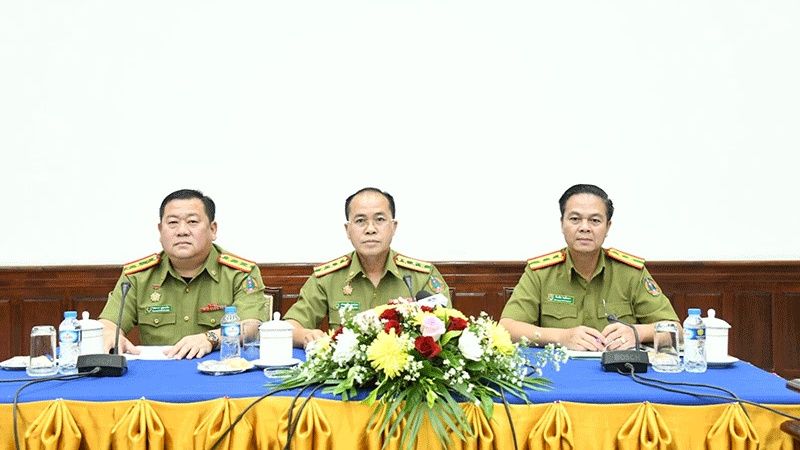
Lao law enforcement has formally charged the proprietor of Tiger Vodka and personnel associated with Nana Backpackers Hostel in connection with the deaths of six international visitors in the tourist hotspot of Vangvieng during November 2024. The Vientiane Province Police Command revealed during a press conference at the Ministry of Public Security on Friday that investigators uncovered methanol concentrations exceeding safety thresholds in samples of Tiger Vodka sourced from a privately run distillery located in Xaimoungkhoun village within Naxaithong district. The announcement represented the most comprehensive public account of the investigation to date, delivered by Colonel Khamfong Vongdalasane, Deputy Chief of the Vientiane Province Police Command.
The six victims comprised James Louis Hutson, an American; Freja Vennervald Sorensen and Anne-Sofie Orkild Coyman, both Danish nationals; Bianca Jones and Holly Bowles, both Australian citizens; and Simone White, a British national. Each death occurred under circumstances that authorities acknowledge remain partially obscured by the absence of post-mortem examinations, a procedural gap that has significantly constrained legal determinations regarding causation. Families of the deceased declined autopsy procedures in most cases, a decision that continues to complicate the investigative process and creates ambiguity surrounding the precise mechanisms of death.
Regarding the Tiger Vodka distillery, authorities have filed charges against the owner under Article 275 of the Penal Code for manufacturing and distributing consumer products hazardous to health, alongside a separate charge under Article 297 for conducting unlicensed commercial operations. The case has been forwarded to the Vientiane Province People's Court for judicial proceedings. Notably, prosecutors initially contemplated charging the distillery owner with violations of food safety legislation but abandoned this approach due to insufficient evidentiary support, subsequently directing investigators to pursue the broader and potentially more serious consumer goods charge instead.
Authorisation from the Australian Embassy confirmed that Aek Udon Hospital in Thailand had identified methanol in blood samples obtained from the two deceased Australian women, providing independent verification of toxic substance presence in at least two of the victims. However, Colonel Khamfong emphasised that current available evidence falls short of the legal threshold required under Lao jurisprudence to establish conclusively that the deaths resulted from the intentional or negligent actions of any identifiable person. This evidentiary barrier has become a defining feature of the investigation's limitations, forcing authorities to charge on the basis of contaminated product distribution rather than proven causal links between that contamination and specific fatalities.
The investigation into Nana Backpackers Hostel has proceeded along a distinct trajectory, centring on allegations of evidence destruction. When James Louis Hutson collapsed fatally in Room 205 on November 13, 2024, hostel staff transported his body directly to Vangvieng District Hospital without notifying police authorities, thereby denying investigators the opportunity to conduct an uncontaminated examination of the accommodation where he had spent his final hours. This action triggered charges against the hostel proprietor and ten staff members under Article 383 of the Penal Code for tampering with evidence. The Vangvieng District Court convicted all ten defendants, but the Vangvieng People's Prosecutor's Office has filed an appeal contending that the imposed sentences were excessively lenient and requesting the higher Vientiane Province People's Court to impose stricter penalties.
Police disclosed that investigators discovered multiple items within Hutson's room, including empty beer bottles, drinking glasses containing residual Tiger Vodka, soft beverages, bottled water, medications, and a handwritten note suggesting suicidal intent. Hutson's family declined permission for an autopsy, and his remains were subsequently released for funeral arrangements in his country of origin. The circumstances surrounding his death—involving both alcohol consumption and a suicide note—introduced additional complexity to the investigation, complicating efforts to determine whether toxic alcohol played a causal role or whether other factors predominated.
The two Danish women who perished exhibited symptoms consistent with poisoning or severe illness, manifesting breathing difficulties, vertigo, and gastrointestinal distress before seeking treatment at local medical facilities. They were initially admitted to Vangvieng District Hospital before being transferred to Hospital 103 in Vientiane, where they ultimately succumbed. Their families similarly declined post-mortem examination, preventing definitive pathological analysis of their conditions. The two Australian women, Bianca Jones and Holly Bowles, arrived at Nana Backpackers Hostel on November 9, 2024. Investigators were unable to comprehensively establish their movements or identify specific consumables they had ingested during their stay at the establishment. Following acute illness, they received care at Vangvieng District Hospital before transfer to Settathirath Hospital in Vientiane. Subsequently, at their families' request, they were transported by medical personnel to Thailand for advanced treatment, where they died shortly thereafter.
British national Simone White experienced loss of consciousness and was moved from Mahosot Hospital to Kasemrad International Hospital in Vientiane on November 13, 2024, where she remained hospitalised until her death on November 21. The convergence of multiple deaths among tourists within a narrow timeframe, coupled with the detection of toxic methanol in vodka samples and in the bloodstream of at least two victims, has generated widespread international concern and scrutiny. For Malaysia and broader Southeast Asia, the incident underscores ongoing vulnerability within backpacker tourism infrastructure and the variable enforcement of consumer product safety standards across the region's jurisdictions.
The Nana Backpackers Hostel remains shuttered pending completion of legal proceedings. Both the proprietor and the ten staff members who face charges have had their travel documents confiscated and are subject to exit bans from Laos until case resolution. The decision to seal the establishment reflects official acknowledgment of the severity of the alleged misconduct and the need to prevent further potential harm. This action also sends a message to the tourism industry regarding the consequences of obstructing investigations and destroying evidence at crime scenes.
Police authorities first learned of Hutson's death on November 14, 2024, after hospital notification that an American national had expired at Vangvieng District Hospital. Subsequent investigation established that he had actually died at the hostel on November 13 before his remains were covertly transferred to the medical facility. This initial concealment of the death location and the hostel's failure to immediately report the fatality to authorities prompted the evidence tampering charges and fundamentally compromised the integrity of the investigation from its inception. The procedural irregularity has become central to the prosecution strategy in the hostel-related proceedings.
Despite the identification of toxic methanol in vodka samples and its presence in victim blood analyses, Colonel Khamfong reiterated that authorities cannot legally establish under Lao law that the deaths stemmed from actions by any specific individual. This evidentiary shortfall reflects both the absence of autopsies and the challenge of proving direct causation without such post-mortem data. The prosecutor's office has directed ongoing investigative work designed to accumulate additional evidence that might eventually satisfy the stringent legal requirements for criminal responsibility. Police emphasised commitment to maintaining transparency and cooperation with diplomatic missions representing the affected nations—the United States, Australia, Denmark, and the United Kingdom—as investigations proceed.
The Vangvieng incident has reignited conversations across Southeast Asia regarding oversight of alcohol production, quality control mechanisms in tourist accommodations, and protocols governing death investigations in jurisdictions where family consent for autopsies significantly constrains forensic capability. The case demonstrates how limited investigative tools and cultural sensitivities around post-mortem procedures can substantially impede criminal justice outcomes, even when preliminary evidence suggests contamination of consumer products.

