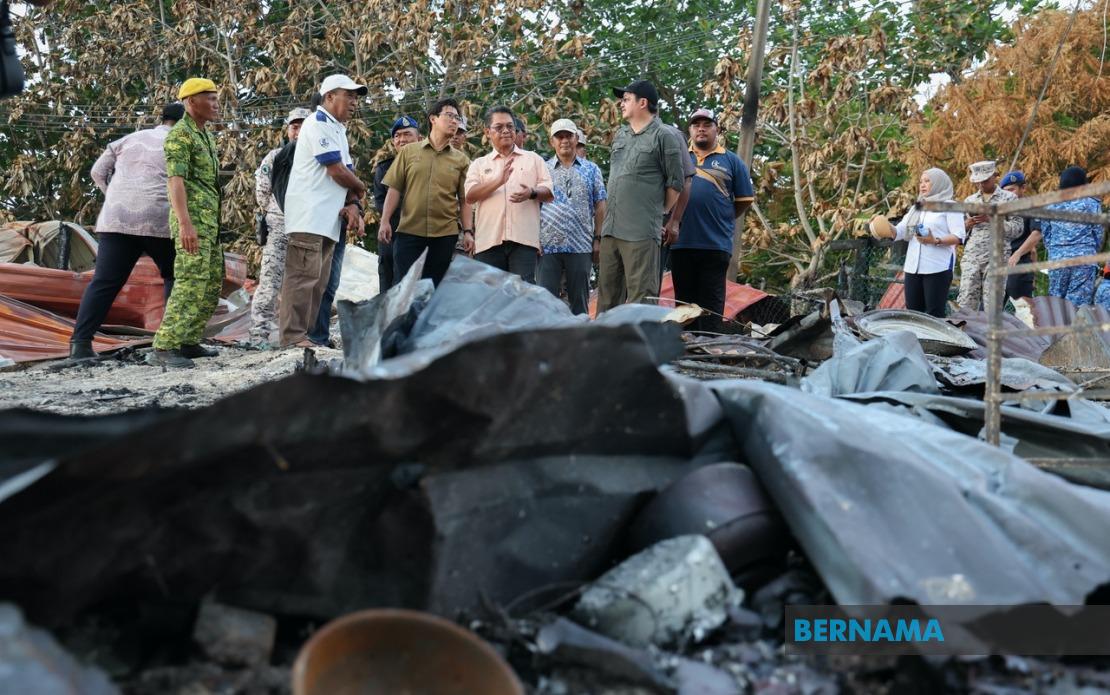
The Federal Government has moved swiftly to support residents of Pulau Nunuyan Laut in Sandakan after a devastating fire destroyed 28 houses and displaced more than 100 people in the early hours of yesterday. Through the Prime Minister's Department (JPM), initial assistance has been extended to 29 household heads affected by the blaze that broke out around 3 am in Kampung Nunuyan Laut. The rapid response underscores the federal administration's commitment to addressing humanitarian emergencies in East Malaysia, where remote island communities often face particular challenges during crises.
Datak Mustapha Sakmud, the Minister in the Prime Minister's Department responsible for Sabah and Sarawak affairs, indicated that the Implementation Coordination Unit has begun executing a multi-pronged relief strategy. Beyond immediate financial assistance, the government has already taken care to source wheelchairs for elderly residents who require mobility support, demonstrating attention to the specific vulnerabilities within the affected population. Mustapha's visit to the fire site accompanied by Sandakan Municipal Council President Datuk Walter Kenson signals high-level governmental engagement with the disaster recovery effort, a gesture unlikely to be lost on residents grappling with sudden displacement.
The coordination framework being established involves multiple layers of government administration working in concert. Mustapha emphasised that the Sandakan Municipal Council and associated agencies have been tasked with conducting a comprehensive needs assessment across all affected families, moving beyond immediate relief toward understanding the full scope of reconstruction required. This systematic approach suggests the government recognises that fire disasters in island communities involve layered challenges—from physical infrastructure to social services—that demand coordinated rather than fragmented responses.
A particularly pressing concern involves critical infrastructure that serves the broader community. The jetty serving as the primary transport route for schoolchildren was damaged in the fire, and Mustapha has specifically flagged this facility for urgent repair through the ICU. The minister's explicit statement that authorities wish to prevent disruption to children's school journeys reveals awareness that disaster recovery extends beyond individual household reconstruction to preserving community functions. For island residents dependent on maritime transport, such infrastructure failures cascade into educational and economic consequences that compound the initial disaster.
Datak Walter provided detail on the second phase of the government's response centred on permanent relocation solutions. The Rural Development Department has been assigned responsibility for determining appropriate resettlement locations, with consideration being given to village reserve land as potential sites for reconstructed communities. This medium-term planning indicates recognition that temporary aid, while essential, must transition toward sustainable housing solutions that restore residents' livelihoods and stability.
A complicating factor in the relocation process is land tenure, which reflects a common challenge in developing Malaysian communities. The fire victims were residing on private land comprising two separate titles or plots, meaning any relocation agreement requires negotiation with private landowners. Walter acknowledged this reality explicitly, indicating that discussions will need to proceed with both property owners to reach arrangements acceptable to affected families and landholders alike. This multi-stakeholder negotiation adds administrative complexity but also emphasises that emergency response in Malaysia's developed areas must navigate property rights alongside humanitarian imperatives.
The government's vision for relocated residents encompasses not merely shelter but comprehensive amenities necessary for dignified living standards. Plans include provision of electricity supply, clean water infrastructure, and maritime access through jetty construction at any relocation site. This holistic approach to infrastructure suggests lessons learned from previous disaster recovery operations—that rebuilding must address interconnected systems rather than isolated elements. For island communities like Pulau Nunuyan Laut's residents, reliable water and power supply represents the difference between viable settlement and marginal existence.
The timing of government intervention reflects Malaysia's institutional capacity to mobilise resources quickly when disaster strikes. Within hours of the fire, senior ministers visited the site, immediate financial assistance reached households, and medium-term planning frameworks were activated. This responsiveness carries particular significance for Sabah's island communities, which occupy a peripheral position in the national economy but constitute integral parts of the Malaysian federation deserving equal emergency response capacity.
The Pulau Nunuyan fire disaster also illuminates ongoing vulnerabilities in Malaysia's smaller communities where overcrowding and limited building regulations can amplify fire risk. The destruction of 28 houses simultaneously suggests clustering of residential structures that may lack adequate fire safety infrastructure or separation standards. As the government pursues relocation, authorities have an opportunity to implement improved building codes and fire prevention measures that could render relocated communities more resilient to future incidents.
Beyond immediate relief, this incident illustrates how disaster recovery in Malaysia operates through federated coordination between federal ministries, state administrative bodies, and local councils. The involvement of JPM, the Sandakan Municipal Council, and the Rural Development Department across successive phases demonstrates institutional architecture designed to ensure no displaced community falls through administrative cracks. For Pulau Nunuyan residents, this framework theoretically guarantees comprehensive support extending from emergency assistance through permanent reconstruction.

