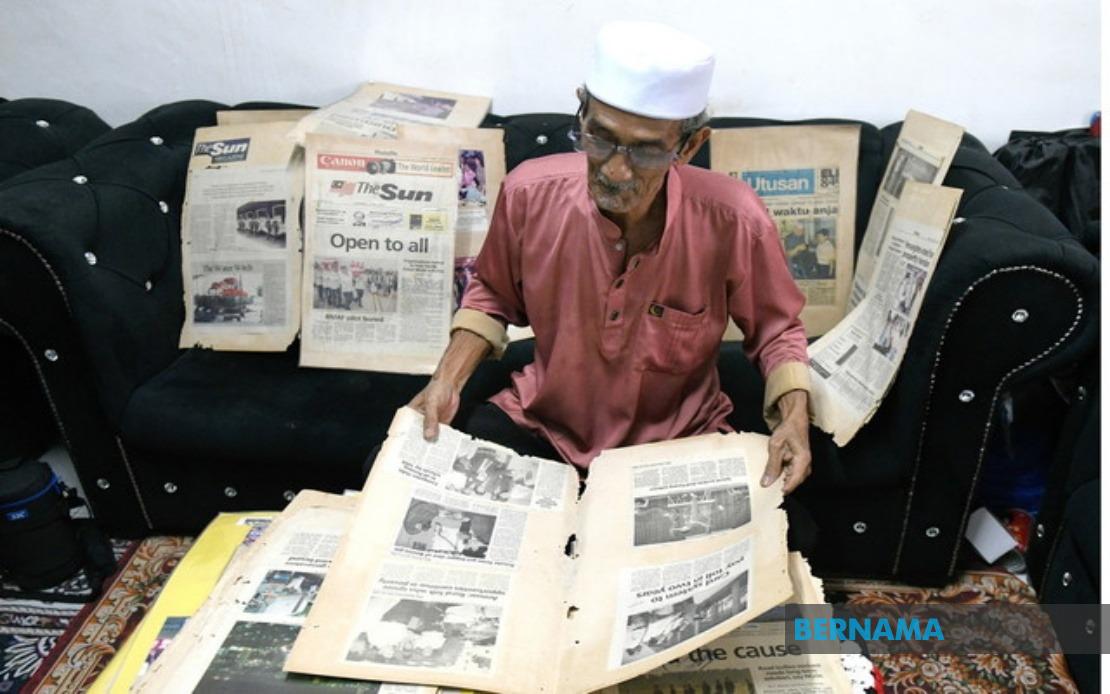
Azmi Sapiei carries scars—both literal and metaphorical—from his thirty-year career capturing Malaysia's unfolding story. The 64-year-old former Bernama photographer and Radio Televisyen Malaysia cameraman has endured physical assaults in pursuit of the shot, including being kicked and spat upon by a suspect during a court case assignment around 2001. Yet these painful moments pale beside what he considers the true test of his profession: the discipline required to document events with accuracy while maintaining the composure necessary to extract genuine news value from every frame.
Azmi's career trajectory mirrors the transformation of Malaysia's media landscape itself. He began his journey in the mid-1980s in a factory setting before the pull of visual storytelling drew him to Kuala Lumpur, where he worked freelance with various agencies and women's magazines. This foundational experience proved invaluable when he joined Bernama in 1993, the national news agency that would become his crucible for professional excellence. Unlike many news organisations that merely hired photographers, Bernama functioned as what Azmi describes as a "school"—an institution that instilled discipline, demanded accuracy, and emphasised that every image must carry genuine news significance beyond mere documentation.
One assignment crystallises the demanding standards Azmi encountered. In July 1994, he secured exclusive photographs of Shamsiah Fakeh, a former Malayan Communist Party member, during her return from China to her nephew's residence in Gombak. The story's exclusivity stemmed from timing and persistence: Azmi and his journalist colleague arrived early enough to gain access before security cordoned off the area. Working with film cameras—the technological standard of that era—he exposed three rolls of film, capturing the scene exhaustively. Upon returning to the office, his editor questioned the quantity, even discarding the rolls in apparent disapproval. Yet when the photographs were developed and published the following day, every major newspaper in Malaysia utilised his images, vindicating both his instincts and the professional gamble he had taken.
The analogue era demanded a fundamentally different skill set than contemporary digital photography. Every frame represented genuine cost—film, development, and printing—making the selection process brutal and intentional. Azmi could not review his work in the field; verification came only after chemical processing revealed whether his composition, timing, and technical settings had succeeded. Beyond capturing images, he bore responsibility for writing photo captions that editors would scrutinise before distribution to Bernama's diverse customer base. This requirement cultivated a discipline that extended photography beyond visual mechanics into narrative construction, forcing photographers to understand not merely how to capture images but why those images mattered to the broader story.
After nearly three years at Bernama, Azmi returned to his Penang hometown to work with The Sun newspaper, a transition that exposed him to the volatility of field assignment work. The incident of being assaulted during court coverage represents an occupational hazard that contemporary photojournalists discuss less frequently than they perhaps should. News photographers often occupy uncomfortable positions—simultaneously present yet separate, documenting events where emotions run high and subjects may view cameras as instruments of their exposure or humiliation. Azmi's resilience through such confrontations speaks to a professional maturity that extends beyond technical competence into emotional fortitude.
His career subsequently expanded into television work with both Bernama TV and, from 2003 until his retirement in mid-2020, RTM Penang as a part-time cameraman. This transition presented distinct physical challenges. Television equipment of that generation proved substantially heavier than still photography apparatus. The Betacam cameras he operated during his Bernama TV tenure, which colleagues colloquially termed "junk iron," weighed approximately twelve kilogrammes—a burden that had to be supported on the shoulder for extended periods during live coverage or lengthy recording sessions. The shift from still to moving images required not merely technical retraining but a wholesale reconstruction of how he approached visual composition, understanding that video demanded different spatial awareness and temporal pacing than still photography.
Azmi's professional journey also illuminates the generational transmission of media expertise within Malaysia. His second son, Muhammad Syafiq, now thirty years old and employed with Media Prima Television Network, grew up observing his father's equipment and gradually transitioned from interested observer to practising cameraman. Following his completion of Sijil Pelajaran Malaysia in 2016, Muhammad Syafiq began accompanying his father to assignment locations, formally operating cameras within a year. Rather than attending formal training programmes alone, Muhammad Syafiq acquired his foundational knowledge through direct mentorship—learning filming techniques, understanding visual angle selection, and internalising the work discipline essential to professional journalism. Azmi thus functioned not merely as a father but as a transmitter of institutional knowledge that might otherwise dissipate when experienced professionals retire.
The evolution from film to digital technology fundamentally reshaped how photographers approach their work, yet Azmi's reflections suggest that the core professional values remain constant. Whether shooting on film cameras that required careful rationing of resources or contemporary digital equipment that permits hundreds of shots without cost, the photographer must still exercise judgment about what constitutes a newsworthy image. The shift toward instant digital feedback has accelerated the decision-making process, yet it has not eliminated the requirement for understanding composition, lighting, and narrative significance. Azmi's career arc—from manual film processing to digital distribution—demonstrates that technological change represents less a fundamental break than an evolution in the tools through which enduring professional principles are executed.
His recognition through the 2006 Penang State Media Award in the visual electronic media category reflected institutional acknowledgment of contributions that extended beyond individual assignments into the broader sphere of Malaysian visual journalism. Yet Azmi's legacy appears less concerned with individual accolades than with the continuation of professional standards through subsequent generations. The pride he expresses regarding his son's career trajectory suggests that the true measure of a media professional's impact lies not in personal achievement but in the transmission of discipline, ethical commitment, and technical excellence to those who follow.
For Malaysian media organisations and journalism educators, Azmi's reflections offer instructive perspective on an era increasingly distant from contemporary practice. The analogue age demanded patience, intentionality, and acceptance of delayed feedback—qualities that the instantaneous digital environment often compromises. Yet those constraints also cultivated professional rigour that perhaps warrants reconsideration as news organisations confront challenges of misinformation and visual manipulation. Azmi's insistence that every image must carry genuine news value, developed through an environment where resources were limited and standards uncompromising, provides a philosophical foundation that transcends technological platforms.