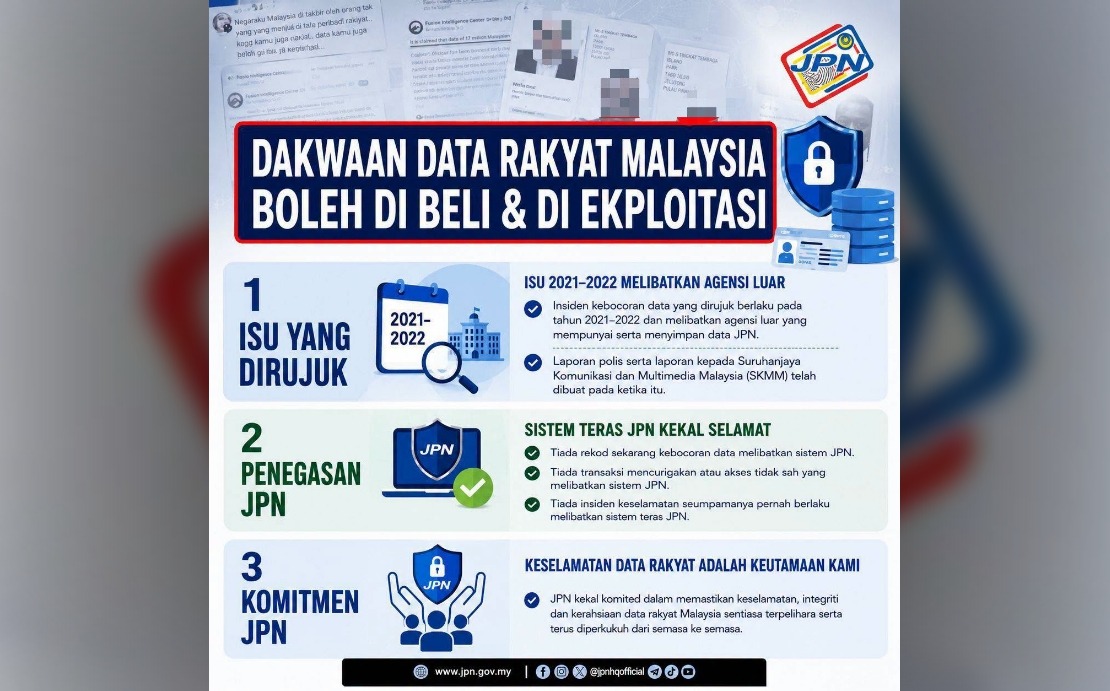
The National Security Council (MKN) moved swiftly to quell public alarm over data leak allegations circulating across social media platforms, establishing that the compromised information stems from cybersecurity breaches that occurred well before 2022 rather than current government or critical infrastructure systems. Through its National Cyber Security Agency (NACSA), the council stressed that while the data was unlawfully extracted through targeted intrusions in earlier years, criminal elements are now deliberately recirculating this stolen information without authorization to amplify its reach and impact.
The distinction made by Malaysian authorities carries significant implications for public trust in digital services. By clarifying that no active breach of current platforms has occurred, the government aims to prevent unnecessary panic while acknowledging that malicious actors continue to exploit previously compromised datasets. This pattern reflects a growing trend across Southeast Asia where organised cybercriminals maintain archives of stolen data harvested over many years, repackaging and reselling access to maximise profit and disruption potential. The timing of such leaks often correlates with attempts to extort organisations or damage public confidence in digital infrastructure.
MACAS and its collaborative partners—MyNIC and the Personal Data Protection Department—have already initiated countermeasures against the illegal distribution networks. These immediate interventions encompass coordinated efforts with overseas service providers to identify, remove, and block access to the websites facilitating unauthorised data dissemination. Such cross-border cooperation is essential given that cybercriminals routinely host illegal content on servers located outside Malaysian jurisdiction, requiring diplomatic and technical arrangements to achieve removal. The agency's proactive approach demonstrates commitment to disrupting the supply chain through which stolen data reaches end users.
Legal responsibility extends beyond those who initially stole the data to individuals and organisations participating in its subsequent distribution. The council emphasised that under Malaysian law, obtaining services built upon unlawfully acquired information constitutes a serious criminal offence, regardless of whether the hosting infrastructure resides within or outside national borders. This expansive legal interpretation reflects international recognition that data crimes transcend geographical boundaries and that jurisdiction over perpetrators must similarly extend beyond territorial limits.
Concurrently, the Royal Malaysia Police has mobilised digital forensic capabilities to investigate those responsible for the original intrusions and ongoing redistribution schemes. Such investigations typically involve tracing financial transactions, identifying command-and-control infrastructure, and reconstructing attack patterns to establish chains of evidence admissible in court. The coordination between civilian cybersecurity agencies and law enforcement reflects the integrated approach Malaysian authorities increasingly employ when addressing complex digital crimes that blur lines between national security and criminal justice.
The government used this incident as an opportunity to highlight pending legislative enhancements designed to close vulnerabilities in Malaysia's existing cyber crime framework. The proposed Cyber Crime Bill, which will be presented to Parliament, introduces significantly stricter penalties for system intrusions, unauthorised data access, and identity theft. Notably, the bill specifically criminalises the use of another person's identity with malicious intent, addressing a gap in protections that cybercriminals have historically exploited. These legislative developments signal that policymakers recognise existing laws require modernisation to match the sophistication and speed of contemporary digital threats.
Complementing legislative reform, the Cyber Security Act 2024, which took effect in August 2024, imposes mandatory protective obligations on organisations operating or managing National Critical Information Infrastructure (NCII). These entities must now implement comprehensive security measures including documented codes of practice, regular risk assessments, and periodic security audits. This framework shifts responsibility from government agencies alone to private-sector entities handling sensitive systems, reflecting the reality that critical infrastructure increasingly relies on private operators from telecommunications to banking to energy distribution.
The council offered reassurance regarding MyDigital ID, which has surpassed 16 million registrations nationwide, clarifying persistent misconceptions about its architecture and security model. Rather than functioning as a centralised repository storing personal data, MyDigital ID operates as an authentication platform that verifies user identity by querying the National Registration Department in real-time. This decentralised approach significantly reduces the risk profile compared to centralised databases, as no single system contains comprehensive personal information. The distinction matters enormously for public confidence, as it demonstrates that the digital identity infrastructure underpinning government and financial services incorporates privacy-by-design principles.
Wide adoption of MyDigital ID across government agencies and private financial institutions represents a deliberate strategy to enhance transaction security while combating identity fraud. As more services integrate this authentication mechanism, the friction for criminals attempting to impersonate legitimate users increases substantially. Banks, telecommunications providers, and government agencies collectively benefit from the consistency and reliability this unified identity verification system provides, reducing fraudulent transactions while streamlining legitimate user access.
The MKN reaffirmed its overarching commitment to enabling Malaysians to participate fully in digital transformation without compromising security or privacy. This articulation reflects recognition that cybersecurity cannot function as an impediment to innovation but must instead operate as an enabler, building confidence in digital systems through robust protective measures and transparent communication. The positioning of NACSA and the council as institutions prepared to address emerging threats sends deliberate signals to the public and private sectors that cybersecurity capabilities are being continuously developed and deployed.
Moving forward, the Malaysian cybersecurity landscape will be shaped significantly by the legislative reforms currently under development and the strengthened enforcement activities already underway. For businesses and individual users across the region observing Malaysia's response, the emphasis on interdepartmental coordination, legislative modernisation, and transparent public communication offers a model for how nations might address data crimes that inherently span multiple jurisdictions. The incident underscores that protecting digital infrastructure requires sustained investment in technical capabilities, legal frameworks, and international partnerships—none of which individually suffice without the others.