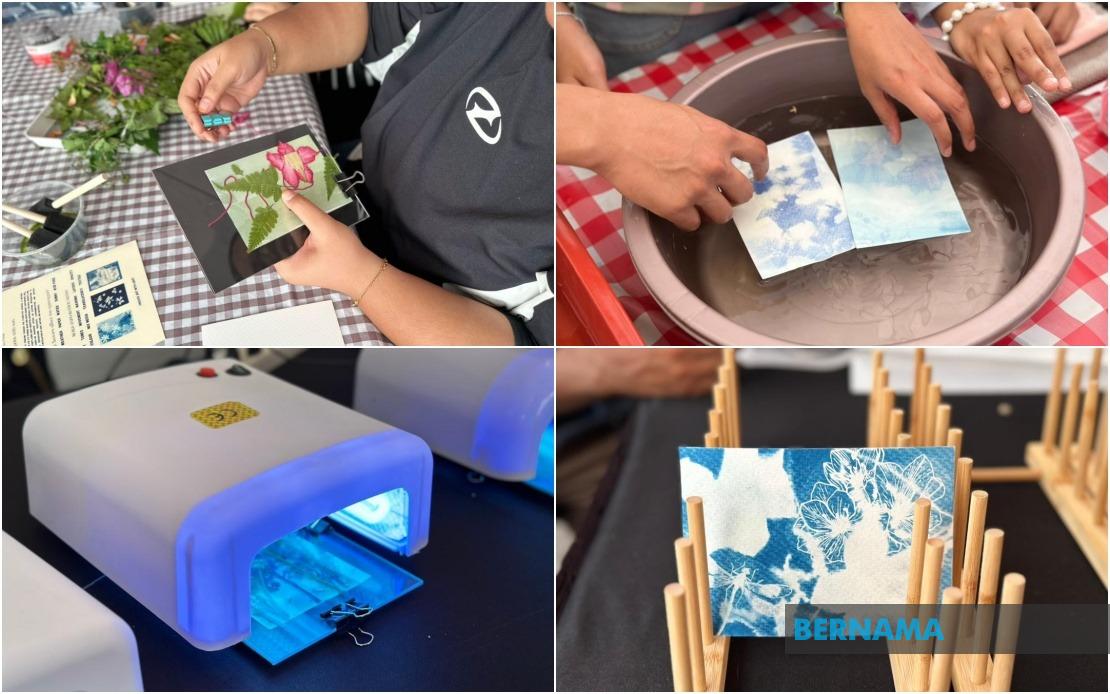
For most people, sunlight is simply a constant backdrop to daily life. But for Penang-born artist Puteri Mas Aishah Ramyusnali, the sun has become a collaborator in her creative practice, with each fluctuation in weather and ultraviolet exposure reshaping the visual outcome of her work. The 24-year-old cyanotype practitioner, who demonstrated her technique at the RIUH Pi HAWANA Carnival at the PICCA Convention Centre @ Arena Butterworth, has discovered that this ancient photographic process offers far more than an intriguing aesthetic—it serves as a lens through which to examine the intricate relationship between human activity and the natural world.
Cyanotype, a contact-printing method dating back to the 19th century, relies on precise atmospheric conditions to function. Puteri Mas Aishah's artistic journey began three years ago when she first encountered the technique during her studies. The process itself is deceptively simple in description yet demands attentiveness to environmental variables that most contemporary artists rarely consider. Objects—leaves, flowers, botanical specimens, or found materials—are arranged directly onto paper that has been treated with a light-sensitive iron compound. This prepared surface is then exposed to sunlight for between 10 and 15 minutes, depending on atmospheric conditions and the intensity of UV radiation present on any given day.
What transforms this into a completed artwork is the subsequent washing process, where the paper undergoes immersion in both acidic and alkaline solutions. It is at this critical stage that the characteristic prussian blue image emerges gradually, revealing what sunlight has inscribed upon the treated paper. The timing and temperature of these wash cycles, alongside the mineral content of available water sources, all contribute to the final tonal range and depth of the print. For Puteri Mas Aishah, a Master of Fine Arts and Technology student at Universiti Teknologi MARA, this interplay between human intention and natural forces has become central to how she understands artistic creation itself.
The artist's investment in tracking daily meteorological patterns reflects a philosophical stance increasingly rare in contemporary art practice. She monitors weather forecasts not merely to plan her workshop schedule but because atmospheric conditions directly determine the vibrancy and saturation of her prints. Days with elevated UV intensity typically yield more concentrated and luminous blue tones, while overcast conditions necessitate extended exposure times and produce subtly different chromatic effects. This sensitivity to environmental variables transformed what might have remained a technical curiosity into a profound meditation on human dependence on natural systems—a dependence that urban life often renders invisible.
Puteri Mas Aishah's transition from student to educator occurred almost serendipitously during her industrial training placement, when she was invited to lead public workshops introducing cyanotype to audiences with no prior exposure to the medium. She initially harboured significant anxiety about conducting these sessions independently, without the reassuring presence of academic mentors or supervisors to guide her through unexpected complications. Yet this apprehension dissipated once she encountered the genuine enthusiasm and curiosity of workshop participants encountering the technique for the first time. That initial experience kindled a deeper commitment to the discipline, transforming her from practitioner into advocate.
Since establishing herself as an educator, Puteri Mas Aishah has cultivated an expanding network of collaborations with art studios and galleries concentrated in the Shah Alam region of Selangor. These partnerships have allowed her to reach increasingly diverse audiences and to refine her pedagogical approaches based on direct feedback from participants spanning various age groups and educational backgrounds. The workshops themselves function as more than technical instruction—they operate as interventions designed to shift how participants conceptualise the relationship between artistic practice and environmental consciousness.
At the heart of Puteri Mas Aishah's artistic philosophy lies a conviction that contemporary society has become disconnected from understanding art's instrumental role in everyday existence. She observes that younger generations particularly tend to regard artistic practice as peripheral to meaningful social contribution, a perception she considers fundamentally mistaken. Through cyanotype specifically, she demonstrates how artistic work can function simultaneously as environmental education, meditative practice, and substantive commentary on human agency within natural systems. The medium itself refuses the separation between aesthetic intention and ecological awareness that characterises much contemporary visual production.
The artist articulates her aspirations for the field with particular emphasis on reaching young people who might otherwise dismiss art as superfluous or impractical. She envisions a cultural context in which artistic endeavour is understood not as luxury or decoration but as essential to how societies develop sustainable relationships with their environments. Cyanotype, with its absolute dependence on solar energy and natural materials, embodies these principles materially. Every print produced represents a negotiation between human creativity and forces entirely beyond individual control, a negotiation that mirrors larger questions about humanity's place within ecological systems.
Puteri Mas Aishah's emergence as a significant voice within Malaysian contemporary art practice arrives at a moment when environmental consciousness is becoming increasingly urgent across Southeast Asia. Her work demonstrates that art practice can function as a sophisticated form of environmental literacy, teaching participants to attend more carefully to weather patterns, UV cycles, water chemistry, and seasonal variations. For Malaysian audiences accustomed to thinking of art primarily in terms of commercial galleries or entertainment value, cyanotype offers a radically different model—one in which aesthetic creation becomes inseparable from ecological awareness and sustainability concerns.