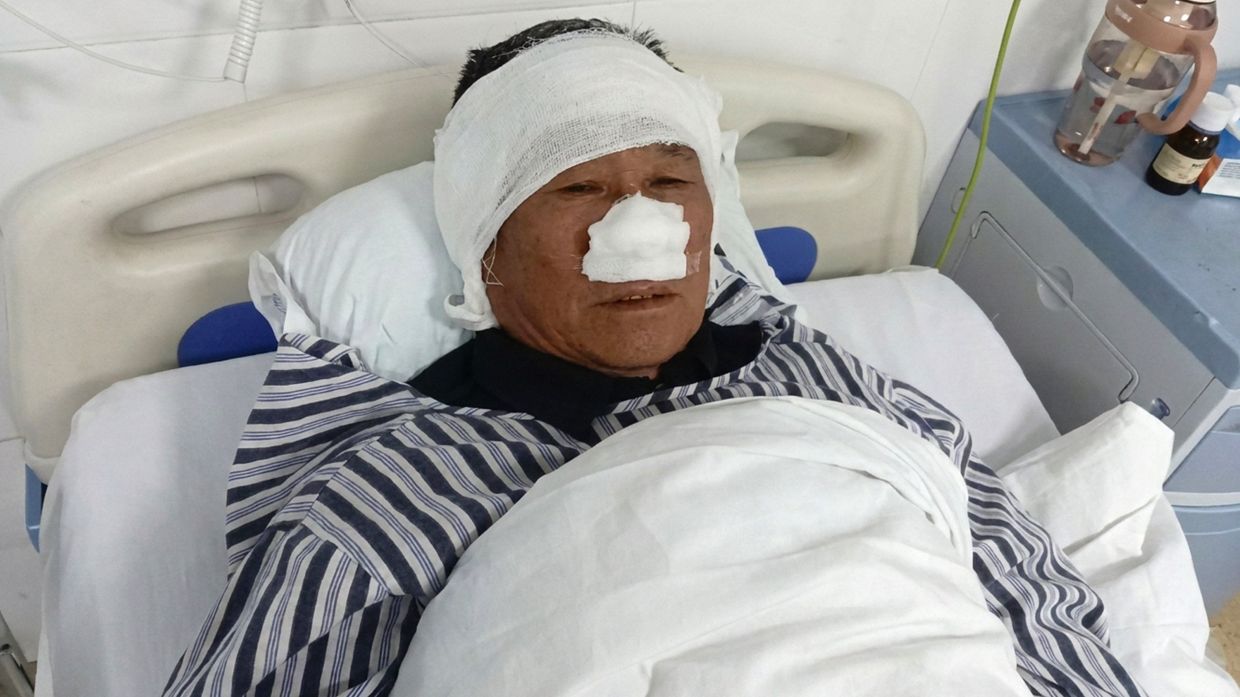
A 69-year-old community volunteer from central China has been officially recognised as a national hero by the Chinese government following an extraordinary act of courage that cost him most of his nose. Zeng Fanlin, from Chenzhou in Hunan province, stepped in to protect a woman under violent assault in April, disregarding the danger to himself and ultimately enduring a serious permanent injury. His inclusion on the government's latest roster of "national heroes for a just cause" in July underscores a broader cultural emphasis in China on celebrating ordinary citizens who intervene to prevent harm and uphold public safety.
Zeng's background provides crucial context for understanding his decision to act. Orphaned during his childhood, he was raised with support from his village community and later received government assistance to complete his formal education. This formative experience of depending on others' goodwill shaped his worldview and sense of obligation to contribute to society. Throughout his life, he channelled this commitment into service, first as a village official and subsequently as a volunteer dispute mediator, a role that positioned him to help neighbours resolve conflicts and maintain community cohesion. His daughter has characterised him as possessing an unwavering moral compass and an inability to remain passive when confronted with injustice, traits that had already manifested in his willingness to assist police in apprehending a thief in 2016.
The incident that transformed Zeng into a nationally recognised figure unfolded when a man in his twenties appeared in the village and began a disturbing spree of violence. The attacker moved through the community assaulting random people and forcibly kicking at residential doors, creating a climate of fear among residents. The situation escalated dramatically when the assailant targeted a woman riding an electric bicycle, seizing her by the throat and subjecting her to what appeared to be an imminent strangulation. Bystanders, intimidated by the attacker's aggression and unpredictability, opted to summon police rather than directly intervene, leaving the woman in immediate mortal danger as the assault continued.
Zeng's intervention was instinctive rather than calculated. Witnessing the assault on the woman, he moved directly toward the attacker and physically tackled him, initiating a violent struggle. Two other villagers quickly recognised the necessity of additional assistance and joined Zeng in restraining the assailant. During the chaotic confrontation, the attacker resorted to biting, inflicting severe damage to Zeng's face. Despite experiencing what must have been excruciating pain from the wound, Zeng maintained his grip on the attacker until police officers arrived and took control of the situation. The suspect was arrested at the scene, while Zeng was transported urgently to hospital for emergency treatment.
Medical assessments revealed the extent of the damage. Doctors determined that the majority of Zeng's nose had been completely severed or destroyed, presenting extraordinarily difficult reconstructive challenges. The surgical team warned that even with intervention, the recovery would be prolonged and potentially complicated by long-term pain, scarring, and potential functional limitations. The estimated cost of the reconstructive procedures exceeded 70,000 yuan, equivalent to approximately US$10,000, a substantial sum that was ultimately covered through government financial support combined with community assistance.
The medical team devised an elaborate reconstruction strategy spanning multiple surgical procedures. Zeng underwent two operations in which surgeons employed a skin graft harvested from his scalp to rebuild the damaged nasal structure and reconstruct the nasal wings, ultimately restoring sufficient function to allow normal breathing. While these interventions achieved important functional goals, Zeng continues to experience daily pain, a reminder of the physical toll his heroic action extracted. The recovery timeline extended across more than six months, during which he endured ongoing discomfort and required careful wound management.
Beyond government recognition, Zeng received financial recognition from prominent organisations. The Alibaba Foundation and regional media outlets awarded him an additional 20,000 yuan in recognition of his demonstrated bravery, supplementing the government support. In July, his name appeared among 86 individuals officially designated as "national heroes for a just cause" by the Chinese government, an honour that reflected his actions and embodied state values regarding civilian heroism and selfless conduct.
Zeng's philosophical response to his ordeal demonstrates remarkable perspective and resilience. When asked about the sacrifice he had made, he told local media that when compared with the value of preserving human life, his injuries represented an acceptable trade. This statement encapsulates a form of moral clarity uncommon in contemporary society, suggesting that he views the outcome as fundamentally justified and correct. His willingness to articulate this perspective publicly has resonated with observers, who have used his story as an exemplar of authentic heroism in everyday contexts.
The broader legal context surrounding the case also carries significance. Under Chinese criminal law, deliberately inflicting severe bodily injury carries potential sentences ranging from three to ten years imprisonment. The attacker's case remains under investigation, though authorities have indicated his violent episode stemmed from emotional dyscontrol. The woman whose life was likely saved by Zeng's intervention has not made any public statement regarding the incident or her rescue.
Zeng's story holds particular resonance across Southeast Asia and beyond, representing a cultural moment when civic courage and personal sacrifice receive formal governmental recognition. In an era often characterised by social fragmentation and reluctance to intervene in public crises, his actions and subsequent honouring offer a compelling counternarrative. The narrative also highlights broader questions about social responsibility, community obligation, and the psychological and physical costs borne by those who choose action over passivity when witnessing harm. For Malaysian readers, where community values and interpersonal responsibility remain culturally significant, Zeng's example provides both inspiration and a sobering reminder of what genuine intervention sometimes requires.

