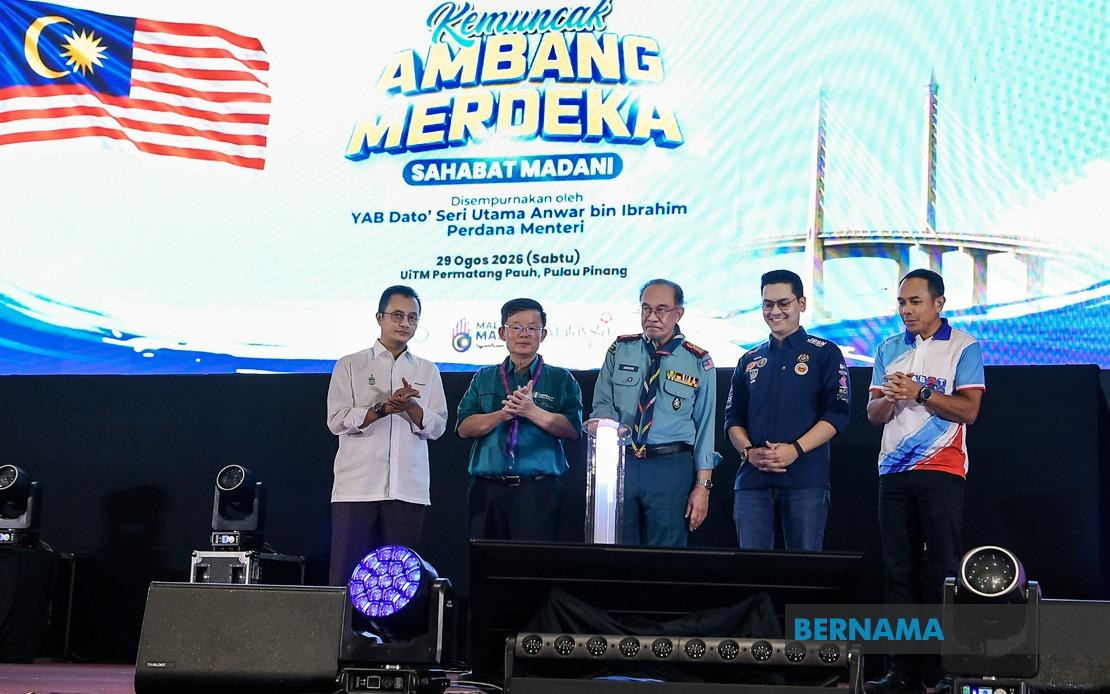
Prime Minister Datuk Seri Anwar Ibrahim has unveiled Sahabat MADANI, an ambitious nationwide volunteer initiative designed to mobilise grassroots civic participation in the pursuit of shared prosperity across Malaysia's diverse communities. The programme, officially launched at Universiti Teknologi MARA (UiTM) Permatang Pauh in Bukit Mertajam during the Ambang Merdeka Sahabat MADANI 2026 highlight programme, has already registered 11,060 volunteers across the country, signalling considerable early momentum for what the government views as a cornerstone of its reform agenda.
The volunteer movement represents a deliberate attempt to operationalise the Malaysia MADANI framework—the government's overarching vision of shared wellbeing—by channelling public energy into concrete community services. Rather than remaining confined to policy documents or ministerial pronouncements, the initiative seeks to embed the concept of collective responsibility into everyday action at the grassroots level. The Implementation Coordination Unit of the Prime Minister's Department (ICU JPM) emphasises that Sahabat MADANI transcends traditional charity work, positioning itself as a structural mechanism for building bridges between government institutions, civil society volunteers, and communities themselves.
The operational focus of Sahabat MADANI reflects pragmatic priorities drawn from identified social needs. Volunteers will concentrate their efforts on supporting vulnerable populations—a category encompassing the chronically poor, elderly persons without family support, and individuals facing temporary hardship. The initiative particularly targets school dropout prevention and intervention, recognising that educational discontinuity remains a significant drag on social mobility and long-term economic participation. Beyond immediate welfare concerns, the programme aims to expand opportunities for youth employment and entrepreneurship, addressing a persistent anxiety among Malaysian policymakers regarding youth underemployment and its attendant social risks.
What distinguishes Sahabat MADANI from conventional volunteer programmes is its explicit emphasis on cross-communal participation. The government frames the initiative as fundamentally about bringing together citizens from different ethnic, religious and socioeconomic backgrounds to work toward common objectives. This framing carries particular significance in a Malaysian context where communal polarisation has periodically threatened social cohesion. By institutionalising regular interaction among volunteers of diverse backgrounds through structured community projects, the initiative implicitly assumes that sustained cooperation on shared problems can erode divisive sentiments and reinforce the perception of mutual interdependence.
The timing of the launch, coinciding with Malaysia's National Day commemorations, carries symbolic weight that officials are evidently keen to exploit. The ICU JPM's statement draws an explicit connection between the country's independence as a nation and citizens' independence as moral agents capable of serving others. This rhetorical move transforms volunteering from an optional charitable impulse into an expression of patriotic duty—a reframing that may resonate with citizens inclined toward civic participation but also risks sounding coercive to those sceptical of government-coordinated social mobilisation.
The initiative's emphasis on transparency and responsiveness to community-identified needs represents a tacit acknowledgement that previous top-down development initiatives have sometimes missed their intended targets or imposed solutions misaligned with local priorities. By making ICU JPM's coordinating role explicitly responsive to volunteer and community feedback, the government appears to be attempting to decentralise decision-making authority and reduce bureaucratic friction. Whether this aspiration translates into actual practice will depend on how institutional incentives are structured and how power is genuinely distributed between central coordinators and volunteer networks.
For Malaysia's youth population—a demographic cohort that has reportedly shown declining engagement with mainstream political and civic institutions—Sahabat MADANI represents an attempt to offer meaningful participation channels beyond electoral politics. The government's explicit call for young people to reject divisive rhetoric and channel their skills toward national progress suggests concern that without alternative outlets for civic energy, younger citizens may gravitate toward more radical or nihilistic positions. The volunteer framework theoretically offers a way for youth to accrue social capital, develop professional skills, and experience tangible impact while remaining loosely aligned with government development objectives.
The 11,060 registrations achieved within the initial launch window suggest the initiative has struck a chord with at least a segment of the Malaysian public. However, converting registrations into sustained volunteer engagement presents an altogether different challenge. Many volunteer programmes struggle with retention as the novelty wears off and volunteers reallocate time toward competing demands. Success will ultimately hinge on whether the government can maintain volunteer motivation through regular coordination, adequate resourcing of projects, and genuine acknowledgement of volunteer contributions.
From a regional perspective, Malaysia's embrace of formal volunteer mobilisation under a comprehensive national framework reflects broader trends across Southeast Asia toward strengthening social fabric through organised civic engagement. Nations facing urbanisation pressures, demographic change, and the erosion of traditional community structures are increasingly seeking to cultivate new forms of collective identity and mutual obligation. Sahabat MADANI occupies this space—attempting to harness modernisation's potential for enhanced social organisation while simultaneously addressing vulnerabilities that traditional structures previously absorbed.
The programme's success will ultimately be measured not by volunteer registration numbers but by the quality and reach of services delivered to vulnerable populations and the measurable strengthening of intercommunal ties among participants. As Malaysia navigates political transitions and addresses persistent inequality, whether Sahabat MADANI becomes a durable institutional mechanism for inclusive development or merely another well-intentioned initiative that fades from public consciousness remains an open question. The forthcoming months will reveal whether the initial enthusiasm of 11,060 volunteers can translate into the kind of sustained, transformative community impact that the government envisions.

