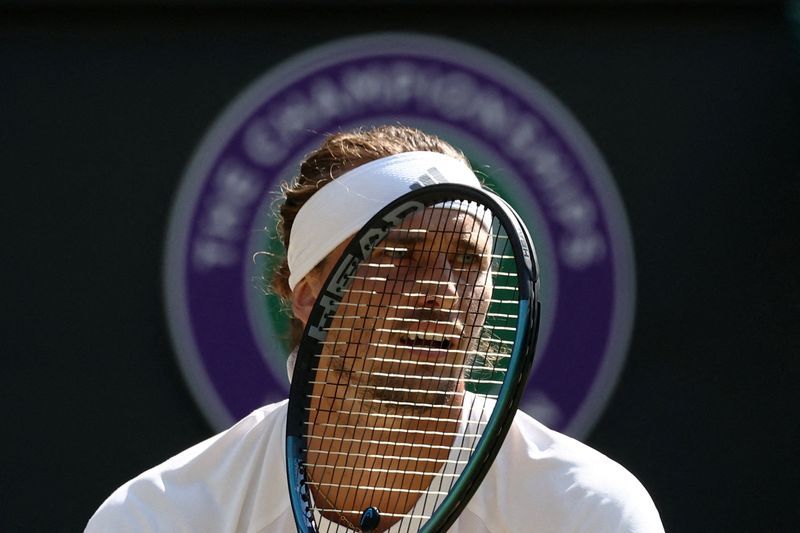
Alexander Zverev has dismantled a significant psychological barrier on his path to Wimbledon glory by comprehensively beating Taylor Fritz 6-4 6-4 6-2 in the quarter-finals on July 8, propelling the German second seed into the semi-finals. The victory represents far more than a routine progression through the tournament bracket. Zverev had endured a tortuous two-year drought against Fritz, losing their last seven encounters including a particularly frustrating defeat at the All England Club just twelve months earlier. This latest triumph demonstrates not merely improved tactical execution but a fundamental shift in the mental contest between the two competitors.
The match itself unfolded with Zverev orchestrating a masterclass in controlled aggression. On a sweltering Court One, the German established an early break and held firm when Fritz mounted a late challenge in the opening set's tenth game. The psychological significance of consolidating that 5-4 advantage proved crucial, as it signalled to both players that Zverev's trajectory had fundamentally altered. Rather than succumbing to the mounting pressure that typically accompanied their encounters, Zverev elevated his intensity precisely when Fritz might have expected to capitalise on familiarity and recent success.
Fritz's physical condition deteriorated progressively throughout the encounter. A medical timeout for a right knee issue after just three games of the second set provided Zverev with the opportunity to capitalise on a vulnerable opponent. Yet the German's performance transcended mere opportunism. He seized the decisive break immediately following the interruption and celebrated with unmistakable relief, recognising the historical weight of extending his advantage. Zverev's emphatic responses to key moments throughout the second set reflected genuine catharsis after years of falling short against an opponent who had become something of a nemesis.
By the third set, the contest had effectively concluded as a meaningful competition. Zverev demonstrated his complete toolkit, producing a scintillating backhand winner to secure a double break at 4-1 before closing out proceedings with minimal resistance. The clinical efficiency of his final-set performance showcased a player operating at genuine peak levels, unmarred by the self-doubt that occasionally surfaces when previous demons resurface. His 12th Grand Slam semi-final appearance now takes him into uncharted territory at Wimbledon specifically, where he had previously fallen short of the last four.
Zverev's breakthrough into the Wimbledon semi-finals carries particular resonance within German tennis history. His achievement positions him as the fifth German man in the professional era since 1968 to reach this stage of the championships. This lineage extends through legendary champions Boris Becker and Michael Stich, as well as the accomplished careers of Rainer Schuettler and Tommy Haas. The weight of German tennis tradition, which has produced multiple Wimbledon champions, now rests partly upon Zverev's shoulders as he pursues consecutive Grand Slam titles following his recent French Open success.
Zverev himself acknowledged the immense concentration required to overcome the Fritz psychological barrier. In post-match remarks, he reflected on the burden of confronting an opponent against whom he had suffered repeated defeats. The German explained that facing Fritz while harbouring the memory of consecutive losses created an almost suffocating awareness during key moments. He disclosed that early in his service games, particularly during the opening set, he faced multiple break points that demanded exceptional focus to repel. These vulnerabilities would normally present opportunities for an opponent possessing Fritz's pedigree and recent form against Zverev.
The German's assessment of his own performance bordered on unusual candour. Rather than attributing victory to fluctuations in form or tactical adjustments, Zverev emphasised the necessity of performing near-perfectly throughout the match. His characterisation of the requirements suggests someone who recognises that psychological factors, rather than purely technical limitations, had previously constrained him against Fritz. This represents genuine insight into the mental architecture of elite sport, where long-standing rivalries can become infected by narrative weight that transcends objective quality differences.
Zverev's opponent in the semi-finals will be Arthur Fery, who overcame Flavio Cobolli to claim his own first Wimbledon semi-final berth. The fixture presents a fascinating dynamic within the context of Wimbledon's narrative arc. Fery represents the home hope carrying British expectations, while Zverev arrives as the established international contender seeking to complete a remarkable Grand Slam sequence. Zverev's magnanimous acknowledgement of Fery's achievement and his self-deprecating humour regarding the crowd's likely allegiances suggests a player sufficiently confident in his abilities to afford such gracious remarks.
The semi-final confrontation will test whether Zverev's psychological breakthrough against Fritz extends to sustaining momentum against fresh opposition operating on home soil. Grand Slam trajectories frequently encounter unexpected complications when favourites face determined challengers in the latter stages, particularly when that challenger enjoys crowd support. Nevertheless, Zverev's comprehensive disposal of Fritz provides genuine grounds for confidence regarding his championship credentials. The German has demonstrated not merely improved form but the psychological resilience required to transcend established patterns of defeat.
For Malaysian and Southeast Asian tennis observers, Zverev's progression carries relevance beyond the immediate Wimbledon narrative. His career trajectory illustrates the sustained commitment required to overcome adversity within sport's highest echelons. The two-year period during which he struggled against Fritz would have tested the resolve of lesser competitors, yet Zverev persisted with his development and ultimately prevailed. His back-to-back Grand Slam ambitions, anchored by the French Open triumph, represent the kind of sustained excellence that defines genuinely elite athletes.
Zverev's advancement to the Wimbledon semi-finals reflects the modern landscape of men's tennis, where multiple players continue to accumulate major titles deep into their late twenties. His positioning as second seed carries inherent pressure, yet his quarter-final performance demonstrated the mental fortitude required to convert seeding advantages into meaningful progression. The upcoming semi-final against Fery will determine whether Zverev can continue writing the next chapter of what increasingly appears a defining period in his professional career.

