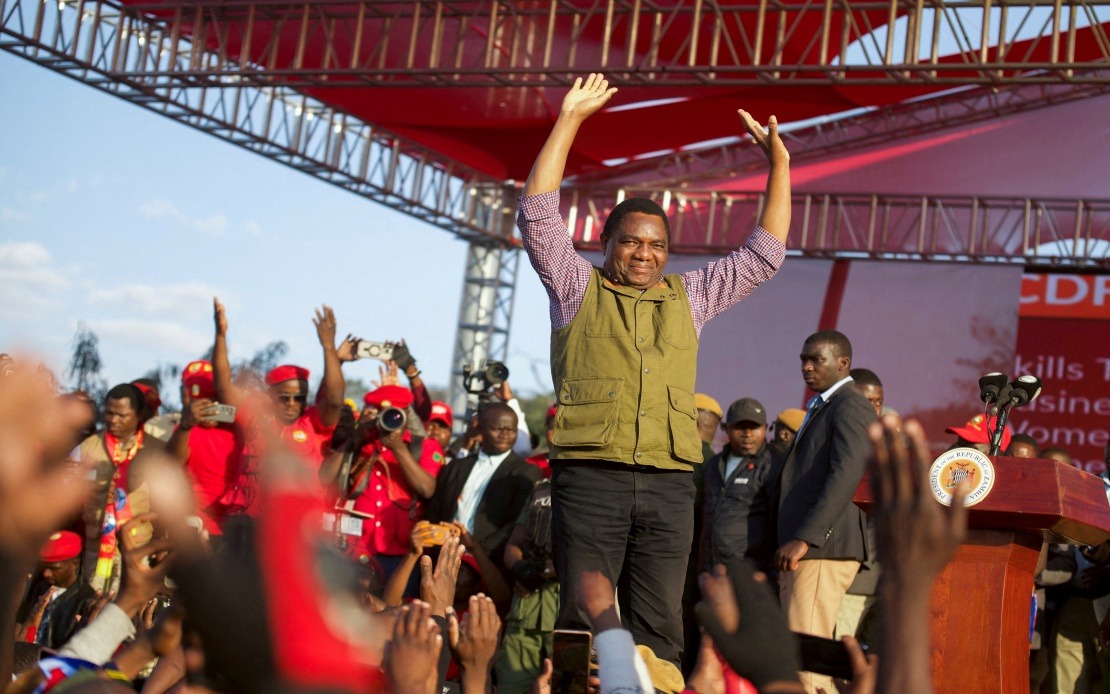
Zambian President Hakainde Hichilema has secured a commanding mandate for a second term after the Electoral Commission of Zambia announced results early Tuesday, declaring him president-elect with more than 2.9 million votes. The 64-year-old leader comfortably surpassed the constitutionally required threshold of 50 per cent plus one vote, demonstrating substantial public backing for his administration's direction over the past term. The electoral victory marks a significant endorsement of his leadership and governing agenda as Zambia navigates complex economic and social challenges in the Southern African region.
Hichilema's principal challenger, Brian Mundubile of the National Restoration Party for Unity and Progress (NRPUP), secured 1.8 million votes, placing him considerably behind the incumbent. The margin of victory reflects the considerable gap between the ruling party's support base and opposition parties, suggesting Hichilema's United Party for National Development (UPND) maintains stronger organizational capacity and public resonance than competing political movements. The contest, held last Thursday, represented the culmination of an election campaign that tested various policy platforms and leadership approaches across the nation.
Electoral Commission of Zambia chairperson Mwanagala Zaloumis announced that Hichilema's victory proved sufficiently decisive that outstanding results from selected polling stations in five of the country's 226 constituencies would not alter the overall outcome. This assessment underscores the comprehensive nature of Hichilema's electoral support across geographic and demographic divides. The commission's confidence in declaring the outcome reflects the magnitude of his victory margin and demonstrates the robustness of Zambia's electoral processes in delivering clear results despite the logistical complexities involved in conducting nationwide polling.
Following the official announcement at the national election centre in Lusaka, Hichilema expressed gratitude to the electorate through a Facebook post, emphasizing his administration's commitment to serving the nation. His message struck a notably humble tone, framing his re-election as renewed public trust rather than personal triumph. The president-elect pledged continued dedication to governance, positioning his second term as an opportunity to build upon initiatives launched during his first administration and to address outstanding challenges requiring sustained policy attention.
The streets of Lusaka erupted in spontaneous celebration as the results became public, with citizens from diverse backgrounds gathering to mark the electoral outcome. Crowds assembled in the early morning hours despite cold weather conditions, indicating the genuine popular sentiment surrounding the election's conclusion. The jubilant scenes reflected the broader significance Zambians attach to democratic processes and the peaceful transfer and renewal of electoral mandates, reinforcing the country's democratic institutions across multiple cycles.
Collins Maoma, national chairperson of the ruling United Party for National Development, characterized the outcome as evidence of sustained public confidence in Hichilema's leadership approach. Addressing reporters, Maoma called upon the president to maintain the governance standards and policy direction that had evidently resonated with voters. His statements highlighted the party's interpretation of the election result as a validating signal for its broader political platform and administrative priorities. The UPND's ability to retain power following competitive elections demonstrates institutional legitimacy and organizational effectiveness within Zambia's political landscape.
The re-election carries implications extending beyond Zambian borders, as Hichilema's leadership influences regional dynamics and international relations across Southern Africa. His administration's policies concerning trade, infrastructure, and governance have attracted regional attention, and his continued leadership provides continuity in bilateral and multilateral engagements. For Malaysian observers and policymakers, the Zambian election exemplifies democratic practice in the African context and reflects broader patterns of electoral competition and political consolidation occurring across the continent.
Hichilema's second-term victory provides opportunity to advance developmental priorities that require sustained commitment beyond single electoral cycles. Issues including economic recovery, infrastructure modernization, and human capital development typically benefit from policy consistency and long-term planning horizons. The decisive mandate he has received from voters offers political capital and public legitimacy to pursue potentially challenging reforms that might encounter resistance during more constrained electoral circumstances. His administration can leverage this freshly validated support to tackle complex policy questions requiring sustained political will.
The election process itself reflects evolution in Zambian democratic institutions and electoral administration. Despite the challenges inherent in conducting elections across a geographically dispersed nation, the Electoral Commission of Zambia successfully managed balloting, vote counting, and result verification procedures that generated public confidence. The transparency demonstrated by commission officials in explaining why outstanding results would not materially affect outcomes suggests growing sophistication in electoral governance. These institutional developments matter considerably for regional stability and democratic credibility across Southern Africa.
Looking forward, Hichilema faces diverse governance challenges requiring skilled administration and coalition management. His second term will unfold amid regional economic uncertainty, climate variability affecting agricultural output, and evolving social demands across Zambian society. The substantial electoral margin he has secured provides foundation for pursuing a coherent policy agenda but does not eliminate the necessity for effective governance, inclusive policymaking, and transparent accountability. His ability to translate electoral victory into tangible improvements in living standards and institutional performance will ultimately determine the success of his second administration and shape Zambia's trajectory during the coming five years.

