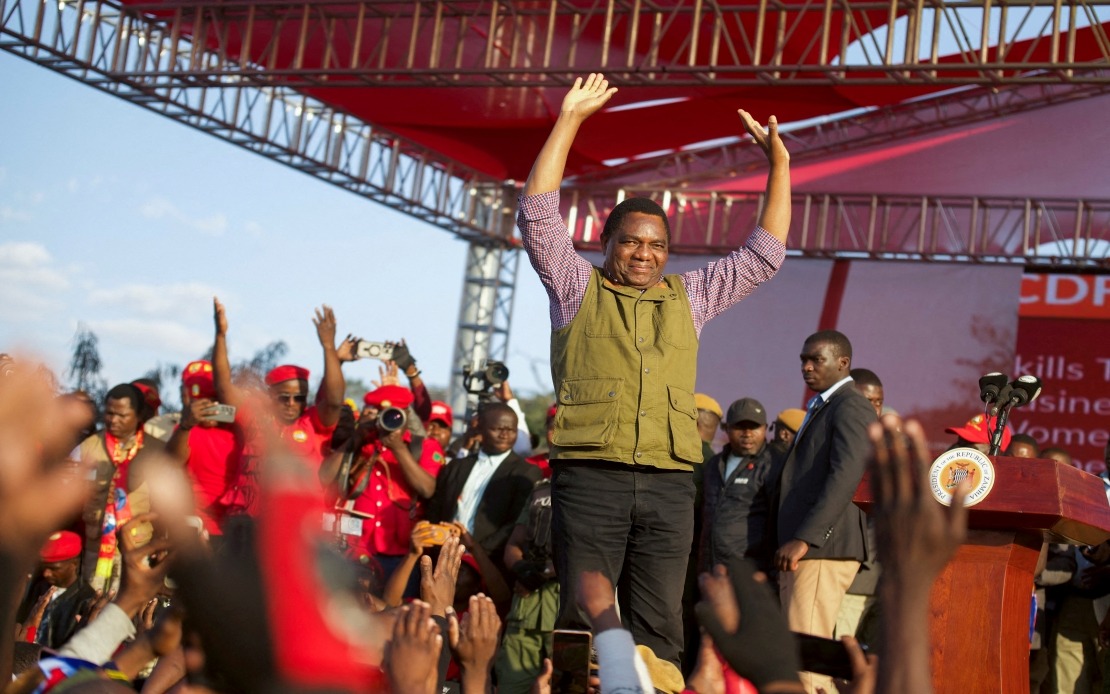
Zambian President Hakainde Hichilema has established a formidable advantage in his country's presidential race, having secured more than 1.5 million votes as results from 135 of the nation's 226 constituencies were tallied by the Electoral Commission of Zambia. The 64-year-old economist and rancher, campaigning under the ruling United Party for National Development (UPND), accumulated 1,544,140 votes through Sunday's count, substantially ahead of his nearest rival as the electoral commission continues compiling returns at its headquarters in Lusaka.
Brian Mundubile, the 55-year-old lawyer representing the National Reconciliation Party for Unity and Prosperity (NRPUP), trails significantly with 1,030,662 votes after nearly 60 per cent of constituencies have reported results. The gap between the two frontrunners underscores Hichilema's strong position as the process advances, though the formal declaration remains pending until results from all 226 constituencies are finalized. Electoral Commission of Zambia Chairperson Mwangala Zaloumis announced the consolidated figures at the National Election Results Centre in Lusaka during the early hours of Monday morning, confirming that 12 candidates remain in contention for the presidency.
For Hichilema, victory in this election would represent validation of his first-term stewardship and provide a mandate to pursue second-phase reforms across the Southern African nation. His initial triumph in 2021 unseated incumbent Edgar Lungu by a margin exceeding one million votes, delivering one of the region's most decisive electoral outcomes. That decisive victory reflected public frustration with economic management under Lungu's administration and generated significant anticipation for the incoming president's reform agenda.
During his first term since 2021, Hichilema has emphasized debt restructuring as a cornerstone achievement, tackling one of Zambia's most pressing economic challenges. The country had accumulated levels of external debt that constrained fiscal flexibility and limited government capacity to invest in public services. Through negotiations with bilateral and multilateral creditors, the administration has pursued a more sustainable debt trajectory, creating space for public investment and improving investor confidence in Zambian financial stability. These debt rehabilitation efforts represent the kind of technical economic work that often receives limited attention from voters but holds substantial importance for long-term national prosperity.
Revitalizing Zambia's mining sector constitutes another central pillar of Hichilema's developmental narrative. As a nation historically dependent on copper exports, Zambia's economic fortunes fluctuate sharply with global commodity prices, rendering diversification and efficiency improvements vital for economic resilience. The administration has pursued policies designed to attract mining investment, improve operational productivity, and enhance the sector's contribution to government revenue. Strengthening mining performance carries particular significance for neighbouring economies throughout Southern Africa, as copper price movements and mining-related trade flows ripple across the region's interconnected economies.
Expansion of social sector programmes, particularly the introduction of free education across public primary and secondary institutions, exemplifies the administration's commitment to social welfare expansion. Education access remains a critical development bottleneck across much of sub-Saharan Africa, with economic barriers preventing many families from enrolling children in formal schooling. By removing tuition barriers, the government has aimed to broaden educational opportunity and develop human capital essential for long-term competitive advantage. Such programmes resonate strongly with voting constituencies prioritizing immediate improvements in household welfare and children's futures.
Mundubile's opposition coalition has nevertheless demonstrated organizational capacity and electoral support, particularly in Zambia's more urbanized regions. The concentration of his support in constituencies spanning Lusaka and the Copperbelt province suggests that urban and mining-dependent constituencies harbour distinct political preferences or grievances compared to rural areas. This geographic polarization reflects broader patterns visible throughout African democracies, where urban voters often mobilize around alternative political visions than their rural counterparts, frequently emphasizing accountability, transparency, and rapid economic transformation.
Zambia's constitutional framework establishes a clear electoral threshold that presidential candidates must achieve for outright victory. The requirement that a successful candidate obtain more than 50 per cent of valid votes cast ensures that the elected president commands majority support across the electorate, a safeguard against fragmented outcomes when numerous candidates compete. Should no candidate surpass this threshold, a runoff ballot between the two frontrunners would determine the presidency. Current vote distributions suggest Hichilema's position may enable him to exceed this threshold based on remaining constituencies, though final confirmation depends on results from the approximately 40 per cent of constituencies yet to report.
The election's conduct and results carry implications extending beyond Zambia's borders. As one of Southern Africa's larger democracies and a significant mineral producer whose economic health influences regional trade and financial stability, Zambian political developments command attention throughout the subregion. The peaceful management of electoral competition, regardless of outcome, reinforces democratic norms across a region where political transitions occasionally generate tension or instability. Successive credible elections strengthen investor confidence and demonstrate institutional capacity to resolve power disputes through established constitutional mechanisms rather than confrontation.
Hichilema's trajectory from opposition challenger in 2021 to incumbent president seeking reaffirmation illustrates the competitive nature of Zambian politics despite the UPND's current dominance. Opposition movements retain sufficient organizational capacity and electoral support to mount credible challenges, preventing the emergence of hegemonic political dominance that might calcify institutional competition. This balance between ruling party strength and viable opposition alternatives represents a valuable feature of Zambian democracy, encouraging governing parties to remain responsive to public concerns and opposition forces to maintain organizational readiness.
As the Electoral Commission of Zambia continues processing returns from outstanding constituencies, the trajectory evident in existing results suggests Hichilema's path toward a second presidential term. Whether he ultimately achieves the required threshold on initial tabulation or faces a runoff ballot may yet depend on the voting patterns in remaining constituency results. The coming days will determine whether the apparent margin persists as final figures emerge, confirming Hichilema's mandate for additional reforms or necessitating negotiated arrangements between leading candidates.

