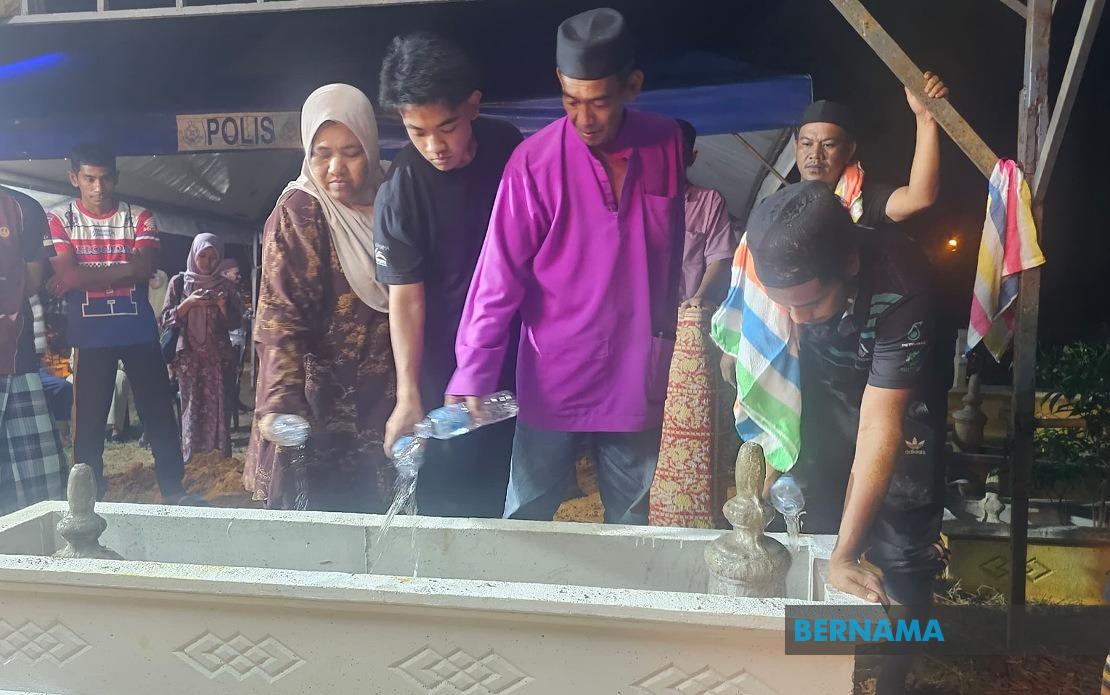
A solemn military funeral service marked the final farewell to Constable Muhammad Raimi Ismarubee, a 24-year-old police officer whose life was cut short in a tragic electrical accident in Sabah. The young constable was laid to rest at the Felda Kerteh 2 Muslim Cemetery in Dungun, Terengganu, early this morning, following a brief but meaningful ceremony attended by hundreds of mourners, including fellow police personnel, family members, and state officials.
Muhammad Raimi's body arrived at his family residence in Felda Kerteh 2 late yesterday evening, where immediate family members observed the traditional funeral rites before proceeding to the cemetery just after midnight. The constable, who had only recently begun his career at the Weston Police Station in September 2024, left behind a grieving family and a community shocked by the suddenness of his passing. As the second of three siblings, his death represents not only a loss to the Royal Malaysian Police force but also a deeply personal tragedy for his loved ones.
The transportation of Muhammad Raimi's remains involved coordinated efforts across multiple states and security agencies. His body was transported by Royal Malaysian Air Force aircraft from Kota Kinabalu International Airport in Sabah to Kuantan Air Base in Pahang, underscoring the significance of his death and the police force's commitment to honouring fallen officers. From there, a solemn hearse procession conveyed him to his final resting place in his hometown of Terengganu, a journey that reflected the respect afforded to those who die in service.
The funeral prayers were solemnized by Datuk Satiful Bahari Mamat, chairman of the Terengganu State Education, Higher Education, Science, Technology and Human Development Committee, reflecting the state's acknowledgement of the tragedy. The presence of Dungun District Police Chief Supt Nik Ab Halim Nik Mat and approximately two hundred officers from various police units demonstrated the strong bonds within the force and the collective grief felt across the institution. Beyond the uniformed presence, the gathering included neighbours, family friends, and community members who came to pay their last respects to a young man whose promising career had been so abruptly terminated.
The electrical incident that claimed Muhammad Raimi's life occurred in the late afternoon of the previous day at Jalan Weston in Kampung Weston, Beaufort, when the three constables made contact with live electrical wires. This tragic event resulted in the deaths of all three officers present at the scene. Alongside Muhammad Raimi, the fatalities included Corporal Chiu Teck Siong, a 40-year-old officer, and Corporal Mohamad Nur Hafiz Ibrahim, aged 29, highlighting the indiscriminate nature of the hazard they encountered. The incident underscores the often-overlooked occupational risks that police personnel face beyond their primary law enforcement duties.
Muhammad Raimi's career in the Weston Police Station, though brief, had spanned several months since his deployment in September 2024. His posting to this station in Sabah represented a typical assignment for a junior constable, yet the circumstances of his death raise pertinent questions about workplace safety protocols and electrical hazard awareness in police facilities. The incident appears to involve direct contact with unprotected electrical infrastructure, raising concerns about whether adequate safety measures were in place to prevent such tragedies.
The loss of three police officers simultaneously in a single incident is relatively uncommon in Malaysia and has sent ripples through the police establishment. The deaths of experienced personnel such as the two corporals, alongside the young constable, represent a significant loss of institutional knowledge and human resources. Corporal Chiu Teck Siong's four decades of life and presumed years of service, combined with Corporal Mohamad Nur Hafiz Ibrahim's younger but still substantial career, underscore the devastating impact across different age groups and experience levels within the force.
For Malaysian police operations in Sabah, an already challenging operational environment given the state's geographic remoteness and complex security landscape, this tragedy compounds existing pressures on personnel deployment and facility management. The incident occurred in Beaufort, a district that requires consistent police presence to maintain order and security across a large but dispersed population. The sudden loss of three capable officers from the Weston Police Station will inevitably create temporary operational challenges for local law enforcement until replacements can be properly trained and deployed.
The incident also brings into sharp focus the need for comprehensive safety audits across police stations throughout the country. Electrical hazards, whether from aging infrastructure, improper maintenance, or lack of proper warning systems, represent preventable dangers that could claim further lives if not systematically addressed. Police stations in remote areas like Beaufort may face particular challenges in ensuring that electrical systems meet current safety standards and are regularly inspected by qualified personnel.
Beyond the immediate operational implications, Muhammad Raimi's death serves as a sobering reminder of the multifaceted risks confronting public servants in Malaysia. While police officers are trained to face dangers inherent to their law enforcement role, occupational accidents resulting from infrastructure failures represent a different category of hazard—one that proper administrative oversight and preventive maintenance ought to eliminate. The tragic loss of this young officer, along with his colleagues, should prompt a comprehensive review of workplace safety protocols across all police facilities, particularly in outlying stations where maintenance oversight may be less robust.
The funeral service concluded a particularly difficult chapter for the Weston Police Station and the broader Sabah police contingent. As Muhammad Raimi was finally laid to rest in his native Terengganu soil, his grieving family and the police force confronted the permanent loss of a dedicated public servant whose career had barely begun. The incident will undoubtedly reverberate through police headquarters in Kuala Lumpur, likely triggering investigations into what precisely transpired and whether systemic failures contributed to the tragedy. For Malaysia's police force and the families involved, the focus must now shift toward honouring these fallen officers' memories while implementing concrete measures to prevent similar tragedies in the future.

