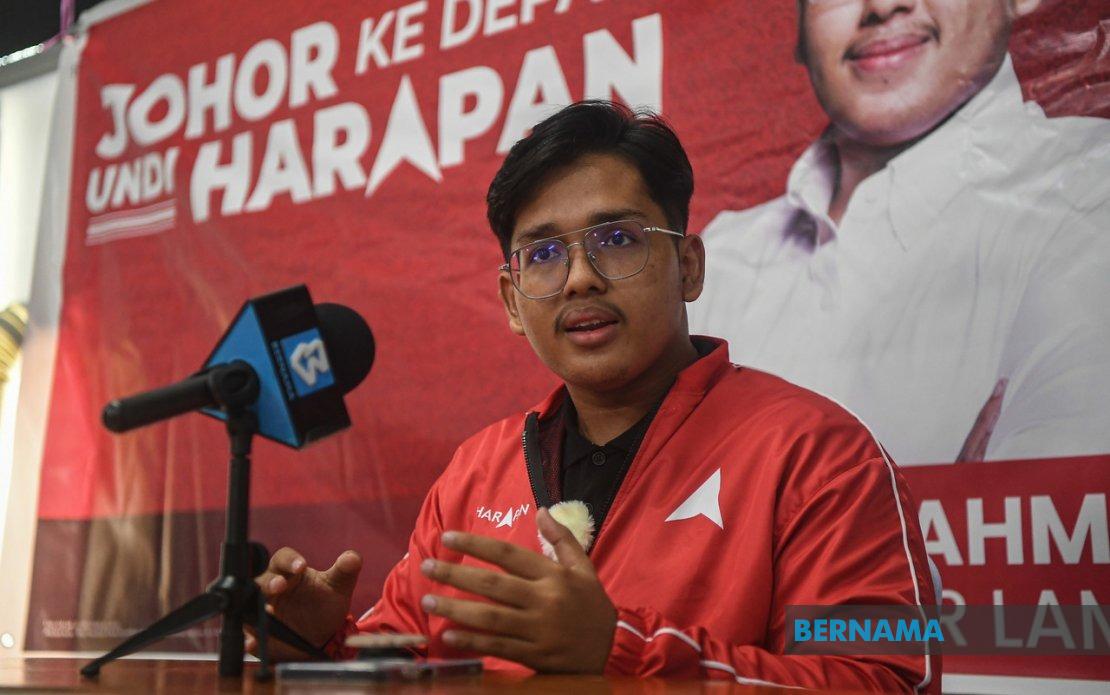
The 16th Johor state election is shaping up to feature an unusual candidate profile in the Johor Lama constituency: a 23-year-old Master of Information Technology student running for Pakatan Harapan who believes his youth is not a liability but a strategic asset. Danish Hossman Abd Rahman's campaign has gained traction among voters fatigued by long-serving leaders, he suggests, with consistent fieldwork and visible engagement cementing confidence that he can mount a genuine challenge to entrenched political structures in the contest.
Danish Hossman's positioning reflects a broader generational shift within Malaysian electoral politics, where younger candidates increasingly argue that age brings not inexperience but authenticity and alignment with contemporary challenges. The undergraduate's reception across Johor Lama, encompassing both urban and rural pockets, indicates receptiveness to candidates willing to conduct intensive ground-level engagement. This resonates particularly among older voters, who paradoxically view his presence as refreshing precisely because established leaders of their own generation have grown distant from constituent concerns.
What distinguishes his campaign narrative is the explicit rejection of generational gatekeeping. Rather than positioning youthfulness as superior to age, Danish Hossman frames himself as a "strategic bridge" connecting seasoned institutional knowledge with the aspirations of younger Malaysians entering the workforce and seeking opportunities in their hometowns. This rhetorical approach acknowledges that effective governance requires both innovation and continuity—a balancing act that more mature politicians have struggled to articulate in an era of political polarization.
The Johor Lama seat itself reflects economic challenges besetting peripheral constituencies within developed states. Housing affordability and employment scarcity have driven youth migration outward, draining local economic vitality and demographic potential. Danish Hossman has identified these twin pressures as campaign focal points, recognizing that abstract political messaging resonates less powerfully than concrete proposals addressing material hardship. His platform emphasizing downstream industrial development and agricultural expansion acknowledges Johor Lama's comparative advantages while proposing investments that could retain younger workers within their communities.
His campaign strategy hinges on repeated, face-to-face voter contact across townships, villages, and Felda settlements—an approach that demands sustained personal effort rather than reliance on campaign machinery or media saturation. By deliberately meeting voters multiple times rather than conducting perfunctory single visits, Danish Hossman signals that he is willing to invest his own time and energy, modeling the accessibility he promises constituents if elected. This grassroots intensity compensates for his lack of political machinery or establishment backing.
The three-cornered contest pitting Danish Hossman against incumbent Norlizah Noh of Barisan Nasional and Aisah Esa representing Perikatan Nasional reflects Malaysia's fractured electoral landscape, where opposition unity remains inconsistent and single-party dominance no longer guarantees victory. For Pakatan Harapan, a party seeking to recover ground after disappointing results in recent polls, a breakthrough in a seat traditionally held by BN would signal organizational recovery and renewed grassroots mobilization capacity. Johor itself remains strategically significant: as the home state of former Prime Minister Mahathir Mohamad and a demographic bellwether, its electoral outcomes influence broader perceptions of political momentum heading into future national contests.
Danish Hossman's deliberate avoidance of personal attacks and appeals to judgment based on capability rather than partisan affiliation speaks to voter fatigue with acrimonious campaign rhetoric. His emphasis on issues—infrastructure, economic development, service quality—rather than personalities or party brand loyalty reflects pragmatism about how swing voters in marginal constituencies actually make electoral decisions. Whether this tone genuinely distinguishes him from competitors or represents carefully calibrated campaign positioning remains unclear; nonetheless, the strategy acknowledges that voters increasingly demand substance over spectacle.
The scale of the 16th Johor election—172 candidates contesting 56 seats—indicates intense competition and fragmentation that benefits candidates able to consolidate specific demographic blocs. Danish Hossman appears to be targeting disaffected older voters and young professionals simultaneously, a coalition that could overcome the traditional dominance of either major bloc if successfully mobilized. His UTHM affiliation provides institutional credibility and connection to student networks, potentially unlocking youth turnout typically suppressed in state elections.
Economic anxiety underpins much of Malaysian electoral competition, and peripheral constituencies like Johor Lama experience these pressures acutely. Young people unable to secure local employment with living wages face either migration to urban centers—draining local talent and entrepreneurial energy—or underemployment and frustration. Danish Hossman's proposals to cultivate downstream agricultural and livestock industries address this structural problem, signaling willingness to engage with local economic realities rather than imposing urban-centric development models.
As polling day approaches on Saturday, with early voting scheduled for Friday, the Johor Lama contest will test whether generational freshness and intensive local engagement can overcome incumbency and established party machinery. For Pakatan Harapan, a party struggling to rebuild credibility after its 2018-2020 federal government imploded, victories in traditionally competitive seats hold disproportionate symbolic significance. Danish Hossman's campaign represents an experiment in whether younger, less politically embedded candidates can reconnect voters with political institutions they increasingly view with skepticism.
Beyond Johor Lama specifically, this candidacy prefigures broader changes in Malaysian political recruitment, as established parties increasingly recognize that voters—particularly younger ones and those in economically stagnant regions—respond to candidates perceived as authentically local and personally committed. Whether Danish Hossman's specific campaign succeeds or fails, his presence indicates that age-based gatekeeping within Malaysian politics is eroding, and that constituent service and visible engagement increasingly matter more than seniority and institutional pedigree. The Johor election will provide preliminary evidence of how deeply this shift has penetrated electoral dynamics.

