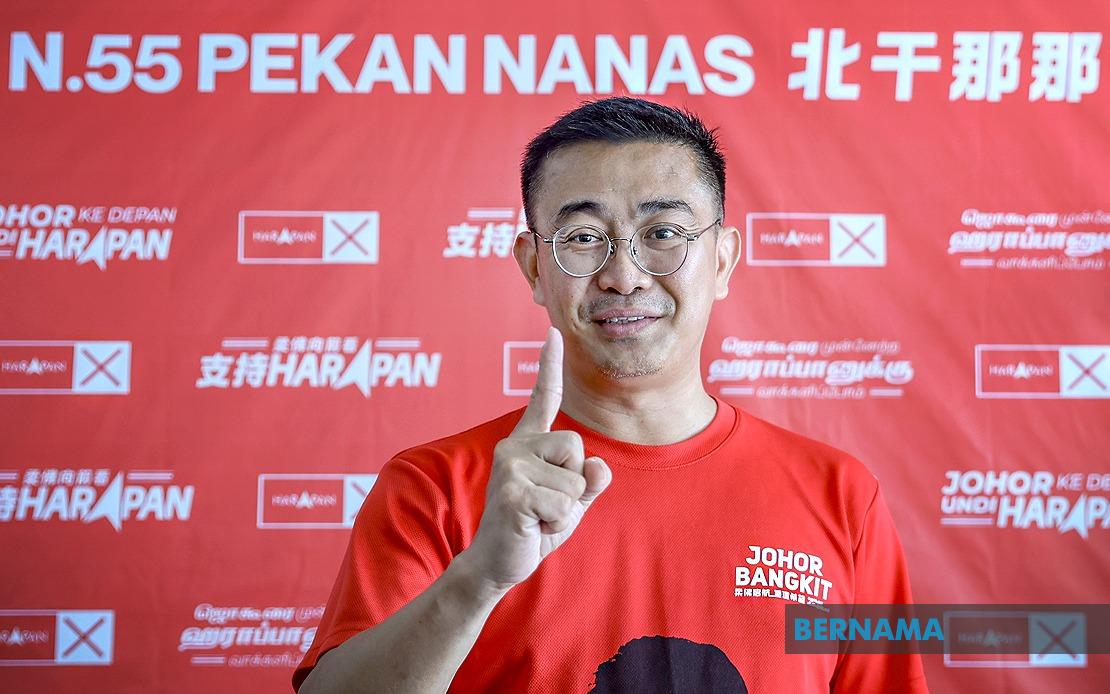
Pekan Nanas remains in play for Pakatan Harapan this election cycle, with former two-term assemblyman Yeo Tung Siong repositioning himself as the coalition's preferred choice to reclaim ground lost since his tenure ended in 2022. Faced with incumbent Tan Eng Meng from Barisan Nasional, Yeo is banking on a decade of prior service to voters and what he characterises as a comprehensive engagement strategy to convince constituents to restore his mandate in the 16th Johor state election.
Yeo's confidence rests substantially on the breadth of his campaign reach across the constituency. Over weeks of canvassing, he maintains contact with approximately 60 per cent of the electorate through a diversified mix of engagement formats including doorstep visits, public market interactions, restaurant discussions, and community seminars. This grassroots approach differs markedly from the protocol-heavy style he critiques implicitly in his commentary, emphasising instead his personal accessibility and willingness to address constituent grievances without bureaucratic intermediaries. The response he describes as markedly positive suggests that at minimum, familiarity with his name and face remains widespread among Pekan Nanas voters.
During his earlier representation between 2013 and 2022, Yeo points to tangible infrastructure achievements designed to address chronic local challenges. Most significantly, he secured a RM500,000 allocation that enabled straightening and improvements to Pulai River flow, targeting the flooding difficulties that had plagued residents for years. In partnership with private developers, his administration also implemented drainage interventions around Kampung Melayu Raya, demonstrating a willingness to collaborate across sectors to deliver practical outcomes. These projects encapsulate the type of constituency-specific problem solving that carries electoral weight in Malaysian state politics, where voters frequently evaluate representatives on delivery of local public goods rather than ideological positioning.
The priorities Yeo articulates for a potential second stint reveal attention to mobility and economic opportunity, twin concerns that resonate increasingly across Malaysian constituencies as commuting pressures mount and youth employment becomes politically charged. Two proposed shortcut routes—linking Ulu Pulai to Pekan Nanas and connecting Pulai to Sri Bunian—would theoretically compress travel times for residents commuting to Johor Bahru. Such infrastructure improvements promise ripple effects beyond convenience; reduced congestion translates to lower transportation costs for workers and students, enhanced business logistics, and marginal but cumulative quality-of-life gains that accumulate over time. These proposals echo broader Malaysian urban-planning frustrations, particularly in the Johor corridor where rapid development has strained road networks.
Yeo's employment strategy hinges on reviving a career carnival programme he previously organised in collaboration with major regional employers. By institutionalising job fairs and maintaining formal partnerships with private sector anchors, he positions himself as a facilitator of economic inclusion rather than a conventional politician dispensing favours. This differentiation carries appeal in an era where Malaysian voters, particularly younger ones, show scepticism toward traditional patronage politics. The focus on connecting Pekan Nanas residents directly with recruiters from established companies suggests a practical pathway to employment rather than government job creation, which increasingly appears limited given fiscal constraints and public sector expansion limits.
Social welfare accessibility features prominently in Yeo's platform, reflecting persistent poverty and vulnerability concerns in Malaysian constituencies. He emphasises streamlining access to assistance from the Social Welfare Department (JKM) and the Social Security Organisation (SOCSO), framing his role as a bridge between constituents and existing government support apparatus. This approach acknowledges that while welfare infrastructure exists, navigation barriers and information gaps often prevent eligible residents from accessing benefits. By positioning himself as a advocate who personally intervenes to connect vulnerable populations with support systems, Yeo appeals to both impoverished voters and middle-class citizens concerned with safety nets.
The electoral context favours Yeo's narrative of renewal but presents structural challenges. Pekan Nanas is not a traditional Pakatan Harapan stronghold, and the coalition's volatile standing in Johor—where it has struggled to consolidate support despite 2018's national victory—means that anti-establishment sentiment alone cannot carry the day. Tan Eng Meng's incumbent advantage, including control over state government patronage networks and the ability to announce projects during the campaign period, provides material structural benefits. Yet Yeo's prior representation suggests sufficient residual personal support and institutional knowledge to mount a competitive challenge.
Geographically, Pekan Nanas sits within the broader Pontian district context, a region where rubber smallholdings and informal economies persist alongside urbanising pressures. This demographic composition—mixing rural and semi-urban voters—suits Yeo's emphasis on localised infrastructure and direct representative accessibility. Voters in such constituencies frequently prioritise tangible constituency development over national political narratives, a tendency Yeo explicitly leverages by foregrounding his prior project delivery and his accessibility as an elected representative.
The voter feedback Yeo cites—traffic congestion and job scarcity—reflects anxieties extending well beyond Pekan Nanas into the wider Johor electorate and Malaysian urban centres generally. These are not parochial concerns but manifestations of broader development challenges afflicting the nation. His campaign frames his candidacy as remedying these pressures through both hard infrastructure and labour market engagement. The specificity of his proposals—named road routes, named agencies, named corporate partners—lends credibility relative to vaguer pledges, though implementation capacity remains uncertain pending electoral outcome.
Yeo's personal background as a former vice-principal and discipline teacher potentially influences his political approach, emphasising structure, institutional engagement, and mentorship-style relationships with constituents. This background contrasts with purely business-oriented politicians or career-track political operatives, perhaps resonating with constituencies valuing educational credentials and quasi-paternal leadership styles. However, the education sector background also invites scrutiny regarding whether his understanding of contemporary economic challenges extends meaningfully beyond educational institutions into manufacturing, services, and informal economy dynamics where many Pekan Nanas residents earn livelihoods.
The one-on-one contest against Tan Eng Meng simplifies the electoral choice for voters, potentially advantaging the candidate able to consolidate support most effectively. Pekan Nanas lacks the multi-cornered contests that have fragmented votes in other Johor constituencies, meaning second preferences and strategic voting matter less than direct head-to-head appeal. Yeo's extensive grassroots engagement appears designed precisely to build that direct personal connection, relying on name recognition and prior relationship histories rather than party machinery.
Ultimately, Yeo's candidacy represents a familiar Malaysian electoral narrative: the former representative seeking to reclaim lost ground through combination of prior service record, direct constituent engagement, and problem-solving orientation. Whether this proves sufficient to overcome the incumbent's structural advantages and Pakatan Harapan's broader instability in Johor remains contingent on local dynamics and voter appetite for change versus continuity. His campaign strategy privileges accessibility and delivery over ideology, a calculus that has succeeded in Malaysian state politics when executed credibly and when constituents perceive genuine divergence from incumbent performance.

