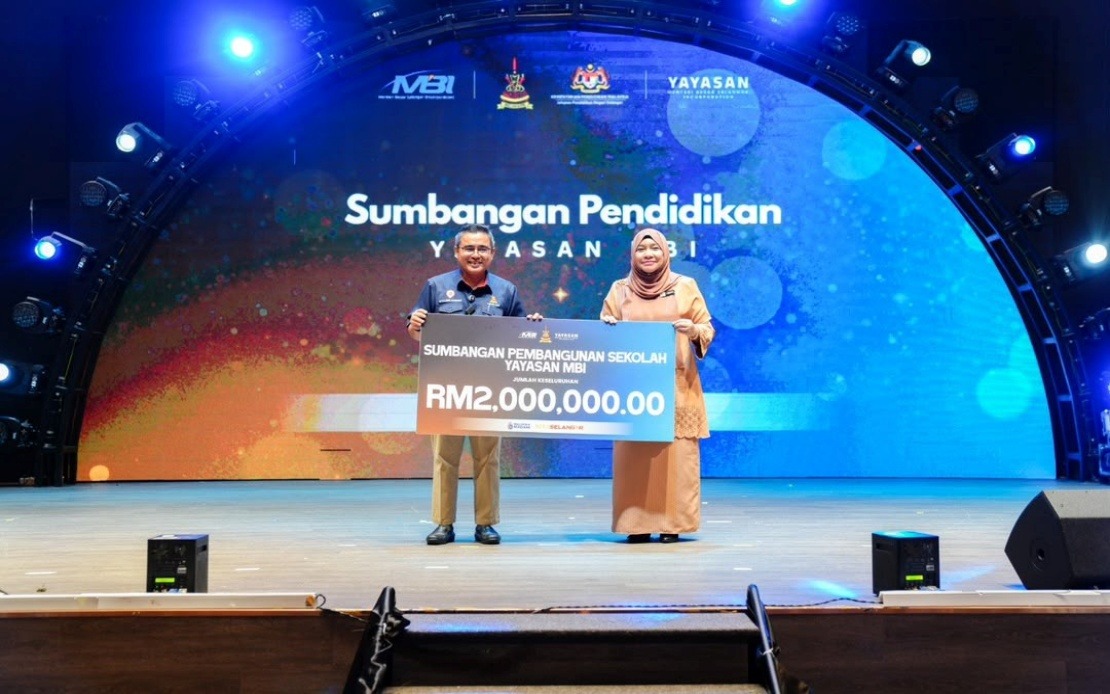
Yayasan Menteri Besar Selangor (Incorporated) has committed RM2 million to its School Development Contribution initiative, signalling a sustained push to enhance educational infrastructure and teacher conditions throughout Malaysia's most industrialised state. The disbursement, announced at the Yayasan MBI Education Aspiration 2026 event, represents a strategic investment in creating physical learning environments that better serve the 2.1 million students and 100,000 educators working across Selangor's sprawling school system.
According to Ahmad Azri Zainal Nor, head of Yayasan MBI, the foundation views education funding as fundamentally different from conventional charity work. Rather than temporary relief measures, the organisation frames its allocations as deliberate contributions to developing the skilled workforce that will drive Selangor's economic competitiveness over the coming decade. This philosophical positioning matters significantly for understanding why the foundation prioritises infrastructure over consumables—improved facilities create permanent advantages that benefit successive cohorts of learners.
The scale of commitment becomes clearer when examining the foundation's portfolio allocation. Approximately two-thirds of Yayasan MBI's initiatives and resources flow directly into education-related programmes, a concentration that reflects state-level priorities in a region where manufacturing and services sectors depend heavily on vocational and technical skills. This weighting also acknowledges that educational disparities between affluent and lower-income communities remain pronounced even in developed areas, with resource-poor schools struggling to maintain basic amenities.
Yayasan MBI's portfolio extends beyond one-time grants into structured, recurring programmes designed to create systemic change. The Back to School Tour Programme addresses the critical period when families struggle with procurement of uniforms, books, and materials—costs that frequently trigger dropout decisions among lower-income households. Meanwhile, the Selangor People's Tuition Programme operates free learning centres offering supplementary instruction in core subjects, directly compensating for disparities in home educational support that correlate strongly with family income levels.
The Didik Kasih Programme represents another layer of intervention, operating on the principle that comprehensive support systems prove more effective than isolated cash transfers. By combining tuition, mentorship, and material assistance, such integrated approaches address multiple barriers simultaneously. This contrasts with purely financial transfers that may not reach the specific bottlenecks preventing student progression.
Parent-Teacher Association collaborations deserve particular attention in the Malaysian context, where these bodies historically lack sustained funding and struggle to mobilise resources across multiple schools. By channelling support through Yayasan MBI, the foundation effectively amplifies the capacity of these grassroots organisations to address school-specific challenges identified by communities themselves. This decentralised approach generates better alignment between funding and actual needs compared to top-down allocation methods.
The partnership between Yayasan MBI and the Selangor State Education Department signals institutional coordination that can improve implementation efficiency. Government education departments often identify unmet infrastructure needs yet lack discretionary budget flexibility to address them rapidly. Foundation contributions, when aligned with departmental planning, can fill gaps while ensuring expenditure aligns with broader educational policy frameworks rather than creating duplicative or misaligned initiatives.
For Malaysian readers and policymakers, Yayasan MBI's approach holds broader implications regarding the appropriate division of labour between government and philanthropic institutions in the education space. While sustained, substantial funding remains fundamentally the responsibility of public treasuries, foundation contributions appear most effective when targeting innovation, addressing emerging gaps that government budgets have not yet absorbed, and demonstrating proof-of-concept for new programme models that may eventually scale within government systems.
Selangor's economic dynamism creates particular urgency around education quality. The state attracts inbound migration from across Malaysia, with students arriving from diverse educational backgrounds. Schools must simultaneously accommodate children from established middle-class families and recent migrants from lower-income communities, amplifying the infrastructure and teacher support demands. Yayasan MBI's investment acknowledges that population diversity and rapid growth strain physical capacity and require deliberate compensation strategies.
The emphasis on teacher support warrants specific attention. Malaysian educators have historically faced salary constraints and limited professional development funding relative to other professions requiring similar qualifications. When foundations and state institutions jointly prioritise teacher conditions, they acknowledge that educational outcomes depend not merely on facilities but fundamentally on educator capability, morale, and motivation. Recognition programmes and infrastructure improvements that ease teaching conditions thus represent investments in educational quality as much as facility enhancements.
Looking forward, the sustainability question becomes critical. Annual disbursements of RM2 million represent meaningful but finite resources. As Selangor's student population grows and educational infrastructure demands increase, foundation contributions alone cannot meet total system needs. Instead, such programmes should function as catalysts encouraging government budget increases and demonstrating the return on educational investment to policymakers weighing competing priorities.
The timing of this announcement also reflects shifting attitudes toward foundation engagement in education across Southeast Asia. Increasingly, governments and philanthropic bodies recognise that effective education systems require hybrid funding models combining public investment, foundation support, and corporate contributions. Yayasan MBI's positioning within Selangor's governance structure enables it to operate as trusted intermediary facilitating such partnerships rather than as external actor imposing solutions.

