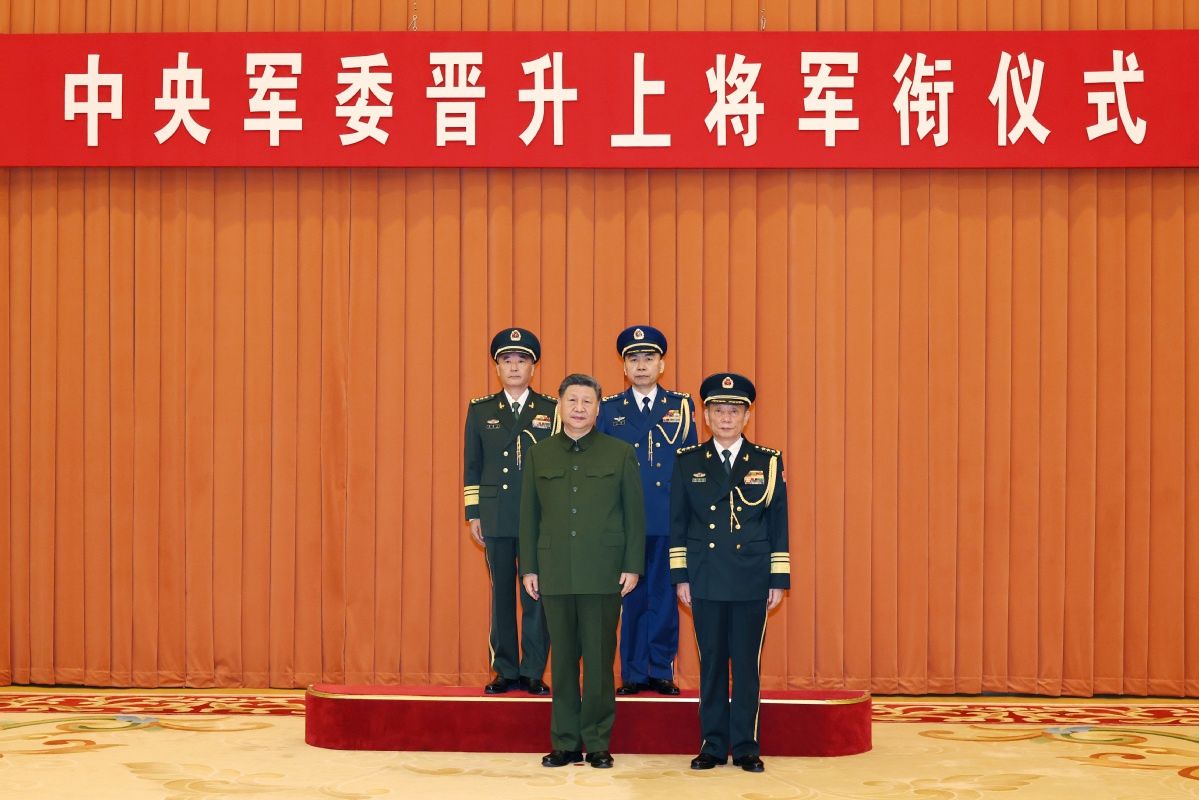
President Xi Jinping continues to consolidate power over China's military establishment through a series of high-level personnel changes announced at an official ceremony in Beijing on Friday, with the appointment of Zhang Shuguang as the new secretary of the Central Military Commission's discipline inspection commission. This move signals an escalation in what has become the most significant restructuring of China's armed forces in approximately fifty years, reshaping the command structure at a moment when geopolitical tensions across the Asia-Pacific region remain elevated.
The personnel shuffle, confirmed by state-run Xinhua News Agency at the Beijing ceremony where Xi presided, represents a deliberate consolidation of control over the military apparatus. Wang Gang has simultaneously been named commander of the People's Liberation Army Air Force, while both men have been elevated to the rank of general, China's most senior active-duty officer rank. These promotions underscore Xi's intention to install trusted loyalists in positions that command vast resources and strategic influence over the nation's defence infrastructure.
Zhang Shengmin, the previous military anti-corruption chief, has been reassigned to serve as vice chairman of the Central Military Commission itself. This lateral movement, while technically a promotion to one of China's highest defence institutions, effectively removes him from the frontline anti-corruption role he previously held. The transition reflects Xi's apparent desire to rotate personnel through sensitive positions, preventing any single official from accumulating excessive autonomy over military discipline and oversight mechanisms.
The trajectory of Chang Dingqiu, the former Air Force Commander, remains ambiguous following his replacement by Wang Gang. State authorities have not publicly disclosed his next assignment, a characteristic silence that in Chinese politics often precedes further scrutiny or administrative repositioning of senior figures. This uncertainty underscores the fluid and precarious nature of high-level military appointments under Xi's tenure, where careers can pivot dramatically based on evolving factional alignments and political calculations.
Xi's assault on military corruption commenced in mid-2023, roughly half a year after he secured an unprecedented third consecutive term as Communist Party general secretary—a development that itself broke with post-Mao succession conventions. Since the campaign's launch, the fallout has claimed two vice chairmen of the Central Military Commission, three additional CMC members, Defence Minister Li Shangfu, and a minimum of twelve senior generals who commanded military regions or major operational units. The sheer scope of removals demonstrates a systematic dismantling of institutional power centres that might have posed countervailing influence to Xi's authority.
Perhaps the most dramatic development occurred earlier in 2024 when Xi initiated an investigation into Zhang Youxia, his former close ally and one of China's highest-ranking generals holding the position of CMC vice chairman. Zhang Youxia's downfall signals that personal relationships and historical loyalty offer no shelter from Xi's modernisation campaign, raising questions about the security of tenure even for those in the uppermost echelons of military command. The decision to investigate such a senior figure sends a powerful message throughout the officer corps about the consequences of perceived disloyalty or the harbouring of independent power bases.
For Southeast Asian observers monitoring China's internal dynamics, these military restructurings carry significant implications. A more cohesively controlled armed forces under Xi's personal direction removes institutional constraints on military adventurism while potentially streamlining decision-making processes for operations affecting regional interests. At the same time, the purge may create uncertainty and reduce operational efficiency as new commanders settle into posts, a factor that some analysts suggest could temporarily moderate aggressive posturing in disputed waters including the South China Sea.
The removal of six military lawmakers from their seats in the National People's Congress during the previous week compounds the sense of comprehensive institutional renovation. These parliamentary purges, combined with the anti-corruption crackdown, suggest Xi is methodically eliminating formal and informal channels through which military interests might gain independent representation in civilian state structures. This consolidation aligns with Xi's broader governance philosophy of concentrating decision-making authority within party bodies that he personally dominates.
The timing and scope of these changes reflect Xi's confidence in his political position but also hint at potential resistance to his rule within military circles. The necessity to remove such large numbers of senior commanders indicates that substantial factions within the armed forces either opposed his governance approach or retained competing power networks from previous administrations. By installing reliable subordinates into the most sensitive positions—particularly anti-corruption oversight and major command roles—Xi minimises the risk of institutional pushback against his policies.
Malaysia and neighbouring nations must carefully observe how these leadership transitions affect China's strategic calculations regarding regional security architecture. Military purges can sometimes correlate with external assertiveness as new commanders seek to demonstrate toughness, or alternatively, they can temporarily reduce capacity for coordinated operations. The anti-corruption campaign itself, while presented as a governance reform, functions simultaneously as a mechanism for eliminating potential rivals and consolidating Xi's hold over the state's coercive apparatus—an important distinction for regional powers assessing Beijing's future trajectory.

