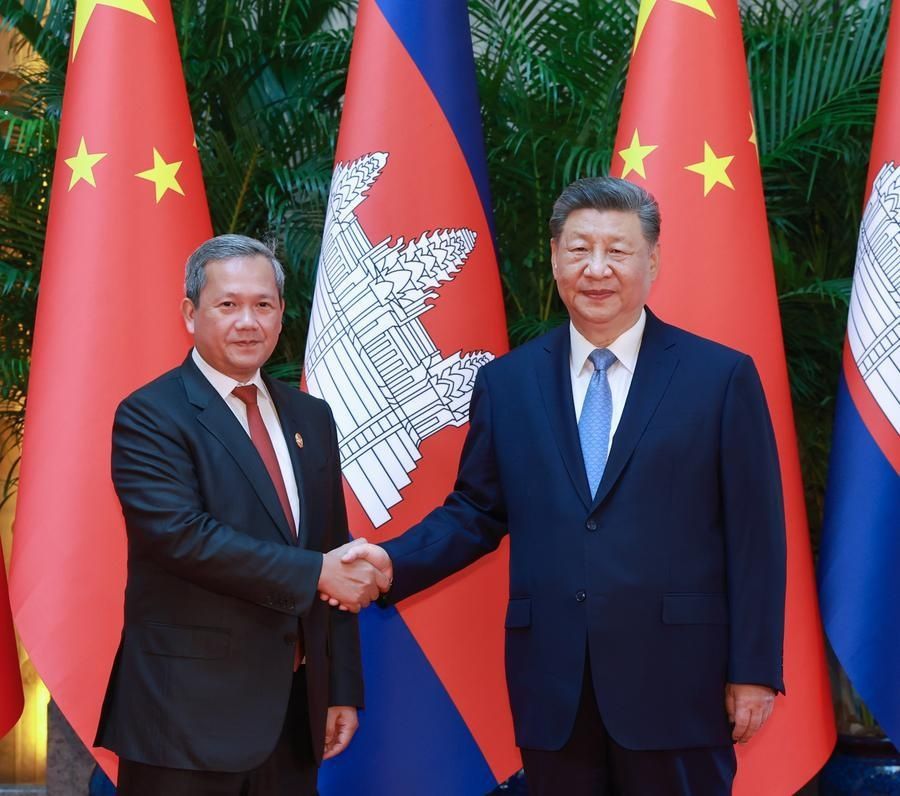
Chinese President Xi Jinping reaffirmed Beijing's commitment to Cambodia during a high-level meeting in Shanghai on Friday, calling for both nations to build upon decades of partnership as they navigate an increasingly complex geopolitical landscape. The encounter between Xi and Cambodian Prime Minister Hun Manet, who travelled to the city for the 2026 World Artificial Intelligence Conference alongside his official state visit, underscored the strategic importance China places on its relationship with the Southeast Asian nation.
The discussion centred on what Chinese officials described as the "Diamond Hexagon" framework, a multilayered cooperation mechanism designed to integrate economic, infrastructure, and security initiatives across bilateral engagement. This framework reflects Beijing's broader strategy to position itself as the primary economic and security partner for Cambodia, particularly as Hun Manet consolidates his relatively new administration and seeks to modernize the kingdom's economy and governance structures.
A cornerstone of the renewed commitment involves accelerating two major economic corridors. The Industrial Development Corridor aims to position Cambodia as an attractive manufacturing hub, potentially drawing investment and expertise from Chinese firms seeking alternatives to Vietnam and Thailand. Simultaneously, the Fish and Rice Corridor capitalizes on Cambodia's agricultural strengths and fishing resources, creating vertically integrated supply chains that bind Cambodian producers to Chinese markets and processing infrastructure. These initiatives promise to boost rural incomes while deepening economic interdependence between the two countries.
Xi emphasized modernizing traditional sectors alongside nurturing emerging industries, particularly artificial intelligence and digital economy development. For Malaysian observers, this strategic pivot is significant: China's investment in Cambodia's digital infrastructure could create a competitive advantage for Chinese companies seeking regional digital dominance, potentially influencing market dynamics across Southeast Asia. Cambodia's relatively underdeveloped digital ecosystem presents both an opportunity for Chinese technology firms and a potential model for how Beijing approaches technological cooperation with smaller regional partners.
Cross-border security cooperation emerged as another critical priority, with Xi specifically citing the need to combat counterfeiting, smuggling, online gambling operations, and telecommunications fraud. These criminal activities have afflicted the entire Southeast Asian region, with Malaysia, Thailand, and other nations bearing significant costs from organized fraud networks, many operating from bases in Cambodia. The pledge to intensify enforcement suggests Beijing and Phnom Penh may coordinate more closely on intelligence sharing and law enforcement operations that could have spillover effects on regional security architecture.
The discussion also touched on the long-standing Cambodia-Thailand border tensions, with Xi expressing support for peaceful resolution through dialogue while suggesting China's willingness to mediate further negotiations. This positioning allows Beijing to maintain influence over a dispute that periodically destabilizes one of Southeast Asia's most important corridors. By positioning itself as a neutral facilitator while maintaining strong security partnerships with both nations, China reinforces its role as an indispensable regional power broker, a dynamic that shapes broader competitive positioning among major powers in the region.
Hun Manet's response demonstrated Cambodia's strategic calculus in maintaining alignment with Beijing despite international scrutiny regarding sovereignty and democratic governance. His explicit commitment to the one-China policy reaffirmed Cambodia's diplomatic stance on Taiwan, a position that occasionally generates tension with Western nations but remains consistent with Phnom Penh's prioritization of Chinese support for development and security. The Prime Minister's emphasis on Cambodia's unwavering friendship with China regardless of "shifts in the international situation" appeared to signal resolve in maintaining the partnership even as regional geopolitical tensions mount.
The commitment to deepen political trust and expand bilateral trade reflects asymmetrical economic reality: China has become Cambodia's largest trading partner, foreign investor, and creditor, making the relationship fundamentally consequential for Phnom Penh's economic trajectory. Chinese investment now dominates sectors including telecommunications, energy, and real estate, creating structural dependencies that limit Cambodia's policy flexibility on issues China prioritizes. For the region more broadly, Cambodia's position as a steadfast Beijing ally influences ASEAN cohesion and Southeast Asia's collective stance on contentious issues like South China Sea sovereignty and great power competition.
The timing of this engagement, coinciding with Hun Manet's attendance at an international AI conference, demonstrates China's strategy of embedding bilateral diplomacy within multilateral forums and technological development narratives. By positioning advanced technology cooperation alongside traditional infrastructure investment, Beijing projects a forward-looking partnership rooted in shared prosperity rather than purely security-driven alliance. This framing appeals to regional audiences and distinguishes Chinese engagement from competitor narratives emphasizing democratic values or rules-based orders.
For Malaysia and other Southeast Asian nations, the deepening China-Cambodia partnership carries both competitive and cooperative implications. Cambodian industrial development supported by Chinese capital could redirect investment flows within ASEAN, potentially attracting manufacturing away from established hubs. Simultaneously, enhanced regional security cooperation addressing transnational crime offers benefits that extend beyond bilateral relations. The trajectory of China-Cambodia ties will likely influence how other ASEAN members calibrate their own strategic positioning amid intensifying great power competition and the ongoing evolution of regional economic integration.
The meeting reflects broader patterns in Beijing's bilateral diplomacy with smaller Southeast Asian neighbors: combining economic incentives, security cooperation, and political reassurance while leveraging asymmetrical interdependencies to secure alignment on matters China deems strategically important. As Hun Manet consolidates his leadership following his succession of longtime ally Prime Minister Hun Sen, maintaining close ties with Beijing provides both resources for domestic development and external validation in an uncertain regional security environment.

