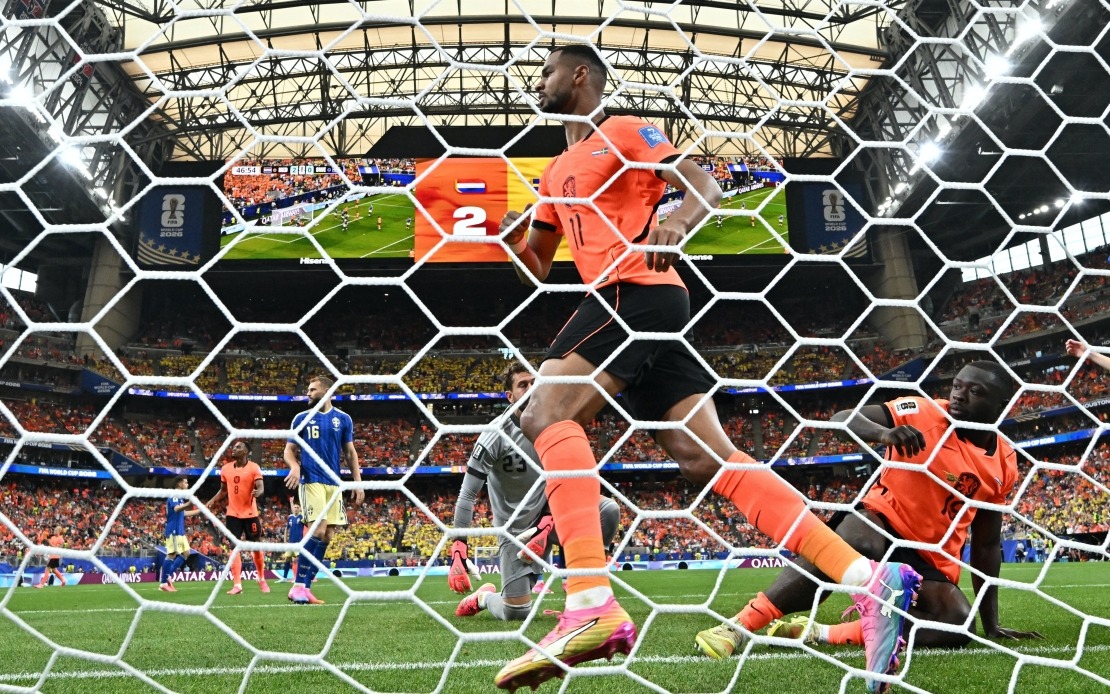
The FIFA World Cup reached a historic scoring milestone this weekend when Cody Gakpo found the net for the Netherlands in a dominant 5-1 victory over Sweden, marking the tournament's 100th goal in its 33rd match. The pace of this milestone underscores a dramatic shift in World Cup dynamics, with the competition averaging 3.03 goals per match—a pace unseen in nearly seven decades. The last time football's premier tournament moved through the century of goals so swiftly was during the 1954 World Cup in Switzerland, when the benchmark arrived after 20 matches played.
This accelerated scoring rate stands in stark contrast to more recent World Cup tournaments, which have historically produced lower goal tallies. The 2014 tournament hosted by Brazil required 36 matches to accumulate 100 goals, whilst Spain 1982 also needed 36 matches to reach the same milestone. Even earlier editions took their time: Argentina 1978 and the United States 1994 both required 38 matches to achieve 100 goals. The dramatic difference suggests fundamental changes in how the modern World Cup is being contested, prompting analysts and observers to examine the various factors contributing to this explosive offensive trend.
Much of the discussion surrounding the high-scoring environment has centred on the official tournament ball, the Trionda. Several football commentators and technical experts have suggested that the ball's design characteristics have created unfavourable conditions for goalkeepers attempting to handle long-range shots. The aerodynamic properties of the Trionda appear to behave unpredictably when struck from distance, making it considerably more challenging for custodians to read and react to attempts from outside the penalty area. This technical disadvantage is reflected in the statistics, with approximately 10 goals already attributed to strikes from beyond the standard shooting range.
Beyond equipment considerations, the physical environment of the World Cup has emerged as a significant contributing factor to the elevated scoring rates. The intense heat prevailing throughout the tournament venue has created arduous conditions that take a visible toll on players as matches progress. The accumulated fatigue from competing in such demanding climates naturally compromises defensive organisation and individual concentration, leading to lapses in positioning and marking that attackers have readily exploited. Tournament organisers have implemented mandatory three-minute cooling breaks during matches, designed to provide relief and prevent heat-related medical incidents. However, these stoppages have inadvertently provided coaching staff with additional strategic opportunities, allowing them to reshape tactical approaches and potentially contributing to the dynamic, fluid nature of matches.
The structural expansion of the World Cup format itself represents perhaps the most significant variable in the equation. The decision to increase the tournament from its traditional 32-team structure to 48 competing nations has fundamentally altered the competitive landscape. Critics argued that including additional teams would inevitably produce one-sided matchups between elite nations and less developed football programmes, resulting in inflated scorelines that would skew the narrative of the competition. Early evidence appeared to support these concerns, with Germany crushing Curaçao 7-1, Canada defeating Qatar 6-0, and Tunisia suffering consecutive heavy defeats to Sweden (5-1) and Japan (4-0) in successive matches.
Yet a closer examination of the broader tournament results reveals a considerably more nuanced picture than initial headlines suggested. Multiple matches have defied expectations of lopsided contests, suggesting that the expanded format has not simply produced a parade of predictable blowouts. Curaçao managed to hold Ecuador to a goalless draw despite their heavy loss to Germany, demonstrating resilience and tactical discipline. Similarly, Cabo Verde frustrated a Spanish side widely regarded as tournament favourites, securing a 0-0 stalemate that captured international attention. Qatar's performance in its opening fixture against Canada provided another perspective: the team played the majority of the match with nine players following disciplinary actions, yet remained competitive throughout, suggesting that the scoreline reflected circumstances rather than pure quality disparity.
The competitive balance has extended beyond these headline-grabbing results. Perceived underdog nations Jordan and Uzbekistan mounted spirited challenges against significantly ranked opponents, suffering only 3-1 defeats to Austria and Colombia respectively. These performances indicate that even teams considered far removed from the tournament's elite have managed to remain tactically organised and competitive throughout their matches, rather than being overwhelmed by superior opposition. The pattern suggests that whilst the expansion has certainly produced some dominant performances, the overall quality distribution across participating nations has resulted in more compelling and unpredictable football than critics initially predicted.
For Malaysian and Southeast Asian observers, the expanded World Cup format carries particular significance. The inclusion of additional nations theoretically enhances opportunities for Asian football development and international visibility, though no Southeast Asian teams have yet qualified for this tournament. The high-scoring environment also reflects changing global football trends that prioritise attacking football and entertaining spectacle, potentially influencing tactical philosophies adopted by regional coaches and players. The demonstration that smaller nations can compete effectively, despite initial setbacks, provides valuable lessons for developing football programmes throughout Southeast Asia.
The combination of technical, environmental, and structural factors has created a World Cup that defies traditional patterns of goal distribution. Whether this trend continues throughout the tournament remains uncertain, as teams settle into their rhythms and tactical approaches become increasingly refined. However, the current trajectory suggests that fans expecting a cautious, defensive tournament have been pleasantly surprised by an abundance of attacking football and entertainment value. The 100-goal milestone achieved at record pace serves as a clear indicator that this World Cup iteration has established its own distinctive character, shaped by modern innovations, environmental challenges, and unprecedented competitive expansion.

