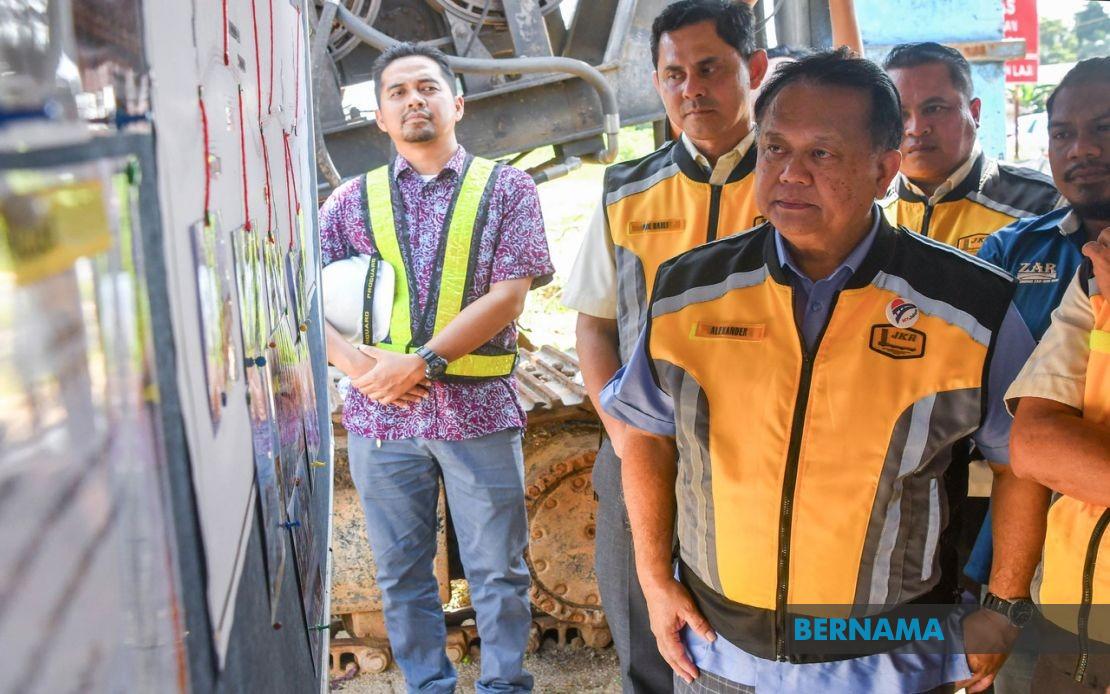
The Works Ministry has thrown its weight behind a concerted effort to salvage 50 infrastructure projects that have fallen behind schedule, as the federal government grapples with the challenge of maintaining momentum across its sprawling development portfolio. Works Minister Datuk Seri Alexander Nanta Linggi disclosed that these troubled schemes represent just six per cent of the 865 projects operating under the ministry's oversight, signalling that whilst the majority remain on track, the handful of problematic cases demand intensive intervention. The admission came during a working visit to Kelantan, where the minister inspected progress on key road infrastructure initiatives that have become increasingly vital to regional connectivity and traffic management.
Delays plaguing the project landscape stem from a complex web of practical and administrative obstacles that have proven challenging to overcome. Contractors facing financial strain and management deficiencies have emerged as primary culprits, whilst land acquisition complications continue to snarl progress across multiple initiatives. Utility companies' refusal or sluggish relocation of essential services has complicated construction schedules, and unforeseen underground conditions—including hidden obstacles only discovered once work begins—have forced costly redesigns and schedule adjustments. In Kelantan specifically, only seven of 104 works ministry projects fall into the "sick" category, suggesting that the state has fared reasonably well in maintaining project momentum despite these systemic pressures.
The ministry's approach to troubled projects reflects pragmatic governance considerations, balancing the competing imperatives of project completion and fiscal responsibility. Rather than adopting a blanket termination policy, officials now conduct granular assessments of each delayed scheme to determine whether remedial action or contract cancellation represents the optimal path. Projects approaching completion with merely ten to fifteen per cent of work remaining often warrant time extensions, Nanta explained, as abandoning these efforts and recruiting replacement contractors would trigger exponentially higher costs and further delays. This measured stance acknowledges that every termination decision triggers potential legal disputes and represents a sunk investment yielding diminishing returns.
The institutional machinery for oversight has been substantially reinforced to prevent further deterioration of project quality. Weekly reviews of delayed initiatives follow cabinet meetings, creating a disciplined rhythm for progress assessment and corrective action identification. The deputy minister has assumed direct responsibility for coordinating monitoring activities across all 50 troubled projects, ensuring that administrative accountability flows through clearly defined channels. This structural arrangement signals ministerial commitment to treating project delivery failures as a priority concern demanding personal oversight from the ministry's highest echelons, rather than relegating the matter to routine bureaucratic handling.
Consequences for persistently underperforming contractors have become increasingly stringent as the ministry demonstrates willingness to wield its enforcement powers. Underperforming contractors face removal from projects, whilst those unable to meet revised completion targets may face full contract termination. However, the minister emphasised that such decisions must navigate the complex terrain of contractual law and governance protocols to forestall legal challenges that could further complicate project delivery. This calibrated approach reflects recognition that heavy-handed action unsupported by proper procedures could backfire through costly litigation, inadvertently worsening delays and project costs.
The RM191 million FT209 and FT131 road upgrading project in Kelantan exemplifies both the potential and the complications inherent in modern Malaysian infrastructure development. Spanning six kilometres from the Pasir Hor interchange to Panchor, the initiative targets chronic congestion along the critical Federal Road FT131 corridor linking Kubang Kerian to Sabak and continuing toward Pengkalan Chepa. The scheme has achieved seventy-one point six one per cent physical completion to date, positioning it for delivery in September 2025 despite the inevitable complications that have emerged during execution. However, the project's implementation has generated unintended consequences that required swift ministerial intervention, demonstrating how even well-intentioned infrastructure investments can create collateral impacts on surrounding communities.
Land acquisition costs for the road project have ballooned to exceed RM200 million to secure rights across 300 individual lots, reflecting the substantial property compensation liabilities inherent in major infrastructure corridors passing through densely settled regions. These acquisition expenditures represent nearly the entire project budget, underscoring how property rights negotiation can consume vast resources in Malaysia's complex land ownership environment. The financial commitments already invested in acquisition and earlier project stages create powerful incentives to push toward completion rather than abandon the initiative midway, notwithstanding any performance shortfalls that might otherwise justify contract cancellation.
Drainage complications have emerged as an unexpected challenge, with flooding affecting residents adjacent to the construction zone despite planners' presumed prior analysis. Pengkalan Chepa Member of Parliament Datuk Dr Ahmad Marzuk Shaary raised these concerns with the minister, triggering an immediate response demonstrating how political pressure channels can accelerate ministerial intervention. The Works Ministry swiftly instructed contractors to construct a forty-metre temporary drainage channel, providing immediate relief whilst permanent drainage solutions await project completion. This responsive action illustrates both the fluid relationship between political representatives and infrastructure delivery bureaucracies, and the reality that even flagship projects can generate localised disruptions requiring creative interim solutions.
The broader implications for Malaysian infrastructure governance centre on the tension between aggressive development ambitions and the ground-level complexities of translating ambitious designs into functioning infrastructure. The acknowledgement that roughly six per cent of projects require intensive corrective supervision suggests either that initial planning and contractor selection processes contain inherent limitations, or that unpredictable real-world conditions inevitably exceed even rigorous pre-construction analysis. Regardless of causation, the ministry's systematic monitoring framework represents progress in identifying and addressing problems before minor delays metastasise into project failures consuming exponentially greater resources.
For southeastern Malaysia specifically, the FT209 and FT131 initiative symbolises how regional connectivity improvements depend on sustained ministerial attention and adequate resource allocation. Kelantan's relatively healthy project completion record—with only seven troubled schemes among 104 active initiatives—suggests that dedicated oversight can yield results, though the persistent challenges affecting even monitored projects underscore how infrastructure delivery remains fundamentally complex. The September 2025 completion target for the road project, if achieved, would provide meaningful relief to congested corridors serving both local commuters and intercity traffic flows, justifying the substantial investment already committed.
Moving forward, the works portfolio's trajectory will depend on whether the weekly review discipline and enhanced deputy ministerial oversight translate into sustained project performance improvements. The ministry's demonstrated willingness to terminate underperforming contracts, tempered by legal prudence and fiscal realism, establishes frameworks for accountability that extend beyond rhetorical commitments. As Malaysian development ambitions continue expanding, the management systems now being implemented across the 865-project portfolio offer potential templates for other government agencies grappling with similar execution challenges. The ultimate test will come as delayed projects either achieve revitalised completion schedules or require difficult decisions about resource reallocation and programmatic adjustment.

