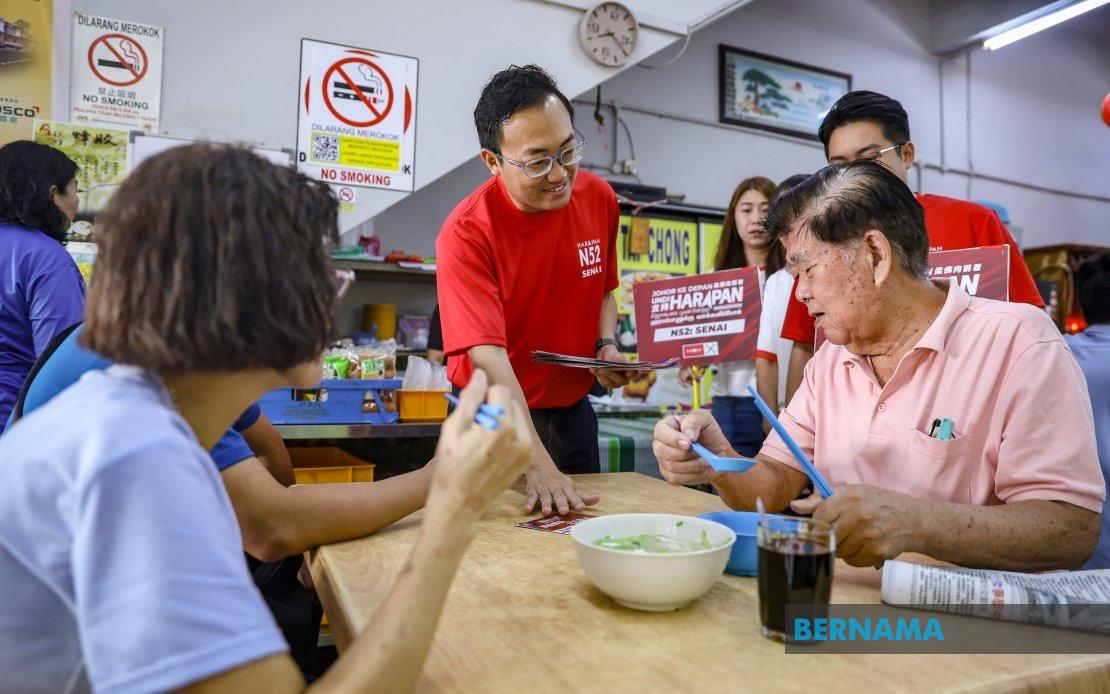
Wong Bor Yang, the incumbent assemblyman for Senai, is banking on a demonstrated record of delivery to help Pakatan Harapan retain the state seat when Johor voters go to the polls on July 11. The sitting representative has framed his candidacy around concrete achievements during his previous term, particularly tackling the constituency's chronic flooding challenges and enhancing public amenities that directly impact residents' quality of life.
Wong's political journey offers an unusual backdrop to his campaign message. Before becoming Senai's state assemblyman, he accumulated more than a decade of grassroots experience since 2014, beginning as a special officer at the Kulai Member of Parliament's office. That lengthy foundation spans multiple political configurations—serving on the opposition benches, transitioning to local government as a city councillor in 2018, and eventually securing the Senai mandate. His background as a trained journalist from Taiwan's Shih Hsin University has shaped his approach to constituency management, blending media literacy with administrative pragmatism.
Flood mitigation stands as Wong's signature achievement. The Senai state seat, encompassing 66,635 registered voters, has battled persistent flash flood issues affecting vulnerable residential pockets. During his previous term, Wong pursued a dual-track strategy. While holding opposition bench status at one point, he leveraged state assembly debates and formal petitions to push government agencies for solutions. His persistence yielded tangible results: the state government approved RM1 million to upgrade drainage infrastructure in Taman Aman, channelling water into Sungai Skudai. Crucially, he collaborated with Kulai MP Teo Nie Ching to secure an additional RM3 million for drainage upgrades in Peladang Kulai Besar and Saleng, removing both settlements from the district's flash flood hotspot list.
Beyond infrastructure, Wong has sought to position Senai as a destination through heritage preservation. The constituency boasts over a century of historical significance, which Wong has activated through community projects. He converted a disused cinema into a community operations centre and rehabilitated a two-decade-old badminton court into a recreational family space branded as Tiny Lake under the Sejati MADANI initiative. These moves reflect an understanding that constituent satisfaction extends beyond solving acute problems to creating spaces for social interaction and cultural continuity.
Healthcare emerges as Wong's declared priority for a potential second term. He has persistently advocated for upgrading Kulai Hospital, arguing that its current 93-bed capacity cannot service the district's projected population of 500,000 by 2030. The hospital, serving a sprawling district, operates at functional capacity, creating bottlenecks in emergency and routine care. Wong has also raised the unresolved land issue delaying construction of a new Health Clinic in Taman Mewah, Senai, blocked by bureaucratic obstacles at the state government level. He frames his next priority as breaking this logjam to enable the Health Ministry to commence construction.
Wong's strategic positioning reflects broader lessons from Johor's electoral psychology. He explicitly appeals to what he describes as the "politically mature and dynamic Bangsa Johor electorate," arguing that voters will differentiate between substantive track records and rhetorical promises. This framing acknowledges Johor's reputation for pragmatic voting behaviour, where performance metrics often outweigh partisan loyalty or charismatic campaigning. His emphasis on results rather than ideology attempts to transcend standard partisan divides.
The incumbent faces a competitive three-cornered contest. Barisan Nasional has fielded Tai Chee Chee as its candidate, while Bersama—a smaller political entity—is represented by Tew Chien How. The presence of three serious contenders scrambling for 66,635 votes suggests neither camp can take the seat for granted. BN's entry indicates the coalition remains active in Johor despite Pakatan's 2022 federal ascendancy, while Bersama's participation reflects ongoing fragmentation in Malaysia's multi-party landscape.
Early voting is scheduled for July 7, with general polling on July 11. The timing allows working voters and those unable to cast ballots on election day an alternative window. Johor's electoral calendar follows a compressed timeframe compared to peninsular elections held in other states, reflecting the state's administrative autonomy and distinct voting cycles.
Wong's campaign strategy reveals how local Malaysian politics increasingly pivots on demonstrable outcomes rather than party machinery alone. His narrative—combining opposition-era persistence with government-era delivery, anchored by specific project numbers and beneficiary communities—appeals to an electorate fatigued by abstract promises. Whether this emphasis on infrastructure completion and healthcare advocacy proves sufficient against fresh candidates and rival party machines will become clearer as polling approaches.
The Senai contest carries implications beyond the immediate state seat. Pakatan's ability to retain constituencies won in 2018, particularly against renewed Barisan competition, will signal whether the coalition's federal presence translates into durable local entrenchment. For Wong personally, the election represents a referendum on whether grassroots administrative competence, accumulated over years of unglamorous service across political alignments, resonates with voters seeking results over rhetoric.

