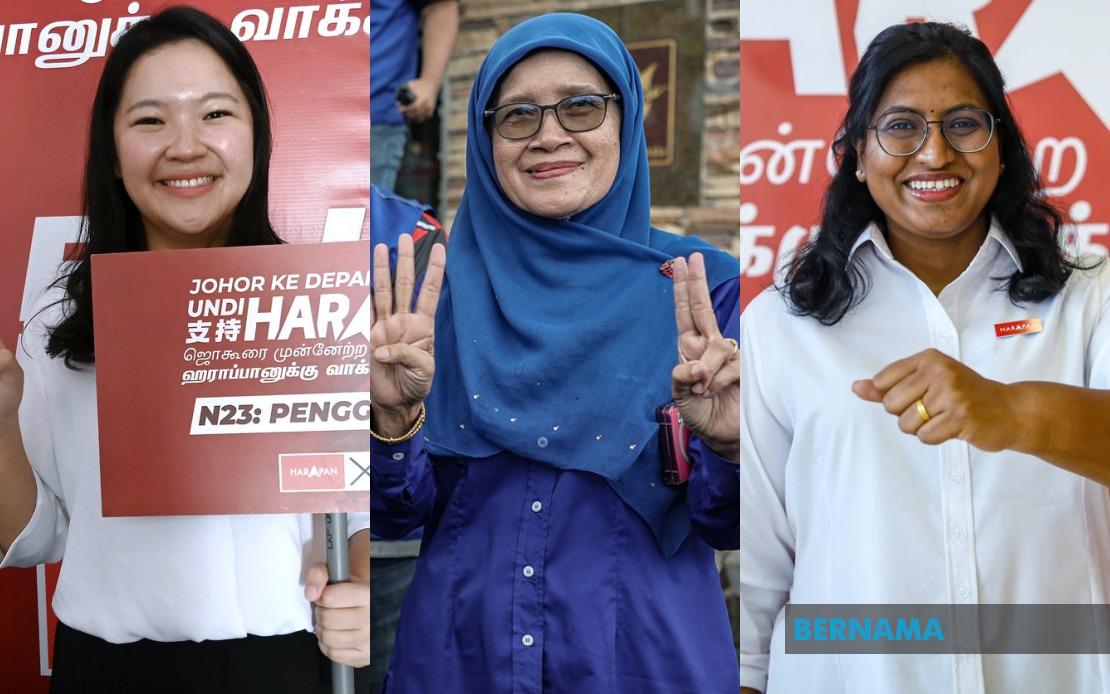
The 16th Johor State Election has delivered mixed results for women candidates seeking representation in the State Legislative Assembly, with ten of the 34 female contenders successfully winning seats. The outcome demonstrates the continuing readiness of Johor voters to back female political leaders, though the overall proportion of women candidates remains modest at nearly 20 percent of the total 172 contestants. This latest electoral cycle offers valuable insights into the trajectory of women's political participation in Malaysia's most southerly peninsula state and the broader question of gender representation in Malaysian politics.
Barisan Nasional's female candidates dominated the results, with seven women securing victories across various constituencies. These successful candidates—Nadhirah Afiqah Abdull Rahim in Serom, Nor Rashidah Ramli in Parit Raja, Alwiyah Talib in Endau, Norlizah Noh in Johor Lama, Fauziah Misri in Penawar, Chan San San in Johor Jaya, and Hasrunizah Hassan in Pulai Sebatang—came from diverse backgrounds but shared electoral momentum that reflected voter confidence in BN's messaging. The three Pakatan Harapan women winners were Felicia Poh Rui Ling in Penggaram, Chu Poh Yee in Mengkibol, and Kartiyaini Jeyapalan in Skudai, suggesting that opposition parties also benefited from female representation in key constituencies.
Nadhirah Afiqah's victory in Serom carried particular significance as her maiden electoral outing. The Ledang Puteri UMNO chief captured the seat for BN with a decisive margin of 9,406 votes, defeating both a Perikatan Nasional candidate and a Pakatan Harapan challenger. Her strong debut performance underscores how strategic candidate selection and party machinery can amplify the electoral prospects of first-time contenders, particularly when they bring established grassroots networks and community profiles to the campaign.
The results for incumbent female candidates paint an encouraging picture of voter retention and growing support for established female leaders. Nor Rashidah's triumph in Parit Raja exemplified this trend, as she accumulated 19,572 votes for a commanding majority of 13,576—more than triple her 2022 margin of 4,219 votes. This substantial swing toward an incumbent female candidate in a hotly contested three-way race suggests that voters reward performance and experience with increased backing, a pattern that bodes well for future elections.
Alwiyah Talib's return to the Endau seat marked her third consecutive term, solidifying her status as an established political figure in that constituency despite facing competition from three rival candidates. Her victory by 3,041 votes came despite a more fragmented contest that included candidates from Perikatan Nasional, the Malaysian Orang Asli Party, and Pakatan Harapan. Meanwhile, Norlizah Noh's resounding success in Johor Lama, where she recorded a majority of 16,344 votes, demonstrated that substantial electoral margins remain achievable for female candidates who build deep community connections.
Two BN women candidates registered particularly impressive victories that challenge conventional wisdom about electoral geography. Fauziah Misri's landslide win in Penawar, secured by a majority of 15,776 votes, showcased BN's strength in this constituency, while Chan San San's upset victory in Johor Jaya proved particularly notable given that seat's historical association with DAP and opposition politics. Chan's capture of 35,971 votes to win against opposition and independent candidates demonstrated that strategic positioning and local appeal can overcome established political strongholds, a lesson relevant to all parties as they contemplate future electoral strategies.
The Pakatan Harapan women victors, though fewer in number, represented important consolidations of support in their respective constituencies. Felicia Poh's maiden victory in Penggaram at just 28 years old signified the coalition's investment in younger female talent, while her four-point-one-thousand-vote margin suggested a solid though not overwhelming constituency preference. Chu Poh Yee's retention of Mengkibol with a majority of 4,213 votes indicated steady support for PH's brand of politics in that area, whereas Kartiyaini Jeyapalan's lawyer background and commanding 15,280-vote majority in Skudai reflected how professional credentials and established community standing strengthen female candidates' electoral prospects across party lines.
The broader context for these results involves the overall composition of the new state assembly following BN's decisive 48-seat victory out of 56 contested seats, with Pakatan Harapan winning the remaining eight. This dominant BN performance naturally translated into greater numeric representation for BN women candidates, though the underlying political dynamics reveal important patterns about party candidate selection and regional voting behaviour. The concentration of female candidates across both major coalitions suggests that gender diversity in candidate slates has become embedded in party strategy, even if women still remain substantially outnumbered by male contenders.
For Malaysian and Southeast Asian observers, the Johor election results offer measured encouragement regarding women's political advancement. The fact that ten female candidates prevailed despite representing less than one-fifth of the candidacy field indicates that female politicians can and do win elections when given the opportunity to contest. However, the continuing gender imbalance in candidate nomination speaks to deeper structural issues within party organisations that limit women's pipeline to electoral office. Johor's results reflect national trends where women constitute a minority of candidates and, consequently, a minority of elected representatives, despite demographic evidence that they vote in substantial numbers.
The electoral performance of these women candidates holds implications for political party strategy across Malaysia. Parties now possess concrete evidence from the Johor results that female candidates can deliver victories, defend seats effectively, and in some cases overperform historical expectations. This data point may encourage greater investment in women's political development and more ambitious nomination targets in future electoral cycles. The competitive successes of women in constituencies ranging from urban Johor Jaya to rural Penawar suggest that gender need not be a barrier to electoral success across diverse demographic contexts.
Looking forward, the ten women who secured seats in the Johor State Legislative Assembly will occupy platforms from which to advance women's policy interests and serve as role models for future female political aspirants. Their presence in the chamber, while not achieving proportional representation, nonetheless ensures that women's perspectives inform parliamentary deliberations on state-level issues including education, healthcare, and economic development. The diversity of backgrounds among the winning candidates—from UMNO party officials to lawyers to community organisers—demonstrates that women's political participation increasingly reflects the full spectrum of Malaysian society.

