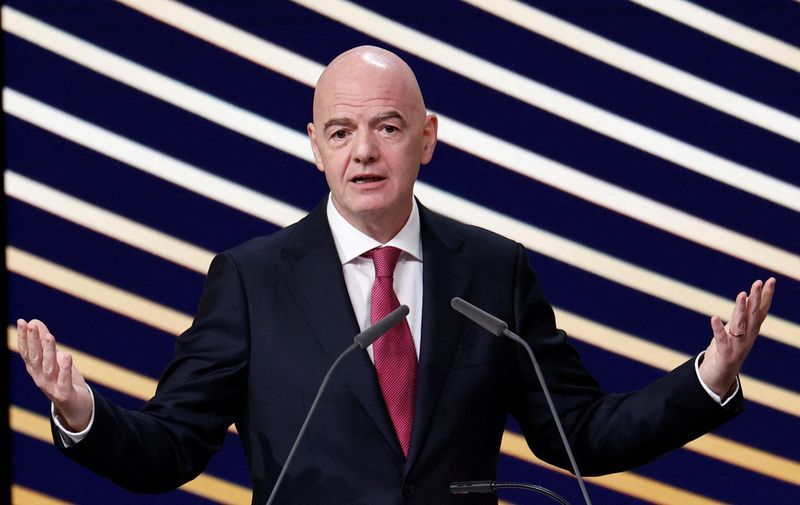
The most serious challenge to FIFA President Gianni Infantino's authority has crystallised not from the sport's traditional power brokers, but from two women who sit at the executive table of European football's governing body. Laura McAllister from Wales and Lise Klaveness of Norway, the sole female representatives on UEFA's executive committee, have emerged as galvanising figures in a movement that threatens to unseat the FIFA chief, exposing the fragility of his grip on the world's most popular sport.
At the heart of the crisis lies a venture known as FIFA Football Enterprises, a private equity-backed project that Infantino championed but which collapsed under intense opposition from UEFA and other regional confederations. The backlash spread rapidly, with Wales becoming the first national association to withdraw support for Infantino's re-election bid. Within weeks, dissent rippled through FIFA's own structures, forcing the organisation toward an emergency meeting in Morocco that underscored the severity of the institutional breakdown. For McAllister and Klaveness, who bring distinct professional backgrounds—one a political scientist, the other a lawyer—the crisis represents something far graver than a boardroom disagreement over commercial strategy.
McAllister articulated the depth of her concerns during an interview, painting a picture of an organisation caught in what she termed a governance crisis. She pointed to a cascade of controversies that have steadily eroded institutional credibility: FIFA's entanglement with the failed European Super League project, political dimensions attached to major tournaments, and a particularly striking incident in which the world governing body rescinded a red card decision after direct intervention from a sitting American president. These episodes, she contended, expose systemic failures that extend far beyond individual decisions or personnel disputes. They reveal an organisation where governance structures have become subordinate to political pressures and commercial interests, fundamentally compromising its integrity.
Yet the standoff has triggered a secondary and perhaps more profound debate about leadership representation in global sport. The question of whether football might be approaching a moment when a woman could lead FIFA has gained traction, particularly after former FIFA President Sepp Blatter unexpectedly endorsed the notion, calling for female leadership of the sport's governing body. McAllister, who holds the position of UEFA vice-president, approached this possibility with characteristic pragmatism. While expressing optimism that such a development could occur, she remained candid about the obstacles. The global political geography of football's member associations presents a formidable challenge; any candidate for FIFA's presidency would need backing extending far beyond Europe's traditionally more progressive governance standards.
McAllister's caution about forcing the issue of female representation reflects a sophisticated understanding of organisational politics. She advocated for building momentum gradually rather than attempting to engineer revolutionary change, suggesting that measured progress might ultimately prove more durable than confrontational approaches. Her reasoning carries particular weight given that only ten of FIFA's 211 member associations are led by female presidents, a stark illustration of how profoundly male-dominated football's hierarchies remain. This underrepresentation is not incidental to governance quality but intimately connected to it; McAllister suggested that women bringing values-driven professional backgrounds often approach football's foundational principles with greater clarity than those steeped primarily in commercial dimensions.
Both McAllister and Klaveness drew on their origins in women's football to shape their governance philosophy. They had represented their countries as international players before transitioning into administrative roles, experiences that cultivated a particular vision of what football should embody. McAllister articulated this vision compellingly: football belongs to all people across the socioeconomic spectrum, from grassroots enthusiasts to elite professionals, from the wealthiest established confederations to the poorest developing nations. This inclusive conception stands in sharp opposition to Infantino's push toward private capital involvement and the politicisation evident in recent World Cup arrangements. For these leaders, the governance crisis represents not merely an operational failure but a threat to football's essential identity.
McAllister's proposal for a boycott of FIFA events achieved unanimous support during UEFA's emergency session, demonstrating how thoroughly her position had resonated with Europe's football leadership. This unified response from the continent's dominant confederation created significant leverage against Infantino, forcing the crisis toward resolution or escalation. The speed with which McAllister and Klaveness mobilised institutional opposition suggests they understood both the moment and their own strategic importance within football's power structures. Their visibility as female voices opposing Infantino paradoxically strengthened their arguments; they could not be dismissed as malcontents or empire-builders in the traditional sense, and their gender made their assertions about governance principles and core values particularly resonant.
Comparison with other sports governance bodies highlights how far football lags behind on gender equity and institutional modernisation. Michael Payne, a former International Olympic Committee marketing director, noted that the IOC has pioneered gender equity initiatives for two decades, transforming Olympic competition into a 50-50 gender balance. FIFA's World Cup remains profoundly unequal by comparison, with the women's tournament receiving minimal investment, media attention, and infrastructure compared to its male counterpart. This disparity reveals not merely a fairness issue but a governance pathology; if football's governing structures cannot even commit to equal investment in competitions, how can they be trusted with safeguarding the sport's fundamental values or resisting commercial and political pressures?
The emergence of female leaders as principal voices resisting Infantino reflects broader dynamics within football where women entering governance roles often bring heightened commitment to institutional legitimacy and ethical standards. McAllister's framing of the crisis as existential captures how these leaders perceive the stakes. Football has developed into a global phenomenon of extraordinary cultural and economic significance; if its governance structures become irredeemably corrupted by private capital interests and political manipulation, the sport itself faces degradation. Women entering leadership positions and finding that their primary imperative is institutional defence against male-dominated corruption suggests that gender equity in sports governance is not merely an aspirational social goal but a practical necessity for preserving institutional integrity.
For Southeast Asian readers, the FIFA governance crisis carries particular relevance given the region's growing investment in football infrastructure and the aspirations of multiple nations to develop competitive teams. How FIFA's governance question resolves will affect everything from tournament scheduling and qualification criteria to financial distribution and corruption oversight. If the Infantino era ends and leadership transitions toward individuals with stronger institutional values, it could reshape football's global governance for years. Conversely, if Infantino consolidates power despite this uprising, it signals that commercial interests and political interference will continue subordinating the sport's foundational principles to elite interests.
The pathway forward remains uncertain, but McAllister's counsel about building momentum while protecting core principles offers a template for sustained institutional change. Whether a woman ultimately becomes FIFA president may matter less than whether this crisis produces genuine governance reform—and whether future leadership, regardless of gender, demonstrates commitment to the sport's universal accessibility and integrity. The crisis reveals that football's most passionate defenders are not primarily those invested in financial structures or political networks, but those who understand the game as a social and cultural force that transcends commercial calculations.

