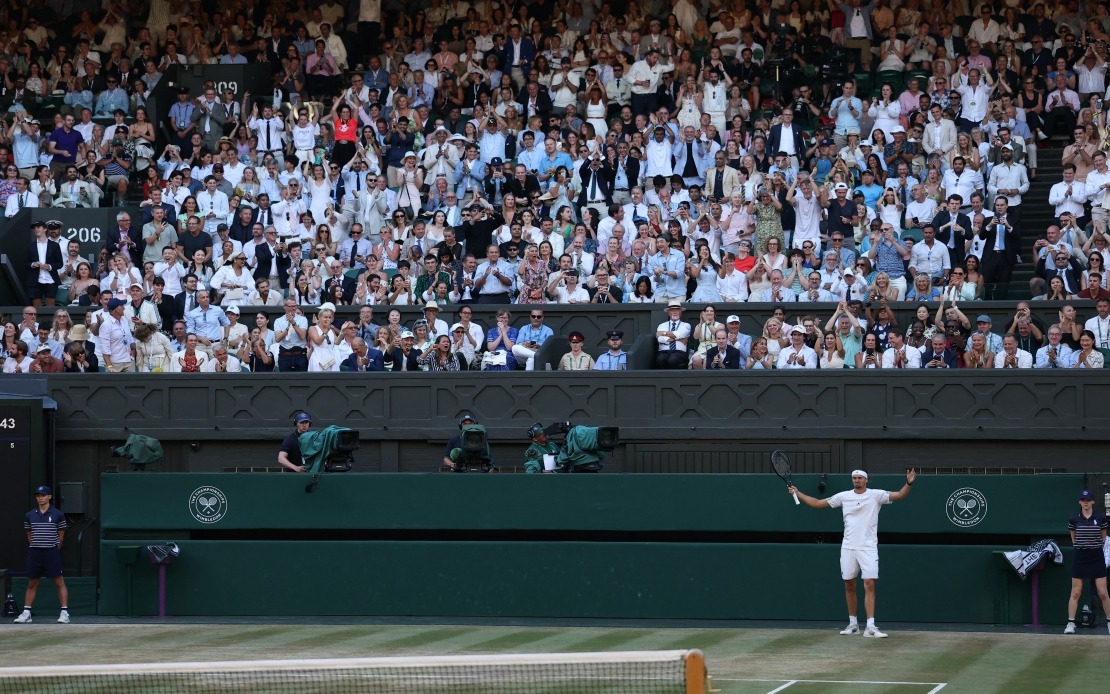
The 2026 Wimbledon Championships concluded with Jannik Sinner claiming the men's singles crown in a compelling four-set victory over Alexander Zverev, capping off a tournament distinguished by extraordinary individual performances and emotional narratives that captivated global audiences. The fortnight on the grass courts of London delivered moments of tennis excellence interspersed with human drama that transcended the sport itself, providing storylines that will resonate far beyond the All England Club's hallowed grounds.
The women's final proved to be one of the Championships' most gripping contests, with debutant grand slam finalist Marketa Noskova staging a remarkable recovery after squandering five championship points during a devastating second-set collapse. The Czech player found herself in familiar historical territory as she surrendered a commanding 5-2 advantage, a painful echo of Jana Novotna's heartbreaking 1993 final loss to Steffi Graf. That moment, when Novotna famously shed tears on the shoulder of the Duchess of Kent, remains etched in Wimbledon folklore as one of sport's most poignant images. However, unlike Novotna, who waited until 1998 for redemption, the 21-year-old Noskova would not be denied. During a crucial bathroom break in the match, she walked past the tournament trophies in the corridors and made a quiet vow to herself: "I'm taking the big one!" This mental recalibration proved transformative, propelling her through the remaining sets to claim her maiden grand slam title.
British hopes at Wimbledon had largely evaporated before the tournament genuinely caught fire, but one homegrown competitor provided the narrative spark that resurrected national interest. Jack Fery, a 23-year-old wild card from Wimbledon itself, emerged as the tournament's most improbable success story by reaching the semi-finals. Ranked 114th in the world, Fery's journey on the grass was characterised by extraordinary resilience in the face of adversity. During a gruelling encounter against Zizou Bergs, he found himself trailing 4-1 in both the fourth and fifth sets whilst enduring three debilitating nosebleeds under the intense heat of Court 18. The physical toll seemed overwhelming, yet Fery rallied to level the match by forcing a decisive tiebreaker. Bergs, positioned 77 places higher in the rankings, crumbled under pressure as the momentum shifted decisively. Fery maintained his composure through the 10-point decider, demonstrating the mental fortitude that characterises genuine champions. His semi-final appearance represented a watershed moment for British men's tennis, marking only the fifth occasion this century that a male player from the host nation had progressed beyond the second week at the All England Club.
Serbia's Novak Djokovic, at 39 years of age, once again demonstrated why longevity in professional tennis defies conventional understanding of athletic decline. Yet his quarter-final triumph came at considerable cost, requiring five hours and fifteen minutes to overcome Felix Auger-Aliassime in what became the longest quarter-final in Wimbledon's 150-year history. The match concluded with merely eight minutes remaining before the 11pm curfew, leaving nothing to chance in terms of scheduling precision. The physical demands manifested in multiple forms of adversity: a calf injury early in the match necessitated treatment, followed by a heated disagreement with tournament referee Denise Parnell regarding the closing of the roof before the third set. These interruptions revealed a player operating at the margins of his physical capacity. Though Djokovic advanced past the world number three seed, the energy expended proved ultimately consequential, as he subsequently succumbed to Sinner in the semi-finals with his reserves visibly depleted.
The women's semi-final between Coco Gauff and Karolina Muchova encapsulated tennis at its most intensely competitive, distilling the entire encounter into a single breathtaking tiebreak lasting eighteen minutes. Both players reached championship point during this climactic passage, yet executed with devastating imprecision when victory beckoned. With the score poised at 8-8, Muchova received a time violation before striking long, offering Gauff her initial opportunity. Yet the American inexplicably netted what appeared a routine drop-shot winner. Muchova subsequently appeared destined for triumph when she received her own match point, but a cruel slip during an attempted volley proved the turning point. Gauff's cross-court forehand swept past the fallen Czech player, and when Muchova finally claimed her match point at 9-8, she executed with clinical precision, manoeuvring the 22-year-old American around the court before her exhausted forehand surrender found the net. The psychological oscillations of such an encounter leave competitors emotionally drained, regardless of outcome.
Perhaps the most profoundly moving narrative threading through Wimbledon 2026 concerned Serena Williams' return to competitive tennis after nearly four years away from the sport. The 44-year-old American icon entered the tournament on a wild card, and her appearance on Centre Court generated a standing ovation that reverberated through the stadium. Williams faced Australian qualifier Storm Sanders, a player nearly twenty-four years younger, yet somehow the veteran competitor emerged as the sentimental favourite. Early in the deciding set, Williams secured a crucial break, prompting spectators to envision a triumphant homecoming. However, the physical demands of elite tennis proved unforgiving. A knee injury sustained during the first set gradually accumulated in its consequences, and as the match progressed into its final stages, Williams' movement deteriorated visibly. Sanders proved an impressive competitor, navigating both the formidable tennis challenge and the extraordinary occasion with composure. The injury subsequently prevented Williams from participating in a planned doubles reunion with her sister Venus, a partnership that has defined much of their collective legacy. Though the result proved disappointing, Williams' presence throughout the first week provided a powerful reminder of why champions transcend their specific accomplishments, instead becoming cultural icons whose mere appearance commands reverence and inspires younger generations.

