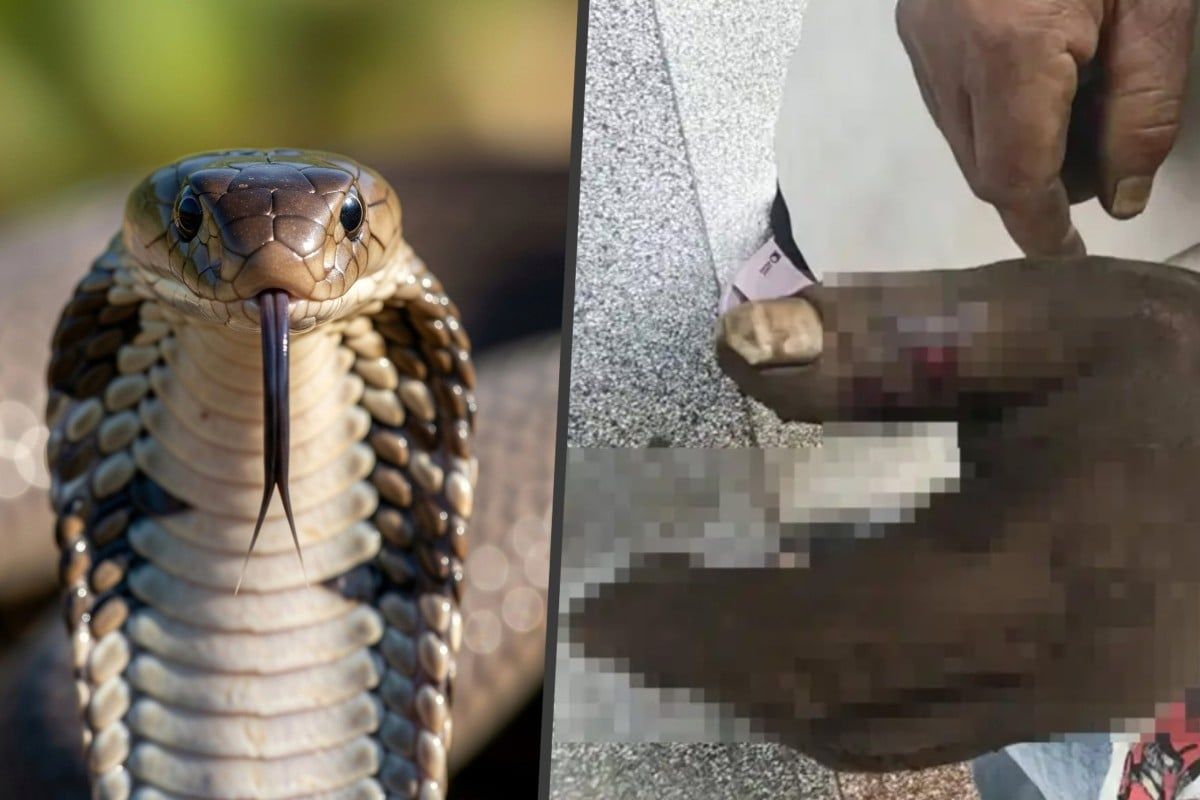
A farming couple in southwestern China became joint victims of a cobra attack when the wife's attempt at emergency treatment inadvertently poisoned herself. The incident, which unfolded in Yuanyang county within Yunnan province, highlights the dangers of relying on dramatised first-aid techniques popularised by television and film rather than evidence-based medical protocols.
The husband was bitten on the finger whilst working in his field, an occupational hazard in rural agricultural regions where venomous snakes inhabit long grass and vegetation. Witnessing his immediate symptoms—swelling, dizziness and weakness—his concerned wife acted decisively, attempting to extract the venom by mouth. She had encountered this rescue method through television depictions and assumed it would save her husband's life. She undertook the procedure without any protective equipment, exposing her oral tissues directly to the cobra's neurotoxins.
Within hours of the bite, the husband was transported to Honghe Prefecture No 3 People's Hospital for professional medical intervention. Yet even as he stabilised under clinical care, his wife's condition deteriorated markedly. Numbness began spreading through her mouth, tongue, face and limbs—classic symptoms of cobra venom poisoning. By the following day, severe fatigue set in, forcing her family to admit her to the same facility where her husband was receiving treatment.
Physicians at the Yunnan hospital confirmed both patients had suffered envenomation from a local cobra species and administered antivenom serum alongside supportive therapies. The couple recovered sufficiently to be discharged within days once their vital signs stabilised. Medical staff seized the opportunity to educate both the family and the broader public about the genuine dangers of the venom-extraction myth that persists in popular culture.
The doctors explained that mouths are surprisingly efficient pathways for toxins to enter the bloodstream. The oral mucosa—the lining inside the mouth—contains an extensive network of capillaries positioned just beneath the surface. When venom contacts these tissues, it traverses into circulation almost immediately, overwhelming the rescuer with systemic poisoning rather than preventing it in the victim. This anatomical reality renders the television trope not merely ineffective but actively dangerous to the well-meaning helper.
The physics of snakebites compounds the problem. Cobra fangs create wounds so minute they resemble pinpricks to the naked eye. The venom does not remain superficially but disperses rapidly into the subcutaneous tissue and bloodstream within moments. Any attempt to extract it mechanically comes far too late, as the toxin has already begun circulating throughout the body. Surgeons have known this for decades, yet the myth persists in entertainment media consumed by millions across Asia.
Hospital protocols identify several other dangerous misconceptions that emerge from dramatisation. Some people attempt to cut open the wound to encourage bleeding, believing they can flush the venom out like infection. This causes excessive blood loss and increases infection risk to an already traumatised area. Others apply extreme heat or ice to the bite site, both of which can damage tissue and accelerate venom absorption rather than slow it. Each of these interventions reflects logical thinking applied without medical foundation.
The correct response to snakebite, according to Yunnan medical professionals, requires restraint rather than action. Victims should immediately contact emergency services whilst remaining as stationary as possible, since movement accelerates the spread of venom through the lymphatic system. Recording the snake's appearance—its colour, pattern markings and head shape—proves invaluable, as it allows emergency room staff to select the specific antivenom most effective against that species. In ideal circumstances, a photograph of the reptile itself can be brought to hospital.
China's social media ecosystem regularly amplifies snakebite incidents, reflecting both public fascination and legitimate anxiety about these medical emergencies. In May, a fourteen-year-old student in Guangdong province was bitten whilst at school, initially dismissing the incident when he felt no pain. Only when numbness and vision disturbances developed hours later did he alert staff. Physicians determined that delaying treatment by merely sixty to one hundred twenty minutes would have resulted in respiratory failure and death. The margin between life and death in serious envenomations proves disturbingly narrow.
The Yunnan case resonated widely online, prompting reflections on the gap between entertainment and reality. Social media commentary noted that television dramas frequently prioritise dramatic visual impact over medical accuracy, creating false confidence in viewers who might someday face genuine snakebite scenarios. Yet some observers also recognised the wife's actions as evidence of devotion, acknowledging her courage even while critiquing her methodology. The incident became a teaching moment for millions across China and beyond.
For Southeast Asian readers, the implications extend beyond rural farming communities. Tourism in the region regularly brings visitors into contact with natural environments where venomous snakes inhabit. Thailand, Malaysia, and Indonesia all have diverse snake populations that occasionally bite workers, farmers, and adventurers. Hospital systems across the region benefit when local populations understand correct first-aid practices. Spreading evidence-based knowledge about snakebite management could prevent secondary casualties from misguided rescue attempts, potentially saving lives whilst protecting rescuers themselves.

