In one of the more unconventional approaches to urban renewal, thousands of students across New York City have taken on the role of junior landscape architects, fundamentally reshaping their school environments. Through an intensive hands-on design process spanning the Community Schoolyards programme since 2002, these young people have converted monotonous asphalt yards into vibrant, vegetation-rich spaces that have become genuine destinations for play and community gathering. The initiative, managed by the Trust for Public Land alongside city education and environmental authorities, represents a substantial investment in children's agency and participation, with nearly US$200mil (RM815.6mil) channelled into 225 completed projects through a combination of government allocations and philanthropic contributions.
The methodology underlying these transformations reveals a sophisticated approach to participatory design. Rather than allowing young designers to pursue every whimsical desire—which initially included swimming pools, chocolate fountains, and koi ponds—the process guided students through the discipline of compromise and feasibility analysis. Participants measured spaces, created detailed maps, and subjected their evolving concepts to scrutiny from teachers, families, and neighbouring residents. This iterative approach meant that final designs balanced imaginative themes with practical functionality, yielding playgrounds that capture childhood fancy while remaining durable and genuinely usable for their intended communities.
One particularly illustrative example emerged from a Bronx girls' basketball initiative. The young women observed that boys dominated the existing courts, discouraging their own participation and confidence. The solution they engineered involved painting one half-court in pink while maintaining the remaining courts in blue, creating what amounted to a designated female-friendly space. The psychological impact proved significant: girls reported heightened confidence and freedom from worry about judgment. Notably, the arrangement operated on consensus rather than exclusion—boys could use the pink court if they asked permission first. For Charlotte Lawrence, an eleven-year-old participant, the initiative transcended athletics, becoming a statement about belonging and self-belief.
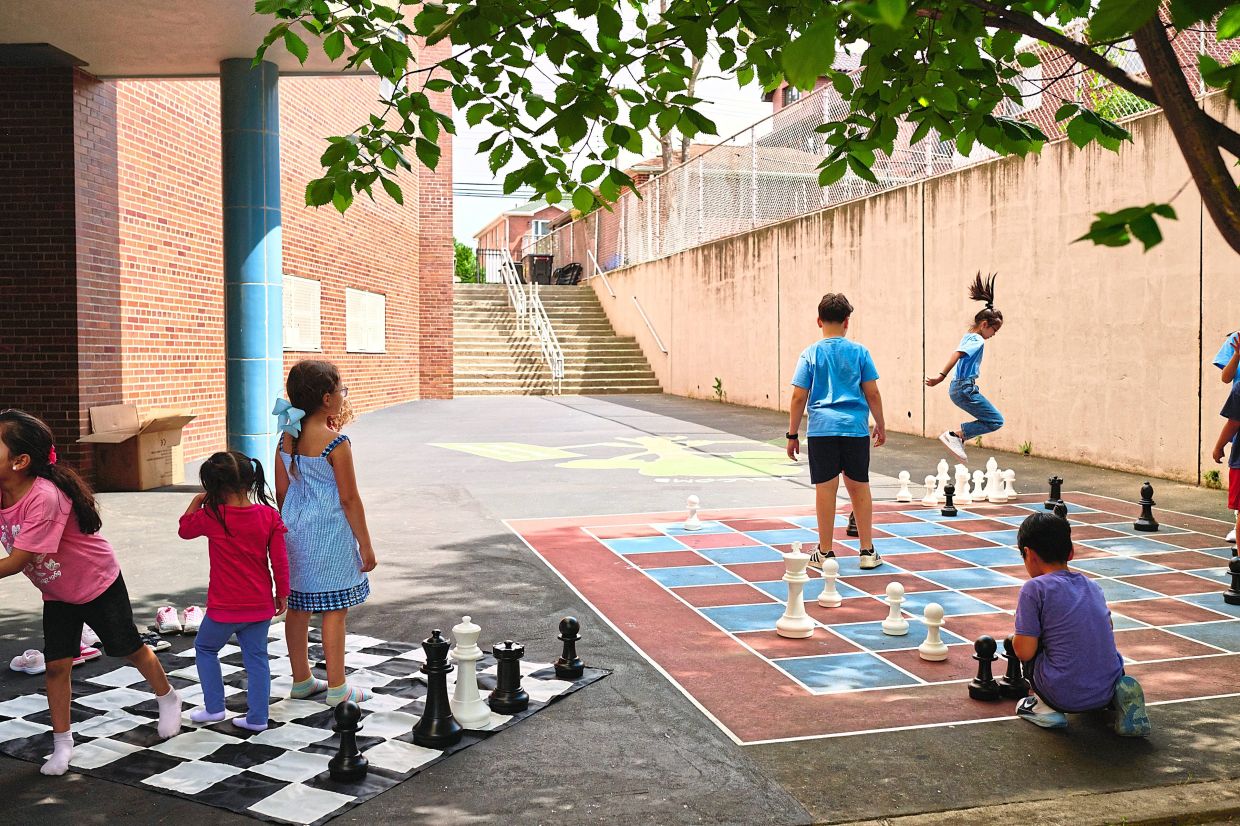
Literary inspiration shaped another striking design at North Hills School in Queens, where students drew from the Harry Potter universe to create two oversized painted chessboards. The chess pieces themselves, rendered life-size, transformed what might otherwise remain an abstract strategic game into a tangible, embodied experience. As student Ayden Chabane explained, the scale elevation allowed players to appreciate the intricate characteristics of individual pieces, deepening engagement with the game itself. The downside—that pieces occasionally broke or went missing—proved minor compared to the enhancement in playability and visual spectacle the design delivered.
Customised seating solutions demonstrated how observational design thinking could address overlooked community needs. At a Harlem playground, administrators noticed that children regularly gathered to have their hair braided on the ground, an informal ritual that deserved proper accommodation. The response involved three pairs of tiered benches, each pair containing seats at slightly different heights—a seemingly modest intervention that expanded functionality far beyond its original intent. Students discovered multiple uses: parkour jumping, impromptu performance stages, and imaginative play scenarios. The design thus achieved what excellent infrastructure accomplishes—invisibility through universal utility.
Thematic coherence elevated several playgrounds beyond purely functional considerations. A Brooklyn installation embraced the "floor is lava" game as its organising principle, painting a volcano in the centre of an existing basketball court with lava flows weaving around equipment, game tables, and seating. This seemingly simple visual choice triggered unexpected social benefits, serving as an icebreaker that encouraged children who might otherwise remain peripheral to participate actively. For Amia Peoples, the accessibility of this particular game opened connections across the broader student population, illustrating how well-designed spaces can inadvertently foster social cohesion.
Nature-themed installations represented another significant category of student innovation. At Emanuel Kaplan School in Queens, students designed mushroom stools—characterised by bright red tops and white spots—that simultaneously honoured their neighbourhood's formerly wooded past and provided dual-purpose seating and play equipment. Young Jack Henshaw described the pleasures of hopping across these stools in sequence, sometimes skipping intervening pieces, turning a rest station into an obstacle course. Separately, students at Pacific School in Brooklyn initially aspired to a petting zoo featuring goats and llamas but pragmatically redirected their ambitions toward a pollinator garden. This compromise proved generative: Team Tomato, a fourth-grade club, assumed stewardship responsibilities whilst the entire school participated through winter seedling cultivation and parental plant donations. For nine-year-old Kamali Foreman, the garden delivered something beyond standard environmental education—a direct sensory encounter with nature through the scents of mint and lavender.
The broader implications of this programme extend well beyond Brooklyn and Queens. In Southeast Asian contexts where rapid urbanisation frequently sacrifices green space and children's autonomy in environmental decision-making, the New York model offers instructive lessons. The programme demonstrates that meaningful youth participation in urban planning need not depend on elaborate or expensive infrastructure; instead, it requires structured processes that respect young people's insights whilst teaching them constraint management and collaborative negotiation. For Malaysia and the region, where school facilities often similarly struggle with underutilised or aesthetically barren grounds, the replication of such participatory design frameworks could simultaneously improve physical environments and cultivate younger generations' civic engagement.
The financial scale of the Community Schoolyards investment—US$200mil over two decades—represents a significant but not prohibitive commitment for affluent urban systems. More importantly, the initiative's longevity suggests sustained political commitment to children's environmental quality, something not universally guaranteed in developing regions where school infrastructure competes with more immediately visible development priorities. The 225 completed sites function as year-round community hubs rather than restricted school facilities, multiplying their social return on investment and strengthening neighbourhood cohesion.
From a policy perspective, the programme illustrates how structured participation requirements can prevent the typical pitfall whereby adult-designed spaces fail to match actual usage patterns. Because the students who would ultimately inhabit these yards participated in their creation, the designs reflect genuine preferences and use cases rather than assumptions. The inclusion of feedback mechanisms from adjacent communities broadened the design lens, ensuring that playgrounds served not only students but extended social networks. This multi-stakeholder approach, whilst potentially slower and more contentious than top-down design, generated spaces with measurable community attachment and longevity.
The creativity embedded in these designs—the whimsy of unicorns and dragons, the specificity of an introvert's corner—suggests that children, when genuinely consulted, produce solutions that adult professionals might overlook. These are not frivolous additions but deliberate accommodations for different social preferences and play styles. The recognition that not all children enjoy competitive group activities, and the consequent design of quiet, vegetated spaces for reading and reflection, represents sophisticated user-centred thinking. Similarly, the understanding that girls face barriers to confidence in sports, and that environmental cues can ameliorate those barriers, shows how thoughtful design intersects with equity.
Looking forward, the Community Schoolyards programme offers a model that developing educational systems might adapt to their own contexts and constraints. Rather than importing wholesale the US programme's financial scale, districts could implement the participatory methodology with more modest resources, using design processes to maximise existing grounds' potential before seeking major capital investment. The essential ingredient—genuine authority given to young people over decisions affecting their immediate environment—costs nothing but requires ideological commitment to student agency. For Malaysia's urban schools confronting similar spaces, such commitment could unlock both environmental improvements and profound learning experiences about citizenship and collaborative problem-solving.

