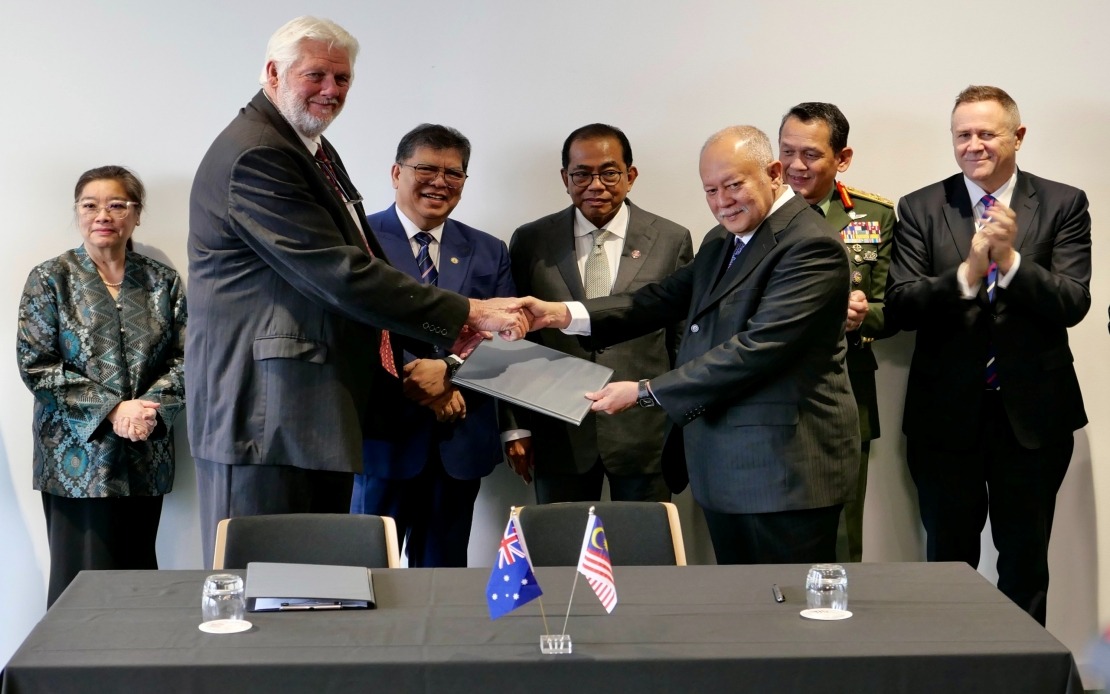
Malaysia is poised to significantly expand its indigenous rocket and missile manufacturing capacity through a landmark collaboration between local defence firm Weststar Defence Industries Sdn Bhd and Australian company Rocket Technologies International Pty Ltd. Defence Minister Datuk Seri Mohamed Khaled Nordin emphasised the strategic importance of this partnership, characterising it as a watershed moment for the country's efforts to build self-reliant defence capabilities in an increasingly complex regional security environment.
The initiative represents more than a simple commercial transaction. It directly supports Malaysia's National Defence Industry Policy, which prioritises the development of homegrown expertise in designing, engineering, and manufacturing advanced defence systems. By transferring knowledge and establishing production infrastructure within the country, the partnership seeks to reduce Malaysia's dependence on foreign suppliers for critical defence technologies and create the human capital necessary to sustain defence innovation over the long term. This approach mirrors strategies adopted by other major Southeast Asian economies that view indigenous defence manufacturing as integral to national security.
Under the agreement, Weststar will construct a dedicated production facility in Malaysia where rocket manufacturing will commence within two years. The project will subsequently expand into missile production, creating a vertically integrated supply chain anchored in Malaysian territory. This phased approach allows the company to build technical expertise progressively while scaling operations as capabilities mature. Such careful sequencing reduces execution risk while ensuring quality standards align with international norms.
Beyond immediate manufacturing benefits, the partnership opens pathways for Malaysian companies to integrate into RTI's worldwide supply networks. This integration has profound implications for the broader Malaysian defence industrial ecosystem. By connecting local suppliers and manufacturers to a global export market, companies gain exposure to international quality requirements, production standards, and customer expectations. Over time, this exposure elevates the competitive capability of Malaysia's entire defence supply chain, potentially enabling other firms to access export opportunities that currently remain inaccessible.
The agreement was formalised during Mohamed Khaled's official visit to Australia, with signatures exchanged at the National Convention Centre in Canberra. Weststar Group founder and group managing director Tan Sri Dr Syed Azman Syed Ibrahim and RTI founder Allan James Payne signed the accord, signalling commitment from senior leadership on both sides. The formal setting and ministerial attendance underscore the strategic weight both governments attach to the arrangement. Australian authorities explicitly approved and supported the collaboration, reflecting Canberra's interest in deepening defence-industrial ties with a key regional partner.
Mohamad Khaled's broader visit agenda revealed the intellectual infrastructure underpinning the partnership. His delegation, which included Royal Malaysian Air Force chief General Tan Sri Muhamad Norazlan Aris and representatives from national defence research institutions, toured Australia's Institute for Space, Defence and Advanced Technologies at the University of Southern Queensland. This site hosts collaborative laboratories focused on advanced composite materials, hypersonic technologies, and aerospace innovation—precisely the technical domains that will anchor Malaysia's expanded manufacturing capabilities. The visit exposed Malaysian officials to models of industry-academia collaboration that Australia has successfully developed, offering practical insights for replicating such approaches domestically.
The involvement of Malaysia's Defence University (UPNM), represented by vice-chancellor Lt Gen Datuk Wira Arman Rumaizi Ahmad, and the National Aerospace Industry Corporation Malaysia (NAICO Malaysia), represented by chief executive officer Prof Shamsul Kamar Abu Samah, indicates that the partnership transcends commercial interests. Educational institutions and government-linked corporations will participate in knowledge transfer, workforce development, and long-term capability building. This multi-institutional approach increases the likelihood that Malaysia can sustain technological advances beyond the initial project timeline.
During his Australian sojourn, Mohamed Khaled held substantive discussions with Australian Deputy Prime Minister and Defence Minister Richard Marles, focussing on broadening bilateral defence cooperation. These conversations explored new domains for strategic alignment, acknowledging shared regional interests in maritime security, counterterrorism, and managing great-power competition dynamics. The substantive engagement between senior defence officials indicates that the Weststar-RTI partnership operates within a broader strategic framework rather than existing in isolation.
Parallel parliamentary diplomacy reinforced these messages. Mohamed Khaled, accompanied by Dewan Rakyat Speaker Tan Sri Johari Abdul and Malaysia's High Commissioner to Australia Datin Paduka Sharrina Abdullah, received an official welcome at Parliament House in Canberra and met with the Speaker of the House of Representatives Milton Dick and other legislators. Such exchanges, though sometimes ceremonial in appearance, communicate sustained political commitment to bilateral relationships and demonstrate that defence partnerships enjoy cross-party support in both democracies. This creates institutional durability that outlasts electoral cycles.
For Malaysian stakeholders, the partnership offers multiple advantages. Defence companies gain access to proven technologies and manufacturing methodologies, reducing development timescales and de-risking investments in unproven approaches. Employment generation spans manufacturing roles, engineering positions, and skilled technical posts. Over time, as Malaysian firms climb the value chain, they can aspire to lead innovation rather than merely execute production. The creation of a regional centre of excellence in rocket and missile manufacturing could position Malaysia as a preferred supplier for other Southeast Asian nations pursuing comparable defence modernisation objectives.
The strategic logic underlying this investment reflects Malaysia's assessment that external military contingencies may demand indigenous defence capabilities rather than relying exclusively on overseas suppliers. Geopolitical competition among major powers, maritime disputes in surrounding waters, and transnational security threats all point toward a future where self-sufficiency in critical defence domains enhances rather than diminishes strategic flexibility. By investing now in manufacturing capacity and human expertise, Malaysia positions itself to respond more autonomously to future security challenges.
Implementation success will depend on multiple factors: sustained government commitment to long-term investment, attraction and retention of qualified technical talent, establishment of robust quality-assurance protocols, and effective collaboration between Malaysian and Australian personnel. International defence manufacturing operates under demanding compliance regimes governing technology transfer, export controls, and intellectual property. Malaysian institutions must navigate these regulatory complexities while building world-class operational standards. Early phases of the partnership will test institutional capacity and strategic patience.
The broader regional implications merit consideration. Southeast Asia faces evolving security demands as competition among major powers intensifies and technological change accelerates. Malaysia's development of indigenous rocket and missile manufacturing capability contributes to regional capacity and demonstrates that smaller nations can pursue strategic self-reliance through partnerships rather than attempting isolated development. If successful, the model may inspire comparable arrangements among other Southeast Asian countries seeking to strengthen defence autonomy while constraining costs through technological cooperation and knowledge sharing.

